DragonFlyBSD Multimedia Resources List
Links on this page refer to multimedia resources (podcast, vodcast,
audio recordings, video recordings, photos) related to DragonFlyBSD or
of interest for DragonFlyBSD users.
This list is available as chronological
overview, as a tag cloud and
via the sources.
This list is also available as RSS feed 
If you know any resources not listed here, or notice any dead links,
please send details to
Edwin Groothuis so that
it can be included or updated.
Newest resources
November 2010DragonFlyBSD 2.8 with Matthew Dillon
Source: bsdtalk
Added: 06 November 2010
Tags: bsdtalk, interview, meetbsd, meetbsd2010, dragonflybsd, matthew dillon
Ogg version (15 minutes), MP3 version (7 Mb, 15 minutes)
Interview from MeetBSD California 2010 with Matthew
Dillon about the recent 2.8 release of DragonFlyBSD.
More information at http://www.dragonflybsd.org/
PC-BSD 9 Alpha with Kris Moore
Source: bsdtalk
Added: 05 November 2010
Tags: bsdtalk, interview, pc-bsd, meetbsd, meetbsd2010, kris moore
Ogg version (18 minutes), MP3 version (9 Mb, 18 minutes)
Interview from MeetBSD California 2010 with Kris
Moore. We talk about the new alpha snapshot of
PC-BSD 9. More information at http://blog.pcbsd.org/
October 2010The mg text editor with Kjell Wooding
Source: bsdtalk
Added: 12 October 2010
Tags: bsdtalk, interview, mg, kjell wooding
Ogg version (14 minutes), MP3 version (7 Mb, 14 minutes)
Interivew with Kjell Wooding. We talk about the mg
text editor. More information can be found in the
OpenBSD man page:
http://www.openbsd.org/cgi-bin/man.cgi?query=mg
PC-Sysinstall with John Hixson
Source: bsdtalk
Added: 05 October 2010
Tags: bsdtalk, interview, pc-sysinstall, pc-bsd, john hixson
Ogg version (14 minutes), MP3 version (7 Mb, 14 minutes)
Interview with John Hixson. We talk about his work
on PC-Sysinstall, the PC-BSD installer and possible
alternative to the FreeBSD sysinstall.
September 2010MeetBSD California 2010
Source: bsdtalk
Added: 29 September 2010
Tags: bsdtalk, interview, meetbsd, meetbsd2010, matt olander, james nixon
Ogg version (12 minutes), MP3 version (6 Mb, 12 minutes)
Interview with Matt Olander and James T. Nixon. We
talk about MeetBSD California 2010. More information
at http://www.meetbsd.com/
FreeNAS 8 with M. Warner Losh
Source: bsdtalk
Added: 19 September 2010
Tags: bsdtalk, interview, freenas, warner losh
Ogg version (37 minutes), MP3 version (18 Mb, 37 minutes)
Interview with M. Warner Losh about FreeNAS 8. More
information at http://freenas.org.
NYCBSDCon with Mark Saad and George Neville-Neil
Source: bsdtalk
Added: 13 September 2010
Tags: bsdtalk, interview, nycbsdcon, nycbsdcon2010, mark saad, george neville-neil
Ogg version (10 minutes), MP3 version (5 Mb, 10 minutes)
Interview with Mark Saad and George Neville-Neil
about the NYCBSDCon 2010. Details can be found at
http://www.nycbsdcon.org/2010/
August 2010July 2010Fossil SCM with D. Richard Hipp
Source: bsdtalk
Added: 22 July 2010
Tags: bsdtalk, interview, fossil scm, richard hipp
Ogg version (30 minutes), MP3 version (15 Mb, 30 minutes)
Interview with D. Richard Hipp. We talk about the
Fossil distributed software configuration management
system. More information can be found at
http://www.fossil-scm.org.
FreeBSD Security Officer Colin Percival
Source: bsdtalk
Added: 02 July 2010
Tags: bsdtalk, interview, bsdcan, bsdcan2010, freebsd, portsnap, freebsd-update, tarsnap, colin percival
Ogg version (20 minutes), MP3 version (9 Mb, 20 minutes)
Interview from BSDCan 2010 with Colin Percival. We
talk about cryptography, Portsnap, FreeBSD Update,
and Tarsnap.
June 2010PF update with Henning Brauer and Peter Hansteen
Source: bsdtalk
Added: 17 June 2010
Tags: bsdtalk, interview, bsdcan, bsdcan2010, openbsd, pf packet filter, henning brauer, peter hansteen
Ogg version (20 minutes), MP3 version (10 Mb, 20 minutes)
Interview from BSDCan 2010 with Henning Brauer and
Peter Hansteen. We talk about recent changes to the
OpenBSD PF packet filter.
Clang and llvm with Roman Divacky and Ed Schouten
Source: bsdtalk
Added: 10 June 2010
Tags: bsdtalk, interview, bsdcan, bsdcan2010, clang, llvm, roman divacky, ed schouten
Ogg version (17 minutes), MP3 version (8 Mb, 17 minutes)
Interview from BSDCan 2010 with Roman DivC!ckC= and
Ed Schouten. We talk about the work being done to
build FreeBSD with Clang/LLVM.
May 2010April 2010TheorArm with Robin Watts
Source: bsdtalk
Added: 30 April 2010
Tags: bsdtalk, interview, theorarm, robin watts
Ogg version (31 minutes), MP3 version (15 Mb, 31 minutes)
Interview with Robin Watts about TheorArm, an Ogg
Theora/Vorbis decoding library optimized for use
on ARM processors. We also talk about the history
of ARM and video formats for the web.
Dru Lavigne
Source: bsdtalk
Added: 18 April 2010
Tags: bsdtalk, interview, pc-bsd, dru lavigne
Ogg version (28 minutes), MP3 version (13 Mb, 28 minutes)
Interview with Dru Lavigne. We talk about her new
book, The Definitive Guide to PC-BSD, and also the
upcoming BSD Professional Certification.
March 2010February 2010Jeff Roberson
Source: bsdtalk
Added: 05 February 2010
Tags: bsdtalk, interview, ule, freebsd, jeff roberson
Ogg version (30 minutes), MP3 version (14 Mb, 30 minutes)
Interview with FreeBSD committer Jeff Roberson. We
talk about his recent work on softupdates journaling
(SUJ) and also the ULE scheduler.
James Nixon from iXsystems
Source: bsdtalk
Added: 02 February 2010
Tags: bsdtalk, interview, ixsystems, pc-bsd, james nixon
Ogg version (16 minutes), MP3 version (8 Mb, 16 minutes)
Interview with James Nixon, webmaster and committer
for PC-BSD. We talk about some of the new features
coming up in 8.0, gaming on BSD, his work on the
unique look and feel of PC-BSD, and Camp KDE.
January 2010December 2009Randal L. Schwartz
Source: bsdtalk
Added: 22 December 2009
Tags: bsdtalk, interview, randal schwartz
Ogg version (24 minutes), MP3 version (12 Mb, 24 minutes)
Interview with Randal Schwartz. We talk about his
early experiences with BSD, permissive licenses,
OpenBSD, OpenSolaris, perl, the BSDFund credit card,
and the Floss Weekly podcast.
FreeNAS with Josh Paetzel from iXsystems
Source: bsdtalk
Added: 15 December 2009
Tags: bsdtalk, interview, ixsystems, freenas, josh paetzel
Ogg version (12 minutes), MP3 version (6 Mb, 12 minutes)
A quick update on FreeNAS with Josh Paetzel from iXsystems.
BSDCan and PGCon with Dan Langille
Source: bsdtalk
Added: 07 December 2009
Tags: bsdtalk, interview, bsdcan, bsdcan2010, pgcon, dan langille
Ogg version (16 minutes), MP3 version (8 Mb, 16 minutes)
Interview with Dan Langille. We talk about the 2010
BSDCan and PGCon conferences. More information at
www.bsdcan.org and www.pgcon.org. We also talk
briefly about FreeBSD 8.
November 2009OpenBSD Enthusiast Girish Venkatachalam
Source: bsdtalk
Added: 30 November 2009
Tags: bsdtalk, interview, openbsd, girish venkatachalam
Ogg version (25 minutes), MP3 version (12 Mb, 25 minutes)
Interview with OpenBSD enthusiast Girish Venkatachalam.
OpenBSD Developer Jacek Masiulaniec
Source: bsdtalk
Added: 05 November 2009
Tags: bsdtalk, interview, openbsd, opensmtpd, jacek masiulaniec
Ogg version (14 minutes), MP3 version (7 Mb, 14 minutes)
Interview with OpenBSD developer Jacek Masiulaniec.
We talk about the OpenSMTPd Mail Transfer Agent and
also a little bit about the Epitome data deduplication
project.
October 2009Richard Clayton - Evil on the Internet - EuroBSDCon
Source: bsdtalk
Added: 31 October 2009
Tags: bsdtalk, interview, eurobsdcon, eurobsdcon2009, richard clayton
Ogg version (69 minutes), MP3 version (33 Mb, 69 minutes)
A recording from EuroBSDCon 2009: Richard Clayton
- Evil on the Internet. A perfect topic for
Halloween. This talk covers phishing, mule recruitment,
fake escrow, fake pharmacies, fake banks, ponzi
schemes, link spammers, etc. Scary stuff.
August 2009July 2009June 2009May 2009Kris Moore at BSDCan2009
Source: bsdtalk
Added: 31 May 2009
Tags: bsdtalk, interview, bsdcan, kris moore
Ogg version (16 minutes), MP3 version (7 Mb, 16 minutes)
Interview with Kris Moore at BSDCan2009.
Cat Allman and Leslie Hawthorn - Getting Started in Free and Open Source
Source: BSDCan - The Technical BSD Conference
Added: 25 May 2009
Tags: bsdcan, bsdcan2009, presentation, getting started, cat allman, leslie hawthorn
Slides (893 Kb, 25 pages)
Getting Started in Free and Open Source
Interested in getting involved? But don't really
know where or how to start?
The talk is called "Getting Started in Free and
Open Source". It's a talk for beginners who are
interested to getting involved but don't really
know where or how to start.
We cover the basics of: -why you might want to get
involved -what you can get out of participating
-more than coding is needed -how to chose a project
-how to get started -etiquette of lists and other
communication -dos and don't of joining a community
Randi Harper - Automating FreeBSD Installations
Source: BSDCan - The Technical BSD Conference
Added: 25 May 2009
Tags: bsdcan, bsdcan2009, presentation, freebsd, pxe, sysinstall, randi harper
Slides (33 Kb, 14 pages)
Automating FreeBSD Installations
PXE Booting and install.cfg Demystified
This paper will provide an explanation of the tools
involved in performing an automated FreeBSD install
and a live demonstration of the process.
FreeBSD's sysinstall provides a powerful and flexible
mechanism for automated installs but doesn't get
used very often because of a lack of documentation.
Joerg Sonnenberger - Journaling FFS with WAPBL
Source: BSDCan - The Technical BSD Conference
Added: 25 May 2009
Tags: bsdcan, bsdcan2009, presentation, netbsd, wapbl, ffs, joerg sonnenberger
Slides (10 Kb, 24 pages)
Journaling FFS with WAPBL
NetBSD 5 is the first NetBSD release with a journaling
filesystem. This lecture introduces the structure
of the Fast File System, the modifications for WAPBL
and specific constraints of the implementation.
The Fast File System (FFS) has been used in the BSD
land for more than two decades. The original
implementation offered two operational modes:
- safe and slow (sync)
- unsafe and fast (async) One decade ago, Kirk
McKusick introduced the soft dependency mechanism
to offset the performance impact without risk of
mortal peril on the first crash. With the advent
of Terabyte hard disks, the need for a file system
check (fsck) after a crash becomes finally unacceptable.
Even a background fsck like supported on FreeBSD
consumes lots of CPU time and IO bandwidth.
Based on a donation from Wasabi Systems, Write Ahead
Physical Block Logging (WAPBL) provides journaling
for FFS with similar or better performance than
soft dependencies during normal operation. Recovery
time after crashes depends on the amount of outstanding
IO operations and normally takes a few seconds.
This lecture gives a short overview of FFS and the
consistency constraints for meta data updates. It
introduces the WAPBL changes, both in terms of the
on-disk format and the implementation in NetBSD.
Finally the implementation is compared to the design
of comparable file systems and specific issues of
and plans for the current implementation are
discussed.
Philip Paeps - Crypto Acceleration on FreeBSD
Source: BSDCan - The Technical BSD Conference
Added: 25 May 2009
Tags: bsdcan, bsdcan2009, presentation, crypto acceleration, freebsd, philip paeps
Slides (361 Kb, 28 pages)
Crypto Acceleration on FreeBSD
As more and more services on the internet become
cryptographically secured, the load of cryptography
on systems becomes heavier and heavier. Crypto
acceleration hardware is available in different
forms for different workloads. Embedded communications
processors from VIA and AMD have limited acceleration
facilities in silicon and various manufacturers
build hardware for accelerating secure web traffic
and IPSEC VPN tunnels.
This talk gives an overview of FreeBSD's crypto
framework in the kernel and how it can be used
together with OpenSSL to leverage acceleration
hardware. Some numbers will be presented to demonstrate
how acceleration can improve performance - and how
it can curiously bring a system to a grinding halt.
Philip originally started playing with crypto
acceleration when he saw the "crypto block" in one
of his Soekris boards. As usual, addiction was
instant and by the grace of the "you touch it, you
own it" principle, he has been fiddling the crypto
framework more than is good for him.
John Baldwin - Multiple Passes of the FreeBSD Device Tree
Source: BSDCan - The Technical BSD Conference
Added: 25 May 2009
Tags: bsdcan, bsdcan2009, presentation, freebsd, device tree, john baldwin
Slides (60 Kb, 15 pages), Paper (103 Kb, 8 pages)
Multiple Passes of the FreeBSD Device Tree
The existing device driver framework in FreeBSD
works fairly well for many tasks. However, there
are a few problems that are not easily solved with
the current design. These problems include having
"real" device drivers for low-level hardware such
as clocks and interrupt controllers, proper resource
discovery and management, and allowing most drivers
to always probe and attach in an environment where
interrupts are enabled. I propose extending the
device driver framework to support multiple passes
over the device tree during boot. This would allow
certain classes of drivers to be attached earlier
and perform boot-time setup before other drivers
are probed and attached. This in turn can be used
to develop solutions to the earlier list of problems.
Brooks Davis - Isolating Cluster Jobs for Performance and Predictability
Source: BSDCan - The Technical BSD Conference
Added: 25 May 2009
Tags: bsdcan, bsdcan2009, presentation, freebsd, cluster, brooks davis
Slides (1.4 Mb, 27 pages)
Isolating Cluster Jobs for Performance and Predictability
At The Aerospace Corporation, we run a large FreeBSD
based computing cluster to support engineering
applications. These applications come in all shapes,
sizes, and qualities of implementation. To support
them and our diverse userbase we have been searching
for ways to isolate jobs from one another in ways
that are more effective than Unix time sharing and
more fine grained than allocating whole nodes to
jobs.
In this talk we discuss the problem space and our
efforts so far. These efforts include implementation
of partial file systems virtualization and CPU
isolation using CPU sets.
George Neville-Neil - Understanding and Tuning SCHED_ULE
Source: BSDCan - The Technical BSD Conference
Added: 25 May 2009
Tags: bsdcan, bsdcan2009, presentation, freebsd, sched_ule, george neville-neil
Slides (228 Kb, 29 pages)
Understanding and Tuning SCHED_ULE
With the advent of widespread SMP and multicore CPU
architectures it was necessary to implement a new
scheduler in the FreeBSD operating system. The
SCHEDULE scheduler was added for the 5 series of
FreeBSD releases and has now matured to the point
where it is the default scheduler in the 7.1 release.
While scheduling processes was a difficult enough
task in the uniprocessor world, moving to multiple
processors, and multiple cores, has significantly
increased the number of problems that await engineers
who wish to squeeze every last ounce of performance
out of their system. This talk will cover the basic
design of SCHEDULE and focus a great deal of attention
on how to tune the scheduler for different workloads,
using the sysctl interfaces that have been provided
for that purpose.
Understanding and tuning a scheduler used to be
done only by operating systems designers and perhaps
a small minority of engineers focusing on esoteric
high performance systems. With the advent of
widespread multi-processor and multi-core architectures
it has become necessary for more users and
administrators to decide how to tune their systems
for the best performance. The SCHEDULE scheduler
in FreeBSD provides a set of sysctl interfaces for
tuning the scheduler at run time, but in order to
use these interfaces effectively the scheduling
process must first be understood. This presentation
will give an overview of how SCHEDULE works and
then will show several examples of tuning the system
with the interfaces provided.
The goal of modifying the scheduler's parameters
is to change the overall performance of programs
on the system. One of the first problems presented
to the person who wants to tune the scheduler is
how to measure the effects of their changes. Simply
tweaking the parameters and hoping that that will
help is not going to lead to good results. In our
recent experiments we have used the top(1) program
to measure our results.
Fernando Gont - Results of a Security Assessment of the TCP and IP protocols and Common implementation Strategies
Source: BSDCan - The Technical BSD Conference
Added: 25 May 2009
Tags: bsdcan, bsdcan2009, presentation, bsd, security assessment, fernado gont
Security Assessment of the Internet Protocol (660 Kb, 63 pages), Slides (473 Kb, 64 pages), Proposal (93 Kb, 3 pages), Security Assessment of the Transmission Control Protocol (TCP) (1.4 Mb, 130 pages)
Results of a Security Assessment of the TCP and IP
protocols and Common implementation Strategies
Fernando Gont will present the results of security
assessment of the TCP and IP protocols carried out
on behalf of the United Kingdom's Centre for the
Protection of National Infrastructure (Centre for
the Protection of National Infrastructure). His
presentation will provide an overview of the
aforementioned project, and will describe some of
the new insights that were gained as a result of
this project. Additionally, it will provide an
overview of the state of affairs of the different
TCP/IP implementations found in BSD operating systems
with respect to the aforementioned issues.
During the last twenty years, many vulnerabilities
have been identified in the TCP/IP stacks of a
number of systems. The discovery of these vulnerabilities
led in most cases to reports being published by a
number of CSIRTs and vendors, which helped to raise
awareness about the threats and the best possible
mitigations known at the time the reports were
published. For some reason, much of the effort of
the security community on the Internet protocols
did not result in official documents (RFCs) being
issued by the organization in charge of the
standardization of the communication protocols in
use by the Internet: the Internet Engineering Task
Force (IETF). This basically led to a situation in
which "known" security problems have not always
been addressed by all vendors. In addition, in many
cases vendors have implemented quick "fixes" to the
identified vulnerabilities without a careful analysis
of their effectiveness and their impact on
interoperability. As a result, producing a secure
TCP/IP implementation nowadays is a very difficult
task, in large part because of the hard task of
identifying relevant documentation and differentiating
between that which provides correct advisory, and
that which provides misleading advisory based on
inaccurate or wrong assumptions. During 2006, the
United Kingdom's Centre for the Protection of
National Infrastructure embarked itself in an
ambitious and arduous project: performing a security
assessment of the TCP and IP protocols. The project
did not limit itself to an analysis of the relevant
IETF specifications, but also included an analysis
of common implementation strategies found in the
most popular TCP and IP implementations. The result
of the project was a set of documents which identifies
possible threats for the TCP and IP protocols and,
where possible, proposes counter-measures to mitigate
the identified threats. This presentation will will
describe some of the new insights that were gained
as a result of this project. Additionally, it will
provide an overview of the state of affairs of the
different TCP/IP implementations found in BSD
operating systems.
Sean Bruno - Implementation of TARGET_MODE applications
Source: BSDCan - The Technical BSD Conference
Added: 25 May 2009
Tags: bsdcan, bsdcan2009, presentation, freebsd, firewire, sean bruno
Slides (72 Kb, 22 pages)
Implementation of TARGET_MODE applications
How we used TARGET_MODE in the kernel to create and
interesting product
This presentation will cover a real world implementation
of the TARGET_MODE infrastructure in the kernel
(stable/6). Topics to include: drivers used (isp,
aic7xxx, firewire). scsi_target userland code vs
kernel drivers missing drivers (4/8G isp support,
iSCSI target)
Target Mode describes a feature within certain
drivers that allows a FreeBSD system to emulate a
Target in the SCSI sense of the word. By recompiling
your kernel with this feature enabled, it permits
one to turn a FreeBSD system into an external hard
disk. This feature of the FreeBSD kernel provides
many interesting implementations and is highly
desirable to many organizations whom run FreeBSD
as their platform.
I have been tasked with the maintenance of a
proprietary target driver that interfaces with the
FreeBSD kernel to do offsite data mirroring at the
block level. This talk will discuss the implementation
of that kernel mode driver and the process my
employer went through to implement a robust and
flexible appliance.
Since I took over the implementation, we have
implemented U160 SCSI(via aic7xxx), 2G Fibre
Channel(via isp) and Firewire 400 (via sbp_targ).
Each driver has it's own subtleties and requirements.
I personally enhanced the existing Firewire target
driver and was able to get some interesting results.
I hope to demonstrate a functional Firewire 400/800
target and show how useful this application can be
for the embedded space. Also, I wish to demonstrate
the need for iSCSI. USB and 4/8G Fibre Channel
target implementations that use the TARGET_MODE
infrastructure that is currently in place to allow
others to expand their various interface types.
The presentation should consist of a high level
overview, followed by detailed implementation
instructions with regards to the Firewire implementation
and finish up with a hands-on demonstration with a
FreeBSD PC flipped into TARGET_MODE and a Mac.
Peter Hansteen - Building the Network You Need with PF, the OpenBSD packet filter
Source: BSDCan - The Technical BSD Conference
Added: 25 May 2009
Tags: bsdcan, bsdcan2009, tutorial, pf, openbsd, peter hansteen
Slides (2.5 Mb, 68 pages)
Building the Network You Need with PF, the OpenBSD
packet filter.
Building the network you need is the central theme
for any network admin. This tutorial is for aspiring
or seasoned network professionals with at least a
basic knowledge of networking in general and TCP/IP
particular. The session aims at teaching tools and
techniques to make sure you build your network to
work the way it's supposed to, keeping you in charge.
Central to the toolbox is the OpenBSD PF packet
filter, supplemented with tools that interact with
it. Whether you are a greybeard looking for ways
to optimize your setups or a greenhorn just starting
out, this session will give you valuable insight
into the inner life of your network and provide
pointers to how to use that knowledge to build the
network you need. The session will also offer some
fresh information on changes introduced in OpenBSD
4.5, the most recent version of PF and OpenBSD. The
tutorial is loosely based on Hansteen's recent book,
/The Book of PF/ (No Starch Press), with updates
and adaptations based on developments since the
book's publication date.
Sean Bruno - Firewire BoF Plugfest
Source: BSDCan - The Technical BSD Conference
Added: 25 May 2009
Tags: bsdcan, bsdcan2009, presentation, firewire, plugfest, sean bruno
Slides (37 Kb, 1 page)
Firewire BoF Plugfest
Debugging and testing of Firewire products with FreeBSD
Come one come all to a Firewire plugfest. Let's
debug and test together and see if we can't knock
out some features and bugs.
A hands-on testing and debugging session of the
Firewire stack in FreeBSD.
Everyone who wishes to attend should bring their
Firewire devices, ext Drives and Cameras, and their
Laptops. I will be debugging and capturing data
points to enhance and improve features in the
Firewire stack.
We should be able to knock out quite a bunch of
bugs if folks can bring their various Firewire
devices along with their various PCs.
Even if your Firewire device works perfectly, bring
it by so it can be documented as supported by the
Firewire team!
Ivan Voras - Remote and mass management of systems with finstall
Source: BSDCan - The Technical BSD Conference
Added: 25 May 2009
Tags: bsdcan, bsdcan2009, presentation, finstall, management, freebsd, ivan voras
Slides (377 Kb, 24 pages)
Remote and mass management of systems with finstall
Automated management on a largish scale
An important part of the "finstall" project, created
as a graphical installer for FreeBSD, is a configuration
server that can be used to remotely administer and
configure arbitrary systems. It allows for remote
scripting of administration tasks and is flexible
enough to support complete reconfiguration of running
systems.
The finstall project has two major parts - the
front-end and the back-end. The front-end is just
a GUI allowing the users to install the system in
a convenient way. The back-end is a network-enabled
XML-RPC server that is used by the front-end to
perform its tasks. It can be used as a stand-alone
configuration daemon. This talk will describe a way
to make use of this property of finstall to remotely
manage large groups of systems.
Colin Percival - scrypt: A new key derivation function
Source: BSDCan - The Technical BSD Conference
Added: 25 May 2009
Tags: bsdcan, bsdcan2009, presentation, scrypt, colin percival
Slides (556 Kb, 21 pages), Paper (201 Kb, 16 pages)
scrypt: A new key derivation function
Doing our best to thwart TLAs armed with ASICs
Password-based key derivation functions are used
for two primary purposes: First, to hash passwords
so that an attacker who gains access to a password
file does not immediately possess the passwords
contained therewithin; and second, to generate
cryptographic keys to be used for encrypting or
authenticating data.
In both cases, if passwords do not have sufficient
entropy, an attacker with the relevant data can
perform a brute force attack, hashing potential
passwords repeatedly until the correct key is found.
While commonly used key derivation functions, such
as Kamp's iterated MD5, Provos and Mazieres' bcrypt,
and RSA Laboratories' PBKDF1 and PBKDF2 make an
attempt to increase the difficulty of brute-force
attacks, they all require very little memory, making
them ideally suited to attack by custom hardware.
In this talk, I will introduce the concepts of
memory-hard and sequential memory-hard functions,
and argue that key derivation functions should be
sequential memory-hard. I will present a key
derivation function which, subject to common
assumptions about cryptographic hash functions, is
provably sequential memory-hard, and a variation
which appears to be stronger (but not provably so).
Finally, I will provide some estimates of the cost
of performing brute force attacks on a variety of
password strengths and key derivation functions.
George Neville-Neil - Thinking about thinking in code
Source: BSDCan - The Technical BSD Conference
Added: 25 May 2009
Tags: bsdcan, bsdcan2009, keynote, bsd, george neville-neil
Slides (4.0 Mb, 137 pages)
Thinking about thinking in code
Proposed keynote talk
This is not a talk that's specific to any BSD but
is a more general talk about how we think about
coding and how our thinking changes the way we code.
I compare how we built systems to how other industries
build their products and talk about what we can
learn from how we work and from how others work as
well.
George Neville-Neil - Networking from the Bottom Up: Device Drivers
Source: BSDCan - The Technical BSD Conference
Added: 25 May 2009
Tags: bsdcan, bsdcan2009, tutorial, device drivers, george neville-neil
PDF file (480 Kb, 68 pages)
Networking from the Bottom Up: Device Drivers.
In this tutorial I will describe how to write and
maintain network drivers in FreeBSD and use the
example of the Intel Gigabit Ethernet driver (igb)
throughout the course.
Students will learn the basic data structures and
APIs necessary to implement a network driver in
FreeBSD. The tutorial is general enough that it can
be applied to other BSDs, and likely to other
embedded and UNIX like systems while being specific
enough that given a device and a manual the student
should be able to develop a working driver on their
own. This is the first of a series of lectures on
network that I am developing over the next year or
so.
Chris Buechler and Scott Ullrich - pfSense: 2.0 and beyond
Source: BSDCan - The Technical BSD Conference
Added: 25 May 2009
Tags: bsdcan, bsdcan2009, presentation, pfsense, chris buechler, scott ullrich
Slides (3.2 Mb, 36 pages)
pfSense: 2.0 and beyond
From firewall distribution to appliance building platform
pfSense is a BSD licensed customized distribution
of FreeBSD tailored for use as a firewall and router.
In addition to being a powerful, flexible firewalling
and routing platform, it includes a long list of
related features and a package system allowing
further expandability without adding bloat and
potential security vulnerabilities to the base
distribution.
This session will start with an introduction to the
project and its common uses, which have expanded
considerably beyond firewalling. We will cover much
of the new functionality coming in the 2.0 release,
which contains significant enhancements to nearly
every portion of the system as well as numerous new
features.
While the primary function of the project is a
firewalling and routing platform, with changes
coming in pfSense 2.0, it has also become an appliance
building framework enabling the creation of customized
special purpose appliances. The m0n0wall code where
pfSense originated has proved popular for this
purpose, with AskoziaPBX and FreeNAS also based
upon it, in addition to a number of commercial
solutions. The goal of this appliance building
framework is to enable creation of projects such
as these without having to fork and maintain another
code base. The existing appliances, including a DNS
server using TinyDNS, VoIP with FreeSWITCH, and
others will be discussed. For those interested in
creating appliances, an overview of the process
will be provided along with references for additional
information.
Kris Moore - PC-BSD - Making FreeBSD on the desktop a reality
Source: BSDCan - The Technical BSD Conference
Added: 25 May 2009
Tags: bsdcan, bsdcan2009, presentation, pc-bsd, freebsd, kris moore
Paper (351 Kb, 9 pages), Slides (512 Kb, 35 pages)
PC-BSD - Making FreeBSD on the desktop a reality
FreeBSD on the Desktop
While FreeBSD is a all-around great operating system,
it is greatly lagging behind in desktop appeal. Why
is this? In this talk, we will take a look at some
of the desktop drawbacks of FreeBSD, and how are
are attempting to fix them through PC-BSD.
FreeBSD has a reputation for its rock-solid
reliability, and top-notch performance in the server
world, but is noticeably absent when it comes to
the vast market of desktop computing. Why is this?
FreeBSD offers many, if not almost all of the same
open-source packages and software that can be found
in the more popular Linux desktop distributions,
yet even with the speed and reliability FreeBSD
offers, a relative few number of users are deploying
it on their desktops.
In this presentation we will take a look at some
of the reasons why FreeBSD has not been as widely
adopted in the desktop market as it has on the
server side. Several of the desktop weaknesses of
FreeBSD will be shown, along with how we are trying
to fix these short-comings through a desktop-centric
version of FreeBSD, known as PC-BSD. We will also
take a look at the package management system employed
by all open-source operating systems alike, and
some of the pitfalls it brings, which may hinder
widespread desktop adoption.
Mike Silbersack - Detecting TCP regressions with tcpdiff
Source: BSDCan - The Technical BSD Conference
Added: 25 May 2009
Tags: bsdcan, bsdcan2009, presentation, tcpdiff, freebsd, mike silbersack
Slides (89 Kb, 33 pages)
Detecting TCP regressions with tcpdiff
Determining if a TCP stack is working correctly is
hard. The tcpdiff project aims for a simpler goal:
To automatically detect differences in TCP behavior
between different versions of an operating system
and display those differences in an easy to understand
format. The value judgement of whether a certain
change between version X and Y of a TCP stack is
good or bad will be left to human eyes.
Determining if a TCP stack is working correctly is
hard. The tcpdiff project aims for a simpler goal:
To automatically detect differences in TCP behavior
between different versions of an operating system
and display those differences in an easy to understand
format. The value judgement of whether a certain
change between version X and Y of a TCP stack is
good or bad will be left to human eyes.
The initial version of tcpdiff presented at NYCBSDCon
2008 demonstrated that it could be used to detect
at least two major TCP bugs that were introduced
into FreeBSD in the past few years. The work from
that presentation can be viewed at
http://www.silby.com/nycbsdcon08/.
For BSDCan 2009, I hope to fix a number of bugs in
tcpdiff, make it easier to use, set up nightly tests
of FreeBSD, and improve it so that additional known
bugs can be detected. Additionally, I plan to run
it on OSes other than FreeBSD.
Constantine A. Murenin - Quiet Computing with BSD
Source: BSDCan - The Technical BSD Conference
Added: 25 May 2009
Tags: bsdcan, bsdcan2009, presentation, bsd, hardware monitors, canstantine murenin
Slides (264 Kb, 16 pages)
Quiet Computing with BSD
Programming system hardware monitors for quiet computing
In this talk, we will present a detailed overview
of the features and common problems of microprocessor
system hardware monitors as they relate to the topic
of silent computing. In a nutshell, the topic of
programmable fan control will be explored.
Silent computing is an important subject as its
practice reduces the amount of unnecessary stress
and improves the motivation of the workforce, at
home and in the office.
Attendees will gain knowledge on how to effectively
programme the chips to minimise fan noise and avoid
system failure or shutdown during temperature
fluctuations, as well as some basic principles
regarding quiet computing.
Shortly before the talk, a patch for programming
the most popular chips (like those from Winbond)
will be released for the OpenBSD operating system,
although the talk itself will be more specific to
the microprocessor system hardware monitors themselves,
as opposed to the interfacing with thereof in modern
operating systems like OpenBSD, NetBSD, DragonFly
BSD and FreeBSD.
Lawrence Stewart - Improving the FreeBSD TCP Implementation
Source: BSDCan - The Technical BSD Conference
Added: 25 May 2009
Tags: bsdcan, bsdcan2009, presentation, freebsd, tcp, lawrence stewart
Slides (2.1 Mb, 38 pages)
Improving the FreeBSD TCP Implementation.
An update on all things TCP in FreeBSD and how they
affect you.
My involvement in improving the FreeBSD TCP stack
has continued this past year, with much of the work
targeted at FreeBSD 8. This talk will cover what
these changes entail, why they are of interest to
the FreeBSD community and how they help to improve
our TCP implementation.
It has been a busy year since attending my inaugural
BSDCan in 2008, where I talked about some of my
work with TCP in FreeBSD.
I have continued the work on TCP analysis/debugging
tools and integrating modular congestion control
into FreeBSD as part of the NewTCP research project.
I will provide a progress update on this work.
Additionally, a grant win from the FreeBSD Foundation
to undertake a project titled "Improving the FreeBSD
TCP Implementation" at Swinburne University's Centre
for Advanced Internet Architectures has been
progressing well. The project focuses on bringing
TCP Appropriate Byte Counting (RFC 3465), reassembly
queue auto-tuning and integration of low-level
analysis/debugging tools to the base system, all
of which I will also discuss.
Stephen Borrill - Building products with NetBSD - thin-clients
Source: BSDCan - The Technical BSD Conference
Added: 25 May 2009
Tags: bsdcan, bsdcan2009, presentation, netbsd, thin client, stephen borrill
Slides (499 Kb, 60 pages)
Building products with NetBSD - thin-clients
NetBSD: delivering the goods
This talk will discuss what thin-clients are, why
they are useful and why NetBSD is good choice to
build such a device.
This talk will provide information on some alternatives
and the strengths and weaknesses of NetBSD when
used in such a device.
It will discuss problems that needed to be addressed
such as how to get a device with rich functionality
running from a small amount of flash storage, as
well as recent developments in NetBSD that have
helped improve the product.
Luigi Rizzo - GEOM based disk schedulers for FreeBSD
Source: BSDCan - The Technical BSD Conference
Added: 25 May 2009
Tags: bsdcan, bsdcan2009, presentation, freebsd, geom, disk schedulers, luigi rzzo
Slides (430 Kb, 40 pages)
GEOM based disk schedulers for FreeBSD
The high cost of seek operations makes the throughput
of disk devices very sensitive to the offered
workload. A disk scheduler can then help reorder
requests to improve the overall throughput of the
device, or improve the service guarantees for
individual users, or both.
Research results in recent years have introduced,
and proven the effectiveness of, a technique called
"anticipatory scheduling". The basic idea behind
this technique is that, in some cases, requests
that cause a seek should not be served immediately;
instead, the scheduler should wait for a short
period of time in case other requests arrive that
do not require a seek to be served. With many common
workloads, dominated by sequential synchronous
requests, the potential loss of throughput caused
by the disk idling times is more than balanced by
the overall reduction of seeks.
While a fair amount of research on disk scheduling
has been conducted on FreeBSD, the results were
never integrated in the OS, perhaps because the
various prototype implementations were very
device-specific and operated within the device
drivers. Ironically, anticipatory schedulers are
instead a standard part of Linux kernels.
This talk has two major contributions:
First, we will show how, thanks to the flexibility
of the GEOM architecture, an anticipatory disk
scheduling framework has been implemented in FreeBSD
with little or no modification to a GENERIC kernel.
While these schedulers operate slightly above the
layer where one would naturally put a scheduler,
they can still achieve substantial performance
improvements over the standard disk scheduler; in
particular, even the simplest anticipatory schedulers
can prevent the complete trashing of the disk
performance that often occurs in presence of multiple
processes accessing the disk.
Secondly, we will discuss how the basic anticipatory
scheduling technique can be used not only to improve
the overall throughput of the disk, but also to
give service guarantees to individual disk clients,
a feature that is extremely important in practice
e.g., when serving applications with pseudo-real-time
constraints such as audio or video streaming ones.
A prototype implementation of the scheduler that
will be covered in the presentation is available
at http://info.iet.unipi.it/~luigi/FreeBSD/
Warner Losh - Tracking FreeBSD in a commercial Environment
Source: BSDCan - The Technical BSD Conference
Added: 25 May 2009
Tags: bsdcan, bsdcan2009, presentation, freebsd, commercial environment, waner losh
Paper (624 Kb, 45 pages), Slides (104 Kb, 10 pages)
Tracking FreeBSD in a commercial Environment
How to stay current while staying sane
The FreeBSD project publishes two lines of source
code: current and stable. All changes must first
be committed to current and then are merged into
stable. Commercial organizations wishing to use
FreeBSD in their products must be aware of this
policy. Four different strategies have developed
for tracking FreeBSD over time. A company can choose
to run only unmodified release versions of FreeBSD.
A company may choose to import FreeBSD's sources
once and then never merge newer versions. A company
can choose to import each new stable branch as it
is created, adding its own changes to that branch,
as well as integrating new versions from FreeBSD
from time to time. A company can track FreeBSD's
current branch, adding to it their changes as well
as newer FreeBSD changes. Which method a company
chooses depends on the needs of the company. These
methods are explored in detail, and their advantages
and disadvantages are discussed. Tracking FreeBSD's
ports and packages is not discussed.
Companies building products based upon FreeBSD have
many choices in how to use the projects sources and
binaries. The choices range from using unmodified
binaries from FreeBSD's releases, to tracking modify
FreeBSD heavily and tracking FreeBSD's evolution
in a merged tree. Some companies may only need to
maintain a stable version of FreeBSD with more bug
fixes or customizations than the FreeBSD project
wishes to place in that branch. Some companies also
wish to contribute some subset of their changes
back to the FreeBSD project.
FreeBSD provides an excellent base technology with
which to base products. It is a proven leader in
performance, reliability and scalability. The
technology also offers a very business friendly
license that allows companies to pick and choose
which changes they wish to contribute to the community
rather than forcing all changes to be contributed
back, or attaching other undesirable license
conditions to the code.
However, the FreeBSD project does not focus on
integration of its technology into customized
commercial products. Instead, the project focuses
on producing a good, reliable, fast and scalable
operating system and associated packages. The project
maintains two lines of development. A current branch,
where the main development of the project takes
place, and a stable branch which is managed for
stability and reliability. While the project maintains
documentation on the system, including its development
model, relatively little guidance has been given
to companies in how to integrate FreeBSD into their
products with a minimum of trouble.
Developing a sensible strategy to deal with both
these portions of FreeBSD requires careful planning
and analysis. FreeBSD's lack of guidelines to
companies leaves it up to them to develop a strategy.
FreeBSD's development model differs from some of
the other Free and Open Source projects. People
familiar with those systems often discover that
methods that were well suited to them may not work
as well with FreeBSD's development model. These two
issues cause many companies to make poor decisions
without understanding the problems that lie in their
future.
Very little formal guidance exists for companies
wishing to integrate FreeBSD into their products.
Some email threads can be located via a Google
search that could help companies, but many of them
are full of contradictory information, and it is
very disorganized. While the information about the
FreeBSD development process is in the FreeBSD
handbook, the implications of that process for
companies integrating FreeBSD into their products
are not discussed.
Ken Caruso - Using BSD in Shmoocon labs
Source: DCBSDCon
Added: 24 May 2009
Tags: dcbsdcon, dcbsdcon2009, slides, freebsd, scmoocon, ken caruso
PDF (447 Kb, 13 pages)
n/a
A Few FreeBSD Core Team Members
Source: bsdtalk
Added: 24 May 2009
Tags: bsdtalk, interview, bsdcan, freebsd core team, robert watson, brooks davis, hiroki sato, philip paeps, george neville-neil
Ogg version (38 minutes), MP3 version (18 Mb, 38 minutes)
Interview with a few of the FreeBSD Core Team members
at BSDCan 2009: Robert Watson, Brooks Davis, Hiroki
Sato, Philip Paeps, and George V. Neville-Neil. We
talk about the recent 7.2 release, and what is
coming for 8.
George Neville-Neil - Performance analysis with (hwpmc)
Source: DCBSDCon
Added: 24 May 2009
Tags: dcbsdcon, dcbsdcon2009, slides, freebsd, hwpmc, george neville-neil
PDF (469 Kb, 71 pages)
FreeBSD has included support for Hardware Performance
Monitoring Counters (hwpmc) for several years now.
The hwpmc system provides access to counters that
are present in all modern Intel and AMD CPUs, as
well as other chipsets, and which give the programmer
the ability to understand the low level performance
issues that may effect their code. This talk will
cover the motivation behind and basic usage of
HWPMC.
AsiaBSDCon 2009 Paper List
Source: AsiaBSDCon
Added: 24 May 2009
Tags: asiabsdcon, asiabsdcon2009
FreeBSD and SOI-Asia Project Mohamad by Dikshie Fauzie (753 Kb, 4 pages), Deprecating groff for BSD manual display by Kristaps Dzonsons (114 Kb, 8 pages), FreeBSD on high performance multi-core embedded PowerPC systems - Rafal Jaworowski (359 Kb, 12 pages), An Overview of FreeBSD/mips by M. Warner Losh (67 Kb, 8 pages), Active-Active Firewall Cluster Support in OpenBSD by David Gwynne (154 Kb, 20 pages), Mail system for distributed network by Andrey Zakharchenko (150 Kb, 3 pages), OpenBGPD - Bringing full views to OpenBSD since by 2004 Claudio Jeker (401 Kb, 6 pages), Environmental Independence: BSD Kernel TCP/IP in Userspace by Antti Kantee (213 Kb, 10 pages), Crypto Acceleration on FreeBSD by Philip Paeps (58 Kb, 3 pages), Isolating Cluster Users (and Their Jobs) for Performance and Predictability by Brooks Davis (662 Kb, 7 pages), PC-BSD - Making FreeBSD on the Desktop a reality by Kris Moore (351 Kb, 9 pages), The Locking Infrastructure in the FreeBSD kernel by Attilio Rao (55 Kb, 7 pages), OpenBSD Hardware Sensors Framework by Constantine A. Murenin (245 Kb, 14 pages)
Papers of the AsiaBSDCon 2009
Ted Unangst - OpenBSD vs SMP, threading, and concurrency
Source: DCBSDCon
Added: 24 May 2009
Tags: dcbsdcon, dcbsdcon2009, slides, openbsd, smp, threading, concurrency, ted unangst
PDF (675 Kb, 32 pages)
I will discuss the current status of kernel SMP
support, the rthreads thread library, and relevant
future developments. Over the years, we have
accumulated several concurrency primitives in the
kernel, causing some confusion amongst developers,
so I will lay out the origin and correct usage for
each. The talk is primarily targeted at the budding
OpenBSD kernel developer, but I will also describe
the end-user effects of each topic.
Sleeping Beauty - NetBSD on Modern laptops
Source: YouTube bsdconferences channel
Added: 24 May 2009
Tags: youtube, presentation, asiabsdcon2008, asiabsdcon, netbsd, laptops, jorg sonnenberger
Flash (1:20:56)
P9A: Sleeping Beauty - NetBSD on Modern Laptops
AsiaBSDCon 2008, Jorg Sonnenberger
clive URL: http://www.youtube.com/watch?v=v9ygBFjGR50
Brooks Davis - Isolating cluster jobs for performance and predictability
Source: DCBSDCon
Added: 24 May 2009
Tags: dcbsdcon, dcbsdcon2009, slides, freebsd, clusters, brooks davis
PDF (952 Kb, 24 pages)
At The Aerospace Corporation, we run a large FreeBSD
based computing cluster to support engineering
applications. These applications come in all shapes,
sizes, and qualities of implementation. To support
them and our diverse userbase we have been searching
for ways to isolate jobs from one another in ways
that are more effective than Unix time sharing and
more fine grained than allocating whole nodes to
jobs. In this paper we discuss the problem space
and our efforts so far. These efforts include
implementation of partial file systems vitalization
and CPU isolation using CPU sets.
Robert Luciani - M:N threading in DragonflyBSD
Source: DCBSDCon
Added: 24 May 2009
Tags: dcbsdcon, dcbsdcon2009, slides, dragonflybsd, concurrency, robert luciani
PDF (1.5 Mb, 23 pages)
Ineffective concurrency mechanisms in an operating
system can lead to low performance in both single
and multiprocessor environments. Practical setbacks
involved with attempting overly invasive kernel
changes have made it difficult in the past to
implement new and innovative concurrency systems.
This paper describes the rationale behind interfaces
in the DragonFly BSD operating system intended to
provide high performance and scalability on
multiprocessor architectures. Using a lock-free
processor centric approach, DragonFly BSD has
developed a unique thread system with the potential
for excellent scalability.
Chris Buechler - Network perimeter redundancy with pfsense
Source: DCBSDCon
Added: 24 May 2009
Tags: dcbsdcon, dcbsdcon2009, slides, pfsense, chris buechler
PDF (6.2 Kb, 30 pages)
This session will first provide an introduction and
overview of pfSense and its common uses. It will
then go on to cover means of providing redundancy
for the critical portions of your network perimeter
using pfSense, including redundancy for your Internet
connections, firewalls and DNS. Live configuration
examples will be shown for as many of these topics
as the session's length permits. This session will
cover pfSense 1.2.1, but will also offer an overview
of some of the enhanced capabilities in this area
that pfSense 2.0 will provide in the future.
DCBSDCon 2009 - Photos
Source: DCBSDCon
Added: 24 May 2009
Tags: dcbsdcon, dcbsdcon2009, photos
Photos of the 2009 DCBSDCon
Using BSD in SchmooCon Labs
Source: YouTube bsdconferences channel
Added: 24 May 2009
Tags: youtube, presentation, dcbsdcon, dcbsdcon2009, bsd, schmoocon, ken caruso
Flash (35:08)
Using BSD in SchmooCon Labs
DCBSDCon 2009, Ken Caruso
clive URL: http://www.youtube.com/watch?v=9ZhfuP4jghY
Richard Bejtlich - Network security monitoring using FreeBSD
Source: DCBSDCon
Added: 24 May 2009
Tags: dcbsdcon, dcbsdcon2009, slides, freebsd, network security, monitoring, richard bejtlich
PDF (972 Kb, 23 pages)
I've been using FreeBSD as my preferred platform
for Network Security Monitoring (NSM) since 2000.
In this presentation I'll discuss my latest thinking
on using FreeBSD to identify normal, suspicious,
and malicious traffic in enterprise networks. FreeBSD
is a powerful platform for network traffic inspection
and log analysis, and I'll share a few ways I use
it in production environments.
P6A: A Portable iSCSI Initiator
Source: YouTube bsdconferences channel
Added: 24 May 2009
Tags: youtube, presentation, asiabsdcon2008, asiabsdcon, iscsi, alistair crooks
Flash (40:57)
P3B: A Portable iSCSI Initiator
AsiaBSDCon 2008, Alistair Crooks
clive URL: http://www.youtube.com/watch?v=MiZY7PMu7Ic
PmcTools talk at the Bangalore chapter of the ACM
Source: Joseph Koshy
Added: 24 May 2009
Tags: freebsd, presentation, freebsd, pmctools, joseph koshy
PDF version (550 Kb, 48 pages)
In April 2009 I was invited to speak on FreeBSD/PmcTools
by the Bangalore chapter of the ACM.
This was an overview talk. The talk briefly touched
upon: the motivations and goals of the project, the
programming APIs, some aspects of the implementation
and on possible future work.
Kurt Miller - Implementing PIE on OpenBSD
Source: DCBSDCon
Added: 24 May 2009
Tags: dcbsdcon, dcbsdcon2009, slides, openbsd, pie, kurt miller
PDF (4.1 Mb, 24 pages)
In this session, Kurt will discuss OpenBSD's PIE
implementation, its impact on existing security
mechanisms such as W^X on i386, and the various
enhancements needed to the runtime linker, kernel
and other system libs.
25 years with BSD
Source: YouTube bsdconferences channel
Added: 24 May 2009
Tags: youtube, keynote, asiabsdcon2008, asiabsdcon, bsd, hideki sunahara
Flash (44:43)
Thinking RealSpace: Life with BSD - ~25 years with BSD
AsiaBSDCon 2008, Hideki Sunahara
clive URL: http://www.youtube.com/watch?v=brYdkQ120Do
Henning Brauer - Faster packets: Performance tuning in the OpenBSD network stack and PF
Source: DCBSDCon
Added: 24 May 2009
Tags: dcbsdcon, dcbsdcon2009, slides, openbsd, performance, henning brauer
PDF (27 Mb, 69 pages)
n/a
BSDCan 2009 with Dan Langille
Source: bsdtalk
Added: 24 May 2009
Tags: bsdtalk, interview, bsdcan, dan langille
Ogg version (13 minutes), MP3 version (6 Mb, 13 minutes)
Interview with Dan Langille. We talk about BSDCan
2009. More information at http://www.bsdcan.org.
Kristaps Dzonsons - Process isolation for NetBSD and OpenBSD
Source: DCBSDCon
Added: 24 May 2009
Tags: dcbsdcon, dcbsdcon2009, slides, openbsd, netbsd, process isolation, kristaps dzonsons
PDF (687 Kb, 27 pages)
In NetBSD and OpenBSD, user-land process and
process-context isolation is limited to credential
cross-checks, file-system chroot and explicit
systrace/kauth applications. I'll demonstrate a
working mechanism of isolated process trees in
branched OpenBSD-4.4 and NetBSD-5.0-beta kernels
where an isolated process is started by a system
call similar to fork; following that, the child
process and its descendants execute in a context
isolated from the caller. This system is the continued
work of "mult" -- first prototyped in a branched
NetBSD-3.1 kernel and isolating all system resources
-- pared down to a lightweight, auditable patch of
process-only separation for both OpenBSD and NetBSD.
I specifically address solutions to performance
issues and mechanism design with an eye toward more
resources being isolated in the future.
OpenBSD Network Stack Internals
Source: YouTube bsdconferences channel
Added: 24 May 2009
Tags: youtube, presentation, asiabsdcon2008, asiabsdcon, openbsd, claudio jeker
Flash (53:41)
P8A: OpenBSD Network Stack Internals
AsiaBSDCon 2008, Claudio Jeker
clive URL: http://www.youtube.com/watch?v=V85It0dGUF4
Marco Peereboom - Epitome
Source: DCBSDCon
Added: 24 May 2009
Tags: dcbsdcon, dcbsdcon2009, slides, epitome, backup, marco peereboom
PDF (197 Kb, 34 pages)
Tired of tape and their weaknesses? So am I!
Epitome is the next generation backup mechanism.
It is based on the idea of providing instant available
backup data while removing duplicate files & blocks
from backups (yes really!). It is a disk based WORM
backup system.
This talk will go into the Epitome protocol and its
application. The code is generic enough that it can
address all 3 major (buzzword compliant) technologies
known as: CAS, DEDUP & SIS.
March 2009P1B: Tracking FreeBSD in a Commercial Setting
Source: YouTube bsdconferences channel
Added: 27 March 2009
Tags: youtube, presentation, asiabsdcon2008, asiabsdcon, freebsd, warner losh
Flash (33:40)
P1B: Tracking FreeBSD in a Commercial Setting
AsiaBSDCon 2008, M. Warner Losh
clive URL: http://www.youtube.com/watch?v=VaZ9Ef04bJg
P4B: Send and Receive of File System Protocols: Userspace Approach With puffs
Source: YouTube bsdconferences channel
Added: 27 March 2009
Tags: youtube, presentation, asiabsdcon2008, asiabsdcon, puffs, antti kantee
Flash (47:29)
P4B: Send and Receive of File System Protocols: Userspace Approach With puffs
AsiaBSDCon 2008, Antti Kantee
clive URL: http://www.youtube.com/watch?v=ziGeB8iRA0c
P3B: BSD Implementations of XCAST6
Source: YouTube bsdconferences channel
Added: 27 March 2009
Tags: youtube, presentation, asiabsdcon2008, asiabsdcon, xcast6, yuji imai
Flash (55:42)
P3B: BSD Implementations of XCAST6
AsiaBSDCon 2008, Yuji Imai
clive URL: http://www.youtube.com/watch?v=g1Ga48smqyI
P5A: Logical Resource Isolation in the NetBSD Kernel
Source: YouTube bsdconferences channel
Added: 27 March 2009
Tags: youtube, presentation, asiabsdcon2008, asiabsdcon, netbsd, kristaps dzonsons
Flash (56:29)
P5A: Logical Resource Isolation in the NetBSD Kernel
AsiaBSDCon 2008, Kristaps Dzonsons
clive URL: http://www.youtube.com/watch?v=c63VneyQI-k
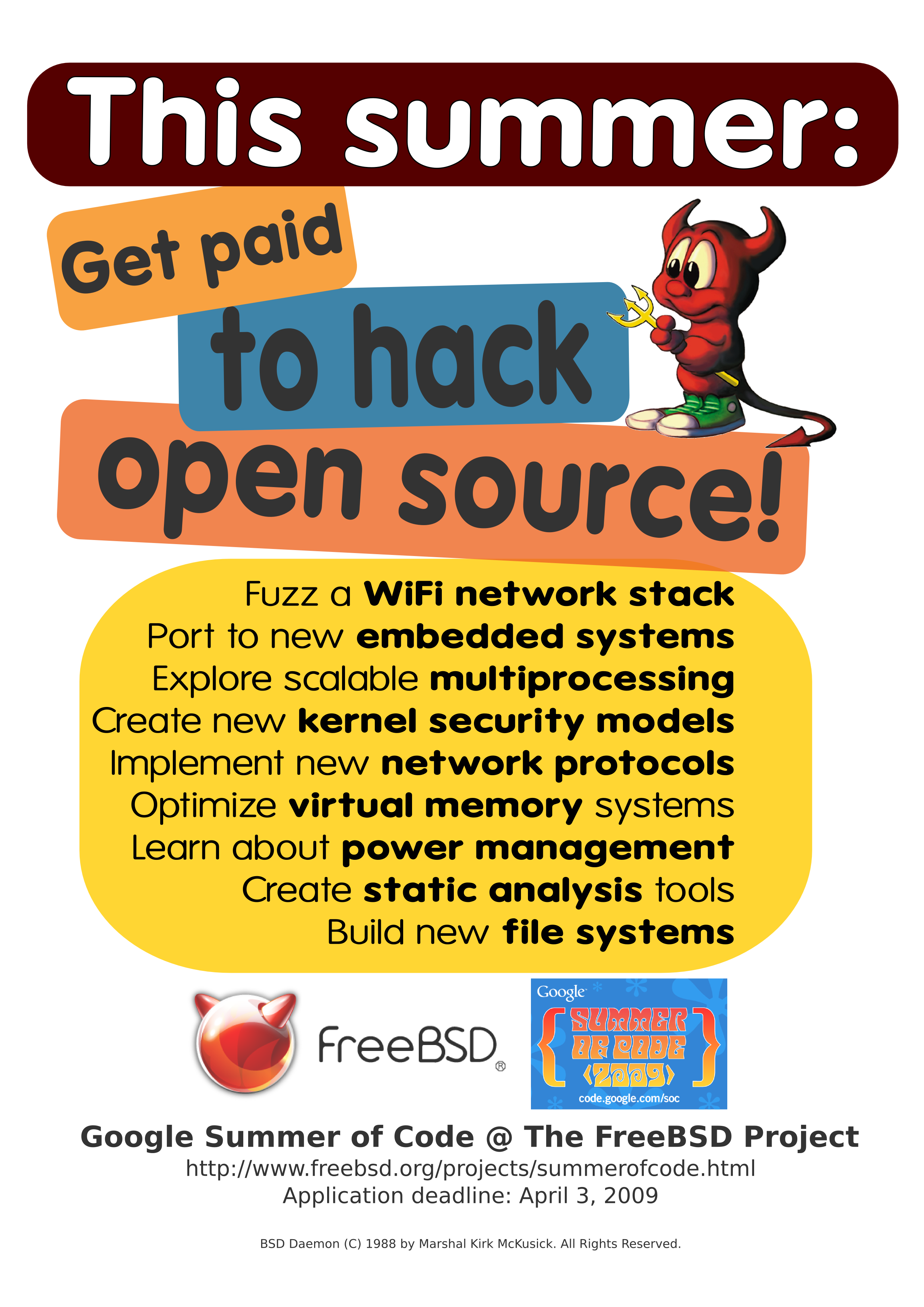
FreeBSD Google Summer of Code posters
Source: FreeBSD Google Summer of Code
Added: 22 March 2009
Tags: freebsd, google, summer of code
PDF version (815 Kb, 1 page), PNG version (1.1 Mb, 2480 x 3507 pixels)
Two posters usable for the announcement of the
participation of the FreeBSD Project in the Google
Summer of Code.
Andrew Doran from the NetBSD Project
Source: bsdtalk
Added: 13 March 2009
Tags: bsdtalk, interview, netbsd, andrew doran
Ogg version (22 minutes), MP3 version (10 Mb, 22 minutes)
Interview with Andrew Doran from the NetBSD Project.
We talk about the upcoming 5.0 release.
A Brief History of the BSD Fast Filesystem, Kirk McKusick
Source: YouTube bsdconferences channel
Added: 13 March 2009
Tags: youtube, presentation, asiabsdcon2008, asiabsdcon, bsd fast filesystem, kirk mckusick
Flash (42:01)
A Brief History of the BSD Fast Filesystem, Kirk McKusick
AsiaBSDCon 2008, Dr. Kirk McKusick
clive URL: http://www.youtube.com/watch?v=tzieR5MM06M
What's your biggest Time Management problem?
Source: New York City *BSD User Group
Added: 13 March 2009
Tags: nycbug, presentation, time management, tom limoncelli
MP3 version (11 Mb)
What's your biggest Time Management problem?
Tom Limoncelli is a FreeBSD user and the author of
the O'Reilly book,"Time Management for System
Administrators". He`ll be giving a brief presentation
with highlights from his book then will take questions
from the audience. Whether you are a system
administrator, a developer (or even a Linux user)
this presentation will help you with something more
precious a quad-processor AMD box.
February 2009Marshall Kirk McKusick at DCBSDCon
Source: bsdtalk
Added: 21 February 2009
Tags: bsdtalk, presentation, bsd, history, kirk mckusick
Ogg version (55 minutes), MP3 version (26 Mb, 55 minutes)
A recording of Marshall Kirk McKusick's talk "A
Narrative History of BSD" at DCBSDCon this past
weekend.
You can get a much more complete history here:
http://www.mckusick.com/history/index.html
Postfix Performance Tuning
Source: New York City *BSD User Group
Added: 21 February 2009
Tags: nycbug, presentation, postfix, john mashey
MP3 version (11 Mb)
Money can buy you bandwidth, but latency is forever!
John Mashey, MIPS
Victor will cover an array of issues connected to
Postfix performance tuning, including:
- Latency, concurrency and throughput
- Postfix input processing
- Queue file format rationale
- Input processing bottlenecks
- Pre-queue filters, milters, content filters
- Tuning for fast (enough) input
- Postfix on-disk queues, requirements and architecture
- What is a "transport"?
- Postfix "nqmgr" scheduler algorithm
- Per-destination in memory queues
- Per-destination scheduler controls
- SMTP delivery
- Understanding delay logging
- Transport process limits, concurrency limits
- Scaling to thousands of output processes
- Connection caching, TLS session caching, feedback controls
Speaker Bio
Victor Duchovni trained in mathematics, switched
tracks to CS in 1980s leaving Princeton with a
master`s degree in mathematics and newly acquired
skills in Unix system administration and system
programming. In 1990 moved to Lehman Brothers,
worked on system management tooling, and network
engineering. Ported "Moira" from MIT to Lehman,
built efficient build systems that predated (and
partly inspired) Jumpstart. In 1994 joined ESM to
market "CMDB" tools to enterprise users, but this
did not pan out, in the mean time learned Tcl, and
contributed bunch of patches to the 7.x early 8.x
TCL releases. In 1997 returned to New York, working
in IT Security at Morgan Stanley since late 1999.
At Morgan Stanley, developed a hobby in perimeter
email security, becoming an active Postfix user and
very soon contributor in May of 2001. In addition
to many smaller feature improvements, contributed
initial implementation of SMTP connection caching,
overhauled and currently maintain LDAP and TLS
support. Made significant design contributions to
queue manager in collaboration with Wietse and
Patrik Raq. In 2.6 contributing support for TLS EC
ciphers and multi-instance management tooling,
ideally also TLS SNI if time permits.
PC-BSD, Matt Olander, AsiaBSDCon 2008
Source: YouTube bsdconferences channel
Added: 21 February 2009
Tags: youtube, presentation, asiabsdcon2008, asiabsdcon, pc-bsd, matt olander
Flash (28:50)
PC-BSD, Matt Olander, AsiaBSDCon 2008
clive URL: http://www.youtube.com/watch?v=N0q37X-MJzY
Reducing Lock Contention in a Multi-Core System, Randall Stewart, AsiaBSDCon 2008
Source: YouTube bsdconferences channel
Added: 21 February 2009
Tags: youtube, presentation, asiabsdcon2008, asiabsdcon, multicore, lock contention, randall stewart
Flash (28:12)
Reducing Lock Contention in a Multi-Core System,
Randall Stewart, AsiaBSDCon 2008
clive URL: http://www.youtube.com/watch?v=OQOMva1SmbY
GEOM - in Infrastructure We Trust, Pawel Jakub Dawidek, AsiaBSDCon 2008
Source: YouTube bsdconferences channel
Added: 21 February 2009
Tags: youtube, presentation, asiabsdcon2008, asiabsdcon, geom, pawel jakub dawidek
Flash (46:38)
GEOM - in Infrastructure We Trust, Pawel Jakub
Dawidek, AsiaBSDCon 2008
clive URL: http://www.youtube.com/watch?v=xMpmOezBJZo
Keynote, Peter Losher, Internet Systems Consortium, AsiaBSDCon 2008
Source: YouTube bsdconferences channel
Added: 21 February 2009
Tags: youtube, keynote, asiabsdcon2008, asiabsdcon, peter losher
Flash (42:44)
Keynote, Peter Losher, Internet Systems Consortium,
AsiaBSDCon 2008
clive URL: http://www.youtube.com/watch?v=vQbdG7TwhKo
Using FreeBSD to Promote Open Source Development Methods, Brooks Davis, AsiaBSDCon 2008
Source: YouTube bsdconferences channel
Added: 21 February 2009
Tags: youtube, presentation, asiabsdcon2008, asiabsdcon, freebsd, promotion, open source development models, brooks davis
Flash (30:07)
Using FreeBSD to Promote Open Source Development
Methods, Brooks Davis, AsiaBSDCon 2008
clive URL: http://www.youtube.com/watch?v=4lcrinKBMas
January 2009FreeBSD Kernel Internals, Dr. Marshall Kirk McKusick
Source: YouTube bsdconferences channel
Added: 19 January 2009
Tags: youtube, course, freebsd, design and implementation of the freebsd operating system, kirk mckusick
Flash (59:57)
The first hour of Marshall Kirk McKusick's course
on FreeBSD kernel internals based on his book, The
Design and Implementation of the FreeBSD Operating
System. This course has been given at BSD Conferences
and technology companies around the world.
clive URL: http://www.youtube.com/watch?v=nwbqBdghh6E
Justin Sherrill of the DragonFlyBSD Digest
Source: bsdtalk
Added: 19 January 2009
Tags: bsdtalk, interview, dragonflybsd, justin sherril
Ogg version (22 minutes), MP3 version (10 Mb, 22 minutes)
Interview with Justin Sherrill of the DragonFlyBSD
Digest, which can be found at
http://www.shiningsilence.com/dbsdlog/
Introduction to Puppet
Source: New York City *BSD User Group
Added: 19 January 2009
Tags: nycbug, presentation, puppet, larry ludwig
MP3 version (11 Mb)
What it is and how can it make system administration
less painful
About the speaker:
Larry Ludwig - Principal Consultant/Founder of
Empowering Media. Empowering Media is a consulting
firm and managed hosting provider. Larry Ludwig
has been in the industry for over 15 years as a
system administration and system programmer. He`s
had previous experience working for many Fortune
500 corporations and holds a BS in CS from Clemson
University. Larry, along with Eric E. Moore and
Brian Gupta are founding members of the NYC Puppet
usergroup.
December 2008Een historisch overzicht van BSD - Hans van de Looy
Source: Nederlandse Linux Gebruikers Group
Added: 31 December 2008
Tags: nllgg, bsd, history, hans van de looy
PDF version (5767 Kb, 38 pages)
Hans zal een historisch overzicht geven van het
ontstaan van *BSD vanaf de oorsprong van UNIX tot
aan de nu bekende *BSD varianten. Hij zal daarbij
met name ingaan wat de oorsprong en het ontstaan
van een aantal *BSD-projecten zijn. Hierbij zal hij
zeer kort ingaan op de verschillende licentieproblemen
die we in het verleden gezien hebben en worden een
aantal bekende personen en data weer eens even op
de kaart geplaatst.
Hans van de Looy is oprichter van Madison Gurkha. Een bedrijf
dat gespecialiseerd is op het gebied van het uitvoeren
van technische ICT-beveiligingsonderzoeken, in de
media ook wel aangeduid met Etisch Hacken. Tijdens
dergelijke onderzoeken maakt hij ook regelmatig
gebruik van op BSD* gebaseerde systemen.
May 2008 developer Vimage report
Source: YouTube bsdconferences channel
Added: 31 December 2008
Tags: youtube, freebsd, vimage, marko zec, julian elischer
Flash (2:44:36)
A sneak peak into the FreeBSD development process.
Warning 2 hours! filmed over 2 days.
(The schedule worked out was optimistic to say the
least but it's still looking ok...)
Marko Zec and Julian Elischer report back to the
developers at BSDCan on the progress on virtualizing
the network stack in FreeBSD. This has been a long
term project but at the time of this recording was
just reaching the point of feasibility. In this
video you can see some of the dynamics of the group
as developers become familiar with the project and
discussions take place regarding such things as
maintainability, ABI compatibility, and even what
to call the feature. In this video you can see the
decision being made by a "quorum" of developers to
take this project mainstream.
The sound is less that perfect, but it's what we have.
This is a montage of 3 video sources, one of which
is a lower resolution, but at times it was the only
camera capturing the action. (the other ran out of
tape for a while)
Thanks to Ed Maste for the added footage.
I will be doing more editing later and will be
substituting in better footage in some places.
clive URL: http://au.youtube.com/watch?v=Px-pSXm32dE
Isilon and FreeBSD
Source: YouTube bsdconferences channel
Added: 31 December 2008
Tags: youtube, freebsd, isilon, zach loafman
Flash (28:58)
Zach Loafman explains how Isilon uses FreeBSD and
how the company adds to it and interacts with the
FreeBSD community.
clive URL: http://au.youtube.com/watch?v=OlMocIwM5QU
ZFS in FreeBSD, by Pawel Jakub Dawidek
Source: YouTube bsdconferences channel
Added: 31 December 2008
Tags: youtube, freebsd, zfs, pawel jakub
Flash (54:34)
Pawel goes over ZFS, and tells us the state of the
FreeBSD port. Source: Julian
clive URL: http://au.youtube.com/watch?v=5-CR3o-Q2CU
Van FreeBSD Documentatie projectleider tot FreeBSD Developer - Remko Lodder
Source: Nederlandse Linux Gebruikers Group
Added: 31 December 2008
Tags: nllgg, freebsd, documentation, nederlands, remko lodder
PDF version (594 Kb, 24 pages)
In 2004 ben ik begonnen met het FreeBSD Dutch
Documentation Project, een project dat inmiddels
bijna het complete handboek vertaald heeft. Sinds
die tijd zijn er vele wegen geweest die ik behandeld
heb, van documentatie projectleider naar Security
Team-lid tot aan FreeBSD Developer.
Remko Lodder is momenteel 25 jaar en werkt als Unix
Engineer voor het bedrijf Snow B.V. waar hij zich
momenteel met name bezig houd met security (firewalls
etc). Hij is sinds 2004 lid van het FreeBSD Development
team en is momenteel 1 van de meest actieve developers
binnen het team.
Michael Lauth from iXsystems
Source: bsdtalk
Added: 31 December 2008
Tags: bsdtalk, interview, ixsystems, michael lauth
Ogg version (17 minutes), MP3 version (8 Mb, 17 minutes)
Interview with Michael Lauth, CEO of iXsystems. We
talk about his experiences with running a business
using BSD.
FreeBSD networking work summary
Source: YouTube bsdconferences channel
Added: 16 December 2008
Tags: youtube, freebsd, networking, robert watson
Flash (55:21)
Robert Watson reports on work currently under way
to optimize the networking stack for new hardware.
Source: Julian
clive URL: http://www.youtube.com/watch?v=ohLVNmI3lCg
Hardware Crypto Suport- Philip Paep. MeetBSD 2008
Source: YouTube bsdconferences channel
Added: 16 December 2008
Tags: youtube, meetbsd, meetbsd2008, crypto, philip paep
Flash (23:03)
Philip gives a short talk on hs experience developing
a driver for hardware crypto. Source: Julian
clive URL: http://au.youtube.com/watch?v=2oV2ZGXO33o
Kris Moore and PCBSD
Source: YouTube bsdconferences channel
Added: 16 December 2008
Tags: youtube, pcbsd, kris moore
Flash (25:14)
PCBSD from a developer's perspective. Source: Julian
clive URL: http://au.youtube.com/watch?v=aHRRa-OvwxM
DCBSDCon with Jason Dixon
Source: bsdtalk
Added: 10 December 2008
Tags: bsdtalk, interview, dcbsdcon, dcbsdcon2009, jason dixon
Ogg version (10 minutes), MP3 version (5 Mb, 10 minutes)
I speak with Jason Dixon about DCBSDCon, which will
take place in February 2009. For more info see
www.dcbsdcon.org
Google Summer of Code 2008. BSD summary
Source: YouTube bsdconferences channel
Added: 07 December 2008
Tags: youtube, meetbsd, meetbsd2008, google soc
Flash (35:15)
A panel discusses the GSOC project an how it and BSD get on.
Source: Julian
clive URL: http://www.youtube.com/watch?v=3l3tuhSmp_E
Embedded FreeBSD
Source: YouTube bsdconferences channel
Added: 07 December 2008
Tags: youtube, meetbsd, meetbsd2007, embedded, freebsd, polish, rafal jaworowski
Flash (1:11:09)
"FreeBSD do zabudowy czyli nie tylko pecety", Rafal
Jaworowski at MeetBSD 2007 in Warsaw, Poland.
clive URL: http://www.youtube.com/watch?v=2HcIJvJX4y8
New features in FreeBSD 7
Source: YouTube bsdconferences channel
Added: 07 December 2008
Tags: youtube, meetbsd, meetbsd2007, freebsd, kris kennaway
Flash (1:07:18)
"New features and improvements in FreeBSD 7", Kris
Kennaway at MeetBSD 2007 in Warsaw, Poland
clive URL: http://www.youtube.com/watch?v=XUjJWhlnujQ
DTrace
Source: YouTube bsdconferences channel
Added: 07 December 2008
Tags: youtube, meetbsd, meetbsd2007, dtrace, polish, slawomir zak
Flash (1:04:23)
"DTrace - Monitoring i strojenie systemu w XXI
wieku", Slawomir Zak at MeetBSD 2007 in Warsaw, Poland.
clive URL: http://www.youtube.com/watch?v=5VK6tV4y3r0
Meet BSD projects from GSoC 2007
Source: YouTube bsdconferences channel
Added: 07 December 2008
Tags: youtube, meetbsd, meetbsd2007, google soc, pawel solyga
Flash (34:37)
"Meet BSD projects from Google Summer of Code 2007",
Pawel Solyga at MeetBSD 2007 in Warsaw, Poland.
clive URL: http://www.youtube.com/watch?v=snVtilaj-KI
FreeBSD, klaster pocztowy
Source: YouTube bsdconferences channel
Added: 07 December 2008
Tags: youtube, meetbsd, meetbsd2007, polish, jan srzednicki
Flash (1:07:56)
"Projektowanie korporacyjnego klastra pocztowego",
Jan Srzednicki at MeetBSD 2007 in Warsaw, Poland.
clive URL: http://www.youtube.com/watch?v=9B8MDy-37TI
BSD is Dying, Jason Dixon, NYCBSDCon 2007
Source: YouTube bsdconferences channel
Added: 06 December 2008
Tags: youtube, nycbsdcon, nycbsdcon2007, bsd is dying, jason dixon
Flash (17:41)
A tongue-in-cheek look at the history and future
of the BSD movement. Modeled after the presentation
styles of Lessig and Hardt, the talk provides a
light-hearted introspection of the leaders,
technologies, and community that forges ahead despite
having been left for dead some 15 years past. This
presentation was given by Jason Dixon at the NYC
BSD Conference at Columbia University on October
28, 2006
clive URL: http://www.youtube.com/watch?v=g7tvI6JCXD0
FreeBSD, Building a Computing Cluster
Source: YouTube bsdconferences channel
Added: 06 December 2008
Tags: youtube, meetbsd, meetbsd2007, freebsd, cluster, performance, brooks davis
Flash (47:51)
"Reflections on Building a High-Performance Computing
Cluster using FreeBSD", Brooks Davis at MeetBSD
2007 in Warsaw, Poland.
clive URL: http://www.youtube.com/watch?v=BpsRb9fJ4Ds
Embedding FreeBSD, MeetBSD 2008
Source: YouTube bsdconferences channel
Added: 06 December 2008
Tags: youtube, meetbsd, meetbsd2008, embedded, freebsd, philip paeps, warner losh
Flash (38:56)
Embedding FreeBSD by Warner Losh and Philip Paeps,
MeetBSD November 15, 2008
clive URL: http://www.youtube.com/watch?v=Fc3xYrxvIU0
BSD Certification, MeetBSD 2008
Source: YouTube bsdconferences channel
Added: 06 December 2008
Tags: youtube, meetbsd, meetbsd2008, bsd certification, dru lavigne
Flash (44:14)
BSD Certification by Dru Lavigne, Chair, BSD
Certification Group, MeetBSD November 15, 2008
clive URL: http://www.youtube.com/watch?v=rGQmLYplO9U
BSD v. GPL, Jason Dixon, NYCBSDCon 2008
Source: YouTube bsdconferences channel
Added: 06 December 2008
Tags: youtube, nycbsdcon, nycbsdcon2008, bsd versus gpl, jason dixon
Flash (16:21)
BSD vs GPL is a sweeping epic, focused on the
dichotomy between good and evil. It peers inside
the hearts and minds of the creators of these
movements and dissects their battle for world
domination. No common documentary will dare to
follow the path that BSD vs GPL blazes. This
presentation was given by Jason Dixon at the NYC
BSD Conference at Columbia University on October
11, 2008
clive URL: http://www.youtube.com/watch?v=mMmbjJI5su0
FreeBSD, Protecting Privacy with Tor
Source: YouTube bsdconferences channel
Added: 06 December 2008
Tags: youtube, meetbsd, meetbsd2007, freebsd, tor, privacy, christian bruffer
Flash (46:24)
"Protecting your Privacy with FreeBSD and Tor",
Christian Brffer at MeetBSD 2007 in Warsaw, Poland.
clive URL: http://www.youtube.com/watch?v=OwBh8ro7xHQ
Detangling and debugging
Source: YouTube bsdconferences channel
Added: 06 December 2008
Tags: youtube, meetbsd, meetbsd2007, debugging, philip paeps
Flash (18:36)
"Detangling and debugging: friends in unexpected
places", Philip Paeps at MeetBSD 2007 in Warsaw,
Poland.
clive URL: http://www.youtube.com/watch?v=G8Fm8mgPyDc
PC-BSD: FreeBSD on the Desktop
Source: YouTube bsdconferences channel
Added: 06 December 2008
Tags: youtube, meetbsd, meetbsd2007, pc-bsd, matt olander
Flash (31:30)
"PC-BSD: FreeBSD on the Desktop", Matt Olander at
MeetBSD 2007 in Warsaw, Poland.
clive URL: http://www.youtube.com/watch?v=oC4gsipGfQU
Isolating Cluster Jobs for Performance and Predictability, Brooks Davis, MeetBSD 2008
Source: YouTube bsdconferences channel
Added: 06 December 2008
Tags: youtube, meetbsd, meetbsd2008, cluster, performance, brooks davis
Flash (43:40)
Isolating Cluster Jobs for Performance and
Predictability by Brooks Davis, The Aerospace
Corporation, MeetBSD November 15, 2008
clive URL: http://www.youtube.com/watch?v=0uBFLJm7IHc
FreeBSD Foundation Update & Recognition, MeetBSD 2008
Source: YouTube bsdconferences channel
Added: 06 December 2008
Tags: youtube, meetbsd, meetbsd2008, freebsd foundation, robert watson
Flash (16:22)
Robert Watson provides a status update on the
non-profit FreeBSD Foundation at MeetBSD November
16, 2008
clive URL: http://www.youtube.com/watch?v=sNQ2d41Vn2A
FreeBSD Profiling, Kris Kennaway, MeetBSD 2008
Source: YouTube bsdconferences channel
Added: 06 December 2008
Tags: youtube, meetbsd, meetbsd2008, freebsd, profiling, kris kennaway
Flash (1:06:23)
FreeBSD Profiling tools, tips and tricks, Kris
Kennaway, MeetBSD 2008
clive URL: http://www.youtube.com/watch?v=Mfb5_uG7BCA
November 2008Asterisk Open Source Community Director John Todd
Source: bsdtalk
Added: 26 November 2008
Tags: bsdtalk, interview, john todd, asterisk, openbsd
Ogg version (23 minutes), MP3 version (11 Mb, 23 minutes)
An interview with Asterisk Open Source Community
Director John Todd, who also happens to be a user
of BSD. We talk about Asterisk on BSD, and his
choice of OpenBSD for his systems.
Server deployment in mass-hosting environment using FreeBSD Ports system by Stanislav Sedov (in russian)
Source: Hostobzor, the Russian conference of hosting provider
Added: 24 November 2008
Tags: hostobzor, hostobzor12, freebsd, ports, stanislav sedov, russian
PDF version (470 Kb, 30 pages), PDF version (61 Kb, 5 pages)
Recently I have been attending Hostobzor 12th, the
Russian conference of hosting providers, beeing
held at Raivola hotel near St. Petersburg. The event
was great as always thanks to organizers. There was
a number of intersting talks given, a lot of
interesting discussions held, and, what I appreciate
better, a lot of new people with great ideas met.
I gave a talk on using the FreeBSD Ports system to
mange a large-scale virtual hosting installations
based on Hosting Telesystems experience. I tried
to describe in detail how we use the ports collection
to deploy a large number of servers diverced by
architecture and OS versions, how we build packages
and distribute them among servers, talked about how
we use Mercurial VCS to incrementally merge upstream
changes into our modified ports collection and
FreeBSD src trees. Hopefully, I've not screwed it
much... At least, some people was interested a lot
and asked interesting questions.
New York City BSD Con 2008
Source: New York City *BSD User Group
Added: 24 November 2008
Tags: nycbsdcon2008, nycbsdcon, presentation
Julio M. Merino Vidal: An introduction to the Automated Testing Framework (ATF) for NetBSD. (570 Kb, 18 pages), Mike Silbersack: Detecting TCP regressions with tcpdiff. (88 Kb, 28 pages), Metthew Dillon: The HAMMER File System. (820 Kb, 16 pages), Kurt Miller: OpenBSD's Position Independent Executables (PIE) Implementation. (21 pages), Adrian Chadd: High-throughput concurrent disk IO in FreeBSD. (197 Kb, 92 pages), Anders Magnusson: Design and Implementation of the Portable C Compiler. (123 Kb, 29 pages), Jason L Wright: When Hardware Is Wrong, or "They can Fix It In Software". (1.7 Mb, 22 pages)
Slides of presentations given at New York City BSD
Conference 2008.
Julian Elischer
Source: bsdtalk
Added: 21 November 2008
Tags: bsdtalk, interview, julian elischer, ironport
Ogg version (16 minutes), MP3 version (16 Mb, 35 minutes)
An interview with Julian Elischer at MeetBSD in
California. We talk about his early days with BSD
and his work using BSD at various companies. He is
currently with IronPort, which was bought by Cisco.
MeetBSD 2008 in California - Presentation
Source: MeetBSD
Added: 19 November 2008
Tags: meetbsd, meetbsd2008, freebsd, presentations
FreeBSD Foundation Update & Recognition by Robert Watson (3.2 Mb, 8 pages), BSD Certification by Dru Lavigne (80 Kb, 19 pages), Crypto Acceleration by Philip Paeps (256 Kb, 20 pages), "Help, my system is slow!" Profiling tools, tips and tricks by Kris Kennaway (172 Kb, 29 pages), Embedding FreeBSD by M. Warner Losh (685 Kb, 31 pages), Isilon and FreeBSD by Zach Loafman (136 Kb, 25 pages), Isolating Cluster Jobs for Performance and Predictability by Brooks Davis (900 Kb, 24 pages), PC-BSD 7 - A Developer's Perspective by Kris Moore (580 Kb, 45 pages), FreeBSD Network Stack Performance - Optimizations for Modern Hardware by Robert Watson (5.5 Mb, 43 pages), A closer look at the ZFS file system by Pawel Jakub Dawidek (470 Kb, 45 pages)
MeetBSD 2008 at the Googleplex in Mountain View,
California to celebrate FreeBSD's 15th Anniversary!
OpenBSD 4.4 Release Song - "Source Wars - Episode IV - Trial of the BSD Knights"
Source: OpenBSD
Added: 18 November 2008
Tags: openbsd, artwork
Ogg version (4.4 Mb, 3 minutes 5 seconds), MP3 version (5.6 Mb, 3 minutes 5 seconds)
Nearly 10 years ago Kirk McKusick wrote a history
of the Berkeley Unix distributions for the O'Reilly
book "Open Sources: Voices from the Open Source
Revolution". We recommend you read his story,
entitled "Twenty Years of Berkeley Unix From
AT&T-Owned to Freely Redistributable" first, to see
how Kirk remembers how we got here. Sadly, since
it showed up in book form originally, this text has
probably not been read by enough people.
The USL(AT&T) vs BSDI/UCB court case settlement
documents were not public until recently; their
disclosure has made the facts more clear. But the
story of how three people decided to free the BSD
codebase of corporate pollution -- and release it
freely -- is more interesting than the lawsuit which
followed. Sure, a stupid lawsuit happened which
hindered the acceptance of the BSD code during a
critical period. But how did a bunch of guys go
through the effort of replacing so much AT&T code
in the first place? After all, companies had lots
of really evil lawyers back then too -- were they
not afraid?
After a decade of development, most of the AT&T
code had already been replaced by university
researchers and their associates. So Keith Bostic,
Mike Karels and Kirk McKusick (the main UCB CSRG
group) started going through the 4.3BSD codebase
to cleanse the rest. Keith, in particular, built a
ragtag team (in those days, USENIX conferences were
a gold mine for such team building) and led these
rebels to rewrite and replace all the Imperial AT&T
code, piece by piece, starting with the libraries
and userland programs. Anyone who helped only got
credit as a Contributor -- people like Chris Torek
and a cast of .. hundreds more.
Then Mike and Kirk purified the kernel. After a bit
more careful checking, this led to the release of
a clean tree called Net/2 which was given to the
world in June 1991 -- the largest dump of free
source code the world had ever received (for those
days -- not modern monsters like OpenOffice).
Some of these ragtags formed a company (BSDi) to
sell a production system based on this free code
base, and a year later Unix System Laboratories
(basically AT&T) sued BSDi and UCB. Eventually
AT&T lost and after a few trifling fixes (described
in the lawsuit documents) the codebase was free. A
few newer developments (and more free code) were
added, and released in June 1994 as 4.4BSD-Lite.
Just over 14 years later OpenBSD is releasing its
own 4.4 release (and for a lot less than $1000 per
copy).
The OpenBSD 4.4 release is dedicated to Keith Bostic,
Mike Karels, Kirk McKusick, and all of those who
contributed to making Net/2 and 4.4BSD-Lite free.
At MeetBSD with some of the FreeBSD Core Team
Source: bsdtalk
Added: 18 November 2008
Tags: bsdtalk, interview, freebsd core team, meetbsd2008, meetbsd, robert watson, brooks davis, kris kennaway, peter wemm, philip paeps, freebsd, subversion
Ogg version (38 minutes), MP3 version (18 Mb, 38 minutes)
A conversation with some of the FreeBSD Core Team
at MeetBSD California 2008. I speak with Brooks
Davis, Kris Kennaway, Robert Watson, Peter Wemm,
and Philip Paeps about the recent core team election,
FreeBSD 7.1 and 8, Developer Summits, and the move
to Subversion.
A Tour of iXsystems
Source: bsdtalk
Added: 16 November 2008
Tags: bsdtalk, interview, ixsystems
Ogg version (8 minutes), MP3 version (4 Mb, 8 minutes)
A brief description of my visit to iXsystems in
California prior to MeetBSD 2008.
Hardware Performance Monitoring Counters
Source: New York City *BSD User Group
Added: 16 November 2008
Tags: nycbug, presentation, george neville-neil, counters
MP3 version (4 Mb)
Many modern CPUs provide on chip counters for
performance events such as retiring instructions
and cache misses. The hwpmc driver and libraries
in FreeBSD give systems administrators and programmers
access to APIs which make it possible to measure
performance without modifying source code and with
minimal intrusion into application execution. This
talk will be a brief introduction to HWPMC, and how
to use it.
Bio: George Neville-Neil is the co-author with Kirk
McKusick of The Design and Implementation of the
FreeBSD Operating System. He works on networking
an operating systems for fun and profit.
BSD on a eeePC 900A
Source: bsdtalk
Added: 16 November 2008
Tags: bsdtalk, eeepc
Ogg version (10 minutes), MP3 version (5 Mb, 10 minutes)
I look forward to attending MeetBSD this weekend.
A brief description of my first attempts to get BSD
on a eeePC 900A. I try OpenBSD 4.4, DragonFlyBSD
2.0.1, PC-BSD 7.0.1, and FreeBSD 7.
October 2008EuroBSDCon 2008 Keynote - George Neville-Neil - Thinking about thinking code
Source: EuroBSDCon
Added: 22 October 2008
Tags: eurobsdcon, eurobsdcon2008, george neville-neil
MP3 (1 byte, 37 minutes), OGG (1 byte, 37 minutes), PDF (1 byte, n pages)
EuroBSDCon 2008 Keynote - George Neville-Neil - Thinking about thinking code
EuroBSDCon 2008 - Matthieu Herrb - Input handling in wscons and X.Org
Source: EuroBSDCon
Added: 22 October 2008
Tags: eurobsdcon, eurobsdcon2008, wscons, x.org, matthieu herrb
MP3 (1 byte, 57 minutes), OGG (1 byte, 57 minutes), PDF (1 byte, n pages)
This talk will present the different layers that
handle input, from the key that gets pressed or the
mouse motion to the applications, all the way through
the kernel drivers, X drivers and libraries, in the
case of the OpenBSD/NetBSD wscons driver and the
current and future X.Org server. It will cover stuff
like keyboard mappings, touch-screen calibration,
multi-pointer X or input coordinates transformations.
It will show some problems of current implementations
and try to show how current evolutions can solve
them.
Matthieu Herrb is maintaing X on OpenBSD. I've been
using X on various systems (SunOS, NetBSD, OpenBSD,
Mac OS X,...) since 1989. He has been a member of
the XFree86 Core Team for a short period in 2003
and is now a member of the X.Org Foundation BoD.
Matthieu Herrb works at LAAS a research laborarory
of the French National Research Agency (CNRS) both
on robotics and network security.
EuroBSDCon 2008 - Martin Schuette - Improved NetBSD Syslogd
Source: EuroBSDCon
Added: 22 October 2008
Tags: eurobsdcon, eurobsdcon2008, netbsd, syslogd, martin schuette
MP3 (1 byte, 42 minutes), OGG (1 byte, 42 minutes), PDF (1 byte, n pages)
Martin Schuette has three main goals, defined by three
internet drafts to implement:
- TLS transport is the most obvious improvement: it
provides a reliable network transport with data encryption
and peer authentication. To make full use of this a
buffering mechanism to bridge temporary network errors
is implemented as well.
- Syslog-protocol extends the message format to use
a complete timestamp, include a fully qualified domain
name, and allow UTF-8 messages. It also offers a
structured data field to unambiguously encode application
dependent information.
- Syslog-sign will allow any syslog sender to digitally
sign its messages, so their integrity can be verified
later. This enable the detection of loss, deletion or
other manipulation syslog data after network transfer
or archiving on storage media.
Martin Schuette is a student of computer science in
Potsdam, Germany, and has been working as a part-time
system administrator for BSD servers since 2004.
In 2007 Martin Schuette already gave a talk on Syslog
at the Chemnitze Linux-Tage
(http://chemnitzer.linux-tage.de/2007/vortraege/detail.html?idx=547
in german; for a newer english version see these slides
for a seminar talk:
http://fara.cs.uni-potsdam.de/~mschuett/uni/syslog-protocols-080522.pdf).
EuroBSDCon 2008 - Michael Dexter - Zen and the Art of Multiplicity Maintenance: An applied survey of BSD-licensed multiplicity strategies from chroot to mult
Source: EuroBSDCon
Added: 22 October 2008
Tags: eurobsdcon, eurobsdcon2008, bsd, michael dexter
MP3 (1 byte, 38 minutes), OGG (1 byte, 38 minutes), PDF (1 byte, n pages)
Many BSD-licensed strategies of various levels of
maturity exist to implement multiplicity, herein
defined as the introduction of plurality to
traditionally singular computing environments via
isolation, virtualization, or other method. For
example, the chroot utility introduces an additional
isolated root execution environment within that of
the host; or an emulator provides highly-isolated
virtual systems that can run complete native or
foreign operating systems. Motivations for multiplicity
vary, but a demonstrable desire exists for users
to obtain root or run a foreign binary or operating
system. We propose a hands-on survey of portable
and integrated BSD-licensed multiplicity strategies
applicable to the FreeBSD, OpenBSD, DragonFlyBSD
and NetBSD operating systems on the i386 architecture.
We will also address three oft-coupled disciplines:
software storage devices, the installation of
operating system and userlands in multiplicity
environments plus the management of select multiplicity
environments. Finally we will comment on each
strategies potential limits of isolation, compatibility,
independence and potential overhead in comparison
to traditional systems. Keywords: multiplicity,
virtualization, chroot, jail, hypervisor, xen,
compat.
Michael Dexter has used Unix systems since 1991 and
BSD-licensed multiplicity strategies for over five
years. He is the Program Manager at the BSD Fund
and Project Manager of the BSD.lv Project.
EuroBSDCon 2008 - George Neville-Neil - Four years of summer of code
Source: EuroBSDCon
Added: 22 October 2008
Tags: eurobsdcon, eurobsdcon2008, google soc, george neville-neil
MP3 (1 byte, 27 minutes), OGG (1 byte, 27 minutes), PDF (1 byte, n pages)
The Google Summer of Code is a program designed to
provide students with real world experience
contributing to open source projects during the
summer break in university studies. Each year Google
selects a number of open source projects to act as
mentoring organizations. Students are invited to
submit project proposals for the open source projects
that are most interesting to them. FreeBSD was one
of the projects selected to participate in the
inaugural Summer of Code in 2005 and we have
participated each year since then. Over the past 4
years a total of 79 students have participated in
the program and it has become a very significant
source of new committers to FreeBSD. This talk will
examine in detail the selection criteria for projects,
the impact that successful projects have had, and
some suggestions for how we can better leverage
this program in the future.
EuroBSDCon 2008 - Pedro Giffuni - Working with Engineering Applications in FreeBSD
Source: EuroBSDCon
Added: 22 October 2008
Tags: eurobsdcon, eurobsdcon2008, freebsd, engineering applications, pedro giffuni
MP3 (1 byte, 51 minutes), OGG (1 byte, 51 minutes), PDF (1 byte, n pages)
In recent years, traditional branches of engineering
like Civil, Chemical, Mechanical, Electrical and
Industrial Engineering are requiring extensive
computing facilities for their needs. Several well
known labs (Sandia, Lawrence Livermore) rely on
huge clusters to do all types of complex analysis
that were unthinkable a couple of decades ago. While
the free BSD variants share the environment with
traditional UNIX systems, frequently used for such
computations, it was not common to find adequate
free software packages to carry complex calculations.
Eventually commercial versions of important math
related packages started to appear for the Linux
platform. Even when the big packages were distant,
the BSDs learned and adapted in resourceful ways:
Matlab and Mathematica, running under Linux emulation,
demanded functionality from the BSDs and NetBSD
implemented a signal trampoline to be able to run
AutoCAD with IRIX binary compatibility. A notable
project that was always available under a free
license was Berkeley's Spice circuit analysis
program, however it was an exception rather than
the rule. Even when the scientific community pressed
for a while to get other important tools like NASA's
FEA package Nastran under a free license, the
objective of being able to access and enhance open
scientific tools was elusive. About a decade ago
the situation started to improve: FreeBSD's ports
system started growing exponentially, first with a
high content in the math category, afterwards with
a CAD section and after sustained growth in those
categories a science section was created. This
growth was mostly pushed by Universities and their
research projects and in general are not well known
with respect to the commercial counterparts. I
started porting math/engineering code for FreeBSD
around 1996. Back then it was absolutely unthinkable
for a Mechanical Engineer to depend only on FreeBSD
for it's daily work. The situation nowadays is
different: there are some very high quality engineering
analysis packages like EDF's Code Aster, with more
than 12 years of professional development, that
just can't be ignored. A Finite Element package,
like Code Aster, can easily cost 5000 US$, is priced
according to the maximum problem size it can solve,
can require yearly licenses, and is rarely available
with source code. In NASTRAN's case the source code
is only available for US citizens under a yearly
fee. Free software does have serious limitations
though; just like in office applications there are
proprietary CAD formats or sometimes the package
simply doesn't have the required functionality.
Having the sources, of course, always has the
advantage of being able to implement (or pay for)
some specific functionality you might need. Many
commercial packages have been recently ported to
Linux, but even when they gain some of the advantages
of an open environment they still have yet another
limitation: they have been very slow to make use
of the multicored features of the new processors
in the market, a huge limitation now that the speed
war between processors has been limited by the
overheating problem. The objective of the talk is
to give an overview of several CAD/CAE packages
that have been made available recently as part of
FreeBSD's ports system and the decisions that were
made to port them. BRLCAD and Varkon are two CAD
utilities that made a transition from closed source
to an open environment and in the process in the
process of getting ported to BSD have gained greater
portability and general "bug" fixes critical for
their consolidation as usable and maintainable
projects. There are also some tricks that have not
been well documented: it is possible to enable
threads and some extra optimizations on some packages,
and it is also possible to replace the standard
BLAS library with the faster GOTO BLAS without
rebuilding the package. It is also possible to build
the packages optimized for a clustered environment,
but perhaps what is most interesting of all is how
all the packages interrelate with each other and
can turn FreeBSD into a complete enginering
environment. No OS distribution so far is offering
all the engineering specific utilities offered
through FreeBSD's ports system: from design to
visualization, passing through analysis FreeBSD is
becoming an option that can't be ignored, and best
of all, it is an effort that will benefit not only
FreeBSD but the wider audience.
Pedro F. Giffuni M. Sc. Industrial Engineering -
University of Pittsburgh Mechanical Engineer -
Universidad Nacional de Colombia I was born in
Bogota, Colombia but I am an Italian citizen. My
experience with computers started when I was about
12 years old With the TRS-80 Color Computer first
using Basic and the OS-9. I studied electronics for
3 years but became tired of worrying about "whatever
happened to electrons in there" and moved to
Mechanical Engineering. For a while I rested from
the computer world until the Internet came stepping
along. I started using FreeBSD around 1995 and soon
fell in love with the idea of being able to install
a complete version of UNIX from the net with just
one floppy. After submitting a the 999th port to
the FreeBSD project Walnut Creek was kind enough
to give me a subscription for several years to
FreeBSD's CD-ROM. Since then I've been on and off
porting software packages or fixing the bugs I have
caused while porting them. Of course there has
always been great respect for the other BSDs and
their wonderful license and while I've given up on
the idea of one day seeing a "UnifiedBSD" I am glad
to see different approaches sharing ideas in a
healthful environment.
Keywords: BSD, engineering, CAE, CAD, math, mechanical,
FreeBSD ports
EuroBSDCon 2008 - George Neville-Neil - Multicast Performance in FreeBSD
Source: EuroBSDCon
Added: 22 October 2008
Tags: eurobsdcon, eurobsdcon2008, multicast, freebsd, george neville-neil
MP3 (1 byte, 39 minutes), OGG (1 byte, 39 minutes), PDF (1 byte, n pages)
In the past ten years most of the research in network
protocols has gone into TCP, leaving UDP to languish
as a local configuration protocol. While the majority
of Internet traffic is TCP, UDP remains the only
IP protocol that works over multicast and as such
has some specific, and interesting uses in some
areas of computing. In 2008 we undertook a study
of the performance of UDP multicast on both 1Gbps
and 10Gbps Ethernet networks in order to see if
changing the physical layer of the network would
give a linear decrease in packet latency. To measure
the possible gains we developed a new network
protocol test program, mctest, which is capable of
recording packet round trip times from many hosts
simultaneously and which we believe accurately
represents how many environments use multicast. The
mctest program has been integrated into FreeBSD and
is now being used to verify the proper operation
of multicast on various pieces of 10Gbps hardware.
EuroBSDCon 2008 - Hauke Fath - Managing BSD desktop clients - Fencing in the herd
Source: EuroBSDCon
Added: 22 October 2008
Tags: eurobsdcon, eurobsdcon2008, bsd, desktop, hauke fath
MP3 (1 byte, 50 minutes), OGG (1 byte, 50 minutes), PDF (1 byte, n pages)
The members of the BSD family have traditionally
prospered off the desktop, as operating systems on
servers and embedded systems. The advent of MacOS
X has marked a change, and moved the desktop more
into focus. Modern desktop systems create a richer
software landscape, with more diverse requirements,
than their server counterparts. User demands,
software package interdependencies and frequent
security issues result in a change rate that can
put a considerable load on the admin staff. Without
central management tools, previously identical
installations diverge quickly. This paper looks at
concepts and strategies for managing tens to hundreds
of modern, Unix-like desktop clients. The available
management tools range from simple, image-based
software distribution, mainly used for setting up
uniform clients, to "intelligent" rule-based engines
capable of search-and-replace operations on
configuration files. We will briefly compare their
properties and limitations, then take a closer look
at Radmind, a suite for file level administration
of Unix clients. Radmind has been in use in the
Institute of Telecommunication at Technische
Universitt Darmstadt for over three years, managing
NetBSD and Debian Linux clients in the labs as well
as faculty members' machines. We will explore the
Radmind suite's underlying concepts and functionality.
In order to see how the concept holds up, we will
discuss real-world scenarios from the system
life-cycle of Installation, configuration changes,
security updates, component updates, and system
upgrades.
Hauke Fath works as a systems administrator for the
Institut fr Nachrichtentechnik (telecommunication)
at Technische Universitt Darmstadt. He has been
using NetBSD since 1994, when he first booted a
NetBSD 1.0A kernel on a Macintosh SE/30. NetBSD
helped shaping his career by causing a slow drift
from application programmer's work towards systems
and network administration. Hauke Fath holds a MS
in Physics and became a NetBSD developer in late
2006.
Keywords: Managing Unix desktop clients, software
distribution, tripwire
EuroBSDCon 2008 - Russel Sutherland - UTORvpn: A BSD based VPN service for the masses
Source: EuroBSDCon
Added: 22 October 2008
Tags: eurobsdcon, eurobsdcon2008, freebsd, vpn, russel sutherland
MP3 (1 byte, 52 minutes), OGG (1 byte, 52 minutes), PDF (1 byte, n pages)
The University of Toronto is a large educational
institutional with over 70,000 students and 10,000
staff and faculty. For the past three years, we
have developed and implemented a ubiquitous VPN
service, based up on OpenVPN and FreeBSD. The service
has over 3000 active customers, with up to 35
simultaneous users. The system supports, Linux, Mac
OS X and Windows XP/Vista/2000 clients. Tools have
been developed to create a central CA which enables
users to log in to a secure server and get their
customized client, certificates and configuration.
The NSIS installer is used to generate the customized
windows installers. Similar packages are generated
for the various Unix based clients. Additional
WWW/PHP based tools, have been developed to monitor
and log usage of the service, using standard graphs,
alarms for excessive use and a certificate revocation
mechanism. The system has been integrated into the
local identity management system (Kerberos/LDAP)
in order to authorize and authenticate users upon
initiation and per session usage. All code is Open
Source and freely available.
EuroBSDCon 2008 - Yvan Vanhullebus - IPSec tools: past, present and future
Source: EuroBSDCon
Added: 22 October 2008
Tags: eurobsdcon, eurobsdcon2008, ipsec, yvan vanhullebus
MP3 (1 byte, 46 minutes), OGG (1 byte, 46 minutes), PDF (1 byte, n pages)
The first part will explain what have been major
changes since Manu's presentation at Bale's EuroBSDCon,
including more detailed informations on changes
which have a significant impact on administrator's
bad habits (why the common way of doing it is bad,
why it was sometimes needed in the past, how to do
it the good way now, why this is far better), on
both the UserLand (ipsec-tools project) and maybe
in [Free|Net]BSD kernels/ IPSec stacks.
The second part will talk about the future of the
project. News of the next major version (which may
be out or about to be out when we'll be ate
EuroBSDCon), news works which are planned or which
are done but not yet public, but also news about
the team: it's new members, new tools, what we would
like to do in tue future, a
Yvan VANHULLEBUS works as an R&D security engineer
for NETASQ since 2000, where he works on FreeBSD
OS. He started to work on KAME's IPSec stack in
2001, provided many patches for various parts of
the stack, then became one of the maintainers of
ipsec-tools project, a fork of KAME's userland
daemon. He became a NetBSD developper when ipsec-tools
was migrated to NetBSD's CVS.
EuroBSDCon 2008 - Paul Richards - eXtreme Programming: FreeBSD a case study
Source: EuroBSDCon
Added: 22 October 2008
Tags: eurobsdcon, eurobsdcon2008, freebsd, extreme programming, paul richards
MP3 (1 byte, 54 minutes), OGG (1 byte, 54 minutes), PDF (1 byte, n pages)
Traditional project management methodologies are
typically based on the waterfall model where there
are distinct phases: requirements capture, design,
implementation, testing, delivery. Once a project
has moved on to the next phase there is no going
back. The end result is often a late project that
no-one wants anymore because the requirements have
fundamentally changed by the time the project is
delivered.
EuroBSDCon 2008 - Paeps Philip - How-to embed FreeBSD
Source: EuroBSDCon
Added: 22 October 2008
Tags: eurobsdcon, eurobsdcon2008, embed, freebsd, philip paeps
MP3 (1 byte, 43 minutes), OGG (1 byte, 43 minutes), PDF (1 byte, 17 pages)
This paper provides a how-to embed FreeBSD. A console
server built form an AT91RM9200 based ARM system
will be explored. This paper will talk about the
selection of hardware. It will explore creating
images for the target system, as well as concentrate
on different alternatives for deploying the system.
A number of different options exist today, and no
comprehensive guide for navigating through the
choices exists today. This paper will explore the
different alternatives that exist today for producing
images targeted at different size requirements. The
differing choices for storage in an embedded
environment are explored. The techniques used to
access rich debugging environments are discussed.
EuroBSDCon 2008 - Constantine Murenin - OpenBSD Hardware Sensors Framework
Source: EuroBSDCon
Added: 22 October 2008
Tags: eurobsdcon, eurobsdcon2008, openbsd, hardware sensors, constantine murenin
MP3 (1 byte, 47 minutes), OGG (1 byte, 47 minutes), PDF (1 byte, n pages)
In this talk, we will discuss the past and present
history and the design principles of the OpenBSD
hardware sensors framework. Sensors framework
provides a unified interface for storing, registering
and accessing information about hardware monitoring
sensors. Sensor types include, but are not limited
to, temperature, voltage, fan RPM, time offset and
logical drive status. The framework spans
sensor_attach(9), sysctl(3), sysctl(8), sensorsd(8),
ntpd(8), snmpd(8) and more than 67 drivers, ranging
from I2C temperature sensors and Super I/O hardware
monitors to IPMI, RAID and SCSI enclosures. Several
third-party tools are also available, for example,
a plug-in for Nagios and ports/sysutils/symon.
Originally based on some ideas from NetBSD, the
framework has sustained many improvements in OpenBSD,
and was ported and committed to FreeBSD and DragonFly
BSD.
Constantine A. Murenin is an MMath graduate student
at the David R. Cheriton School of Computer Science
at the University of Waterloo (CA). Prior to his
graduate appointment, Constantine attended and
subsequently graduated from East Carolina University
(US) and De Montfort University (UK), receiving two
bachelor degrees in computer science, with honors
and honours respectively. A FreeBSD Google Summer
of Code 2007 Student, OpenBSD Committer and Mozilla
Contributor, Constantine's interests range from
standards compliance and usability at all levels,
to quiet computing and hardware monitoring.
http://Constantine.SU/
EuroBSDCon 2008 - Ion-Mihai Tetcu - Improving FreeBSD ports/packages quality
Source: EuroBSDCon
Added: 22 October 2008
Tags: eurobsdcon, eurobsdcon2008, freebsd, ports, packages, ion-mihai tetcu
MP3 (1 byte, 56 minutes), OGG (1 byte, 56 minutes), PDF (1 byte, n pages)
This talk is focused on ways to improve the quality
of FreeBSD's ports and packages and it's partially
based on the 5 months experience of writing and
running the consecutive versions of "QA Tindy".
Ion-Mihai "IOnut" Tetcu is a 28 years old FreeBSD
ports committer and maintains about 40 ports scattered
in the Ports Tree. He lives in Bucharest, Romania
where he runs and co-owns an IT& company and he's
a member of Romanian FreeBSD and FreeUnix User Group
(RoFUG). His non-IT interests include history,
philosophy and mountain climbing.
EuroBSDCon 2008 - Nick Barkas - Dynamic memory allocation for dirhash in UFS2
Source: EuroBSDCon
Added: 22 October 2008
Tags: eurobsdcon, eurobsdcon2008, ufs2, nick barkas
MP3 (1 byte, 32 minutes), OGG (1 byte, 32 minutes), PDF (1 byte, n pages)
Hello My name is Nick Barkas. I'm a master's student
studying scientific computing at Kungliga Tekniska
hgskolan (KTH) in Stockholm, Sweden. I have just
begun work on a Google Summer of Code project with
FreeBSD: Dynamic memory allocation for dirhash in
UFS2 . I would like to present my results from
this project at EuroBSDCon this year. This project
is very much a work in progress now so it is a bit
difficult to summarize what I would ultimately
present. I will try to describe an outline, though.
First I will give background information on dirhash:
an explanation of the directory data structure in
UFS2, how directory lookups in this structure
necessitate a linear search, and how dirhash speeds
these lookups up without having to change anything
about the directory data structure. Next I will
explain the current limitation that dirhash's maximum
memory use must be manually specified by administrators,
or left at a small conservative default of 2MB. I
will explain some different methods I will have
explored to try and make this maximum memory limit
dynamically increase and decrease as the system has
more or less free memory, and which method I will
have ultimately settled on and implemented. Then
I'll present some test results of performance of
operations on very large directories with and without
dynamic memory allocation enabled for dirhash. Next
I will talk about how speed gains from dirhash are
limited by the fact that the hash tables exist only
in memory and must be recreated after each system
boot, as big directories are scanned for the first
time, or even have to be recreated for a directory
that has not been scanned in some time if its dirhash
has been discarded to free memory. These problems
can be eliminated by using an on-disk index for
directory entries. I will talk about some of the
challenges of implementing on-disk indexing, such
as remaining backwards compatible with older versions
of UFS2 and interoperating properly with softupdates.
Then, if my SoC project has permitted me time to
work on this aspect of it, I will explain some
possible methods for adding directory indexing to
UFS2 that meets these challenges, and which of those
ideas I will have implemented. Finally I will present
results of some benchmarks on this filesystem with
indices, and compare to performance with dirhash,
and with no indices or dirhashes.
Keywords: dirhash, ufs2, filesystems, performance tuning
EuroBSDCon 2008 - Aggelos Economopoulos - An MP-capable network stack for DragonFlyBSD with minimal use of locks
Source: EuroBSDCon
Added: 22 October 2008
Tags: eurobsdcon, eurobsdcon2008, dragonflybsd, mp, network stack, aggelos economopoulos
MP3 (1 byte, 42 minutes), OGG (1 byte, 42 minutes), PDF (1 byte, n pages)
Given the modern trend towards multi-core shared
memory multiprocessors, it is inconceivable for
production OS kernels not to be reentrant. The
typical approach for allowing multiple execution
contexts to simultaneously execute in kernel mode
has been to use fine-grained locking for synchronising
access to shared resources. While this technique
has been proven efficient, empirical evidence
suggests that the resulting locking rules tend to
be cumbersome even for the experienced kernel
programmer, leading to bugs that are hard to diagnose.
Moreover, scaling to more processors requires
extensive use of locks, which may impose unnecessary
locking overhead for small scale multiprocessor
systems. This talk will describe the typical approach
and then discuss the alternative approach taken in
the DragonFlyBSD network stack. We will give an
overview of the various protocol threads employed
for network I/O processing and the common-case code
paths for packet reception and transmission.
Additionally, we'll need to make a passing reference
to DragonFlyBSD's message passing model. This should
establish a baseline, allowing us to focus on the
recent work by the author to eliminate use of the
Big Giant Lock in the performance-critical paths
for the TCP and UDP protocols. The decision to
constrain this work on the two by far most widely-used
transport protocols was made in order to (a) limit
the amount of work necessary and (b) explore the
effectiveness of the approach on the cases that
matter at this point in time.
EuroBSDCon 2008 - Brooks Davis - Isolating cluster jobs for performance and predictability
Source: EuroBSDCon
Added: 22 October 2008
Tags: eurobsdcon, eurobsdcon2008, freebsd, cluster, brooks davis
MP3 (1 byte, 51 minutes), OGG (1 byte, 51 minutes), PDF (1 byte, n pages)
The Aerospace Corporation operates a federally
funded research and development center in support
of national-security, civil and commercial space
programs. Many of our 2400+ engineers use a variety
of computing technologies to support their work.
Applications range from small models which are
easily handled by desktops to parameter studies
involving thousands of cpu hours and traditional,
large scale parallel codes such as computational
fluid dynamics and molecular modeling applications.
Our primary resources used to support these large
applications are computing clusters. Our current
primary cluster, the Fellowship cluster consists
of 352 dual-processor nodes with a total of 14xx
cores. Two additional clusters, beginning at 150
dual-processor nodes each are being constructed to
augment Fellowship. As in In any multiuser computing
environment with limited resources, user competition
for resources is a significant burden. Users want
everything they need to do their job, right now.
Unfortunately, other users may need those resources
at the same time. Thus, systems to arbitrate this
resource contention are necessary. On Fellowship
we have deployed the Sun Grid Engine scheduler which
scheduled batch jobs across the nodes. In the next
section we discuss the performance problems that
can occur when sharing resources in a high performance
computing cluster. We then discuss range of
possibilities to address these problems. We then
explain the solutions we are investigating and
describe our experiments with them. We then conclude
with a discussion of future work.
EuroBSDCon 2008 - Robert Watson - FreeBSD Network Stack Performance Optimizations for Modern Hardware
Source: EuroBSDCon
Added: 22 October 2008
Tags: eurobsdcon, eurobsdcon2008, freebsd, network stack, hardware, robert watson
MP3 (1 byte, 53 minutes), OGG (1 byte, 53 minutes), PDF (1 byte, n pages)
The arrival of high CPU core density, with commodity
quad-core notebooks and 32-core servers, combined
with 10gbps networking have transformed network
design principles for operating systems. This talk
will describe changes in the FreeBSD 6.x, 7.x, and
forthcoming 8.x network stacks required to exploit
multiple cores and serve 10gbps networks. The goal
of the session will be to introduce the audience
to general strategies used to improve performance,
their rationales, and their impact on applications
and users:
- Introduction to the SMPng Project and the follow-on Netperf Project
- Workloads and performance measurement
- Efficient primitives to support modern network stacks
- Multi-core and cache-aware network memory allocator
- Fine-grained network stack locking
- Load-balancing and contention-avoidance across multiple CPUs
- CPU affinity for network stack data structures
- TCP performance enhancements including TSO, LRO, and TOE
- Zero-copy Berkely Packet Filter (BPF) buffers
- Direct network stack dispatch from interrupt handlers
- Multiple input and output queues
Robert Watson is a researcher at the University of
Cambridge Computer Laboratory investinging operating
system and network security. Prior to joining the
Computer Laboratory to work on a PhD, he was Senior
Principal Scientist at McAfee Research, now SPARTA
ISSO, a leading security research and development
organization, directing government and commercial
research contracts for customers that include DARPA,
the US Navy, and Apple Computer. His research
interests include operating system security, network
stack structure and performance, and windowing
system structure. He is also a member of the FreeBSD
Core Team and president of the FreeBSD Foundation.
EuroBSDCon 2008 - Edd Barret - Modern Typesetting on BSD
Source: EuroBSDCon
Added: 22 October 2008
Tags: eurobsdcon, eurobsdcon2008, typesetting, bsd, edd barrett
MP3 (1 byte, 33 minutes), OGG (1 byte, 33 minutes), PDF (1 byte, n pages)
Edd Barrett will speak about using the BSD Platform
as a means of typesetting from a practical standpoint
at EuroBSDcon 2008. Edd Barrett does not wish to
go into the technicalities of each typesetter, but
rather state which are good for certain types of
document, and which tools (ports and packages),
integrate well with the available typesetters.
Edd Barrett os a student from the UK, currently on
"placement year" as a systems administrator for
Bournemouth University. Open Source *NIX has been
his platform of choice for many years and he has
been using OpenBSD for about 3 years now, simply
because it is small, clean, correct and secure.
Just recently he has started developing things I
want or need for OpenBSD.
EuroBSDCon 2008 - Joerg Sonnenberger - Sleeping beauty - NetBSD on Modern Laptops
Source: EuroBSDCon
Added: 22 October 2008
Tags: eurobsdcon, eurobsdcon2008, netbsd, laptops, joerg sonnenberger
MP3 (1 byte, 54 minutes), OGG (1 byte, 54 minutes), PDF (1 byte, n pages)
This paper discusses the NetBSD Power Management
Framework (PMF) and related changes to the kernel.
The outlined changes allow NetBSD to support essential
functions like suspend-to-RAM on most post-Y2K X86
machines. They are also the fundation for intelligent
handling of device activity by enabling devices
on-demand. This work is still progressing. Many of
the features will be available in the up-coming
NetBSD 5.0 release The NetBSD kernel is widely
regarded to be one of the cleanest and most portable
Operating System kernels available. For various
reasons it is also assumed that NetBSD only runs
well on older hardware. In the summer of 2006 Charles
Hannum, one of the founders of NetBSD, left with a
long mail mentioning as important issues the lack
of proper power management and suspendto- RAM
support. One year later, Jared D. McNeill posted a
plan for attacking this issue based on ideas derived
from the Windows Driver Model. This plan would
evolve into the new NetBSD Power Management Framework
(PMF for short).
EuroBSDCon 2008 - Anttii Kantee - Converting kernel file systems to services
Source: EuroBSDCon
Added: 22 October 2008
Tags: eurobsdcon, eurobsdcon2008, anttii kantee
MP3 (1 byte, 55 minutes), OGG (1 byte, 55 minutes), PDF (1 byte, n pages)
ABSD/UNIX operating system is traditionally split
into two pieces: the kernel and userspace. Historically
the reasons for this were clear: the UNIX kernel
was a simple entity. However, over time the kernel
has grown more and more complex. Currently, most
of the same functionality is available both in
userspace and the kernel, but under different names.
Examples include synchronization routines and
threading support. For instance, to lock a mutex
in the NetBSD kernel, the call is mutex_enter(),
while in userspace the routine which does exactly
the same thing is known as pthread_mutex_enter().
Taking another classic example, a BSD style OS has
malloc()/free() available both in userspace and the
kernel, but with different linkage (the kernel
malloc interface is currently being widely deprecated,
though). This imposes a completely arbitrary division
between the kernel and userspace. Most functionality
provided by an opearating system should be treated
as a service instead of explicitly pinning it down
as a userspace daemon or a kernel driver. Currently,
due to the arbitrarily difference in programming
interface names, functionality must be explicitly
ported between the kernel and userspace if it is
to run in one or the other environment. By unifying
the environments where possible, the arbitrary
division is weakened and porting between these
environments becomes simpler.
Antti Kantee has been a NetBSD developer for many
many moons. He has managed to work on quite a few
bits and pieces of a BSD system: userland utilities,
the pkgsrc packaging system, networking, virtual
memory, device drivers, hardware support and file
systems.
See also http://www.netbsd.org/docs/puffs/rump.htm
New York City BSD Con 2008: BSD v. GPL - a.k.a. not the sequel to "BSD is Dying"
Source: New York City *BSD User Group
Added: 14 October 2008
Tags: nycbsdcon, nycbsdcon2008, presentation, humor, bsd versus gpl, jason dixon
MP4 (15 Mb)
BSD vs GPL is a sweeping epic, focused on the
dichotomy between good and evil. It peers inside
the hearts and minds of the creators of these
movements and dissects their battle for world
domination. No common documentary will dare to
follow the path that BSD vs GPL blazes.
New York City BSD Con 2008
Source: New York City *BSD User Group
Added: 13 October 2008
Tags: nycbsdcon2008, nycbsdcon, presentation
Jeremy C. Reed: Introduction to DNSSEC. (15 Mb), Michael Lucas: Network Refactoring, or doing an oil change at 80 MPH. (10 Mb), Anders Magnusson: Design and Implementation of the Portable C Compiler. (15 Mb), Jason Dixon: BSD versus GPL. (4 Mb), Kurt Miller: OpenBSD's Position Independent Executables (PIE) Implementation. (10 Mb), Metthew Dillon: The HAMMER File System. (14 Mb), Pawel Jakub Dawidek: A closer look at the ZFS file system. (16 Mb), Jason L Wright: When Hardware Is Wrong, or "They can Fix It In Software". (9 Mb), Michael Shalayeff: Porting PCC. (11 Mb), Adrian Chadd: High-throughput concurrent disk IO in FreeBSD. (14 Mb), Mike Silbersack: Detecting TCP regressions with tcpdiff. (11 Mb), Julio M. Merino Vidal: An introduction to the Automated Testing Framework (ATF) for NetBSD. (10 Mb)
Audio recordings of presentations given at New York
City BSD Conference 2008. Courtesy of nikolai at
fetissov.org. The main page also has links to the
slides.
Live from NYCBSDCon Sunday
Source: bsdtalk
Added: 13 October 2008
Tags: bsdtalk, nycbsdcon2008, nycbsdcon, interview
Ogg version (25 minutes), MP3 version (12 Mb, 25 minutes)
A copy of Sunday's live stream from NYCBSDCon
2008.
Live from NYCBSDCon Saturday
Source: bsdtalk
Added: 12 October 2008
Tags: bsdtalk, nycbsdcon2008, nycbsdcon, interview, jason dixon, pawel jakub dawidek, kris more, matt olander, george neville-neil, phillip coblentz, jason wright
Ogg version (40 minutes), MP3 version (18 Mb, 40 minutes)
A copy of Saturday's live stream from NYCBSDCon
2008. I wander around during lunch talking to random
people. Voices include Jason Dixon, Pawel Jakub
Dawidek, Kris Moore, Matt Olander, George Neville-Neil,
Phillip Coblentz, and Jason Wright.
Kris Moore
Source: bsdtalk
Added: 06 October 2008
Tags: bsdtalk, interview, kris more, pc-bsd
Ogg version (12 minutes), MP3 version (6 Mb, 12 minutes)
Interview with Kris Moore. We talk about the recent
release of PC-BSD 7.0.
September 2008Interview with Chess Griffin
Source: bsdtalk
Added: 26 September 2008
Tags: bsdtalk, interview, chess griffin, linuxreality
Ogg version (24 minutes), MP3 version (11 Mb, 24 minutes)
Interview with Chess Griffin, host of the LinuxReality
podcast. We talk about his use of Linux and recent
exploration into the BSDs.
Questions for you
Source: bsdtalk
Added: 16 September 2008
Tags: bsdtalk
Ogg version (6 minutes), MP3 version (3 Mb, 6 minutes)
- Things have been very busy at the beginning of the school year, so I'm sorry that I haven't been producing as many shows as usual.
- Registration is open for NYCBSDCon and the list of speakers is available. Are you going?
- I plan on streaming live during the conference. Do you have any suggestions for live streaming software that is known to work well on the BSDs? Are there any live CDs like Dyne:bolic?
- I've come into possession of a Soekris 5501. What are your suggestions for soekris-friendly projects to test?
August 2008Welcome - Cambridge University FreeBSD DevSummit - Robert Watson
Source: FreeBSD Developer Summit - Cambridge
Added: 25 August 2008
Tags: devsummit2008, devsummit, pdf, freebsd, robert watson
PDF version (264 Kb, 12 pages)
Welcome by Robert Watson
Cambridge FreeBSD DevSummit2008 - Photos - Kris Kennaway
Source: FreeBSD Developer Summit - Cambridge
Added: 25 August 2008
Tags: devsummit2008, devsummit, photos, kris kennaway
Photos of the 2008 FreeBSD DevSummit at the Cambridge University
by Kris Kennaway.
Cambridge FreeBSD DevSummit2008 - Photos - Ollivier Robert
Source: FreeBSD Developer Summit - Cambridge
Added: 25 August 2008
Tags: devsummit2008, devsummit, photos, ollivier robert
Photos of the 2008 FreeBSD DevSummit at the Cambridge University by Ollivier Robert
Cambridge FreeBSD DevSummit2008 - Photos - Simon Nielsen
Source: FreeBSD Developer Summit - Cambridge
Added: 25 August 2008
Tags: devsummit2008, devsummit, photos, simon nielsen
Photos of the 2008 FreeBSD DevSummit at the Cambridge University
by Simon Nielsen.
variant Symlinks - Brooks Davis
Source: FreeBSD Developer Summit - Cambridge
Added: 25 August 2008
Tags: devsummit2008, devsummit, pdf, freebsd, variant symlinks, brooks davis
PDF version (213 Kb, 15 pages)
Variant Symlinks by Brooks Davis
NYCBSDCon Update with Isaac Levy and Steven Kreuzer
Source: bsdtalk
Added: 19 August 2008
Tags: bsdtalk, interview, nycbug, nycbsdcon, nycbsdcon2008, isaac levy, steven kreuzer
Ogg version (15 minutes), MP3 version (7 Mb, 15 minutes)
An update on NYCBSDCon 2008 with Isaac Levy and
Steven Kreuzer. More information on the conference
can be found at http://www.nycbsdcon.org/
Public Key sudo
Source: New York City *BSD User Group
Added: 19 August 2008
Tags: nycbug, presentation, sudo, public key, matthew burnside
MP3 version (2 Mb)
Two tools which have become the norm in Linux- and
Unix-based environments are SSH for secure
communications, and sudo for performing administrative
tasks. These are independent programs with substantially
different purposes, but they are often used in
conjunction. In this talk, I describe a flaw in
their interaction, and then present our solution
called public-key sudo.
Public-key sudo is an extension to the sudo
authentication mechanism which allows for public
key authentication using the SSH public key framework.
I describe our implementation of a generic SSH
authentication module and the sudo modifications
required to use this module.
Bio:
Matthew Burnside is a Ph.D. student in the Computer
Science department at Columbia University, in New
York. He works for Professor Angelos Keromytis in
the Network Security Lab. He received his B.A and
M.Eng from MIT in 2000, and 2002, respectively. His
research interests are in network anonymity, trust
management, and enterprise-scale policy enforcement.
July 2008Martin Tournoij from DaemonForums.org
Source: bsdtalk
Added: 23 July 2008
Tags: bsdtalk, interview, daemonforums, martin tournoij
Ogg version (7 minutes), MP3 version (3 Mb, 7 minutes)
A brief interview with Martin Tournoij, one of the
founders of DaemonForums.org.
Matthew Dillon
Source: bsdtalk
Added: 09 July 2008
Tags: bsdtalk, interview, hammer, matthew dillon
Ogg version (30 minutes), MP3 version (14 Mb, 30 minutes)
An interview with Matthew Dillon. He gives a fairly
technical description of the HAMMER filesystem
features that will make it in the DragonflyBSD 2.0
release.
Configuration Management with Cfengine
Source: New York City *BSD User Group
Added: 03 July 2008
Tags: nycbug, presentation, configuration management, cfengine
MP3 version (6 Mb, 58 minutes)
Configuration Management with Cfengine
Cfengine is a policy-based configuration management
system. Its primary function is to provide automated
configuration and maintenance of computers, from a
policy specification.
The cfengine project was started in 1993 as a
reaction to the complexity and non-portability of
shell scripting for Unix configuration management,
and continues today. The aim was to absorb frequently
used coding paradigms into a declarative, domain-specific
language that would offer self-documenting
configuration.
about the speaker:
Steven Kreuzer has been working with Open Source
technologies since as long as he can remember,
starting out with a 486 salvaged from a dumpster
behind his neighborhood computer store. In his spare
time he enjoys doing things with technology that
have absolutely no redeeming social value.
June 2008Michael W. Lucas
Source: bsdtalk
Added: 15 June 2008
Tags: bsdtalk, interview, bsdcan2008, michael lucas
Ogg version (12 minutes), MP3 version (6 Mb, 12 minutes)
Interview with Michael W. Lucas at BSDCan 2008. We
talk about some of his books and strategies for
writing technical publications.
A Few FreeBSD Core Team Members
Source: bsdtalk
Added: 05 June 2008
Tags: bsdtalk, interview, bsdcan2008, freebsd core, warner losh, george neville-neil murray stokely, hiroki sato, robert watson, brooks davis, philip paeps
Ogg version (26 minutes), MP3 version (12 Mb, 26 minutes)
An interview with a few of the FreeBSD Core Team
members: Warner Losh, George V. Neville-Neil, Murray
Stokeley, Hiroki Sato, Robert Watson, Brooks Davis,
and Philip Paeps. The interview was recorded at
BSDCan2008 in Ottawa, Cananda.
May 2008Sean Cody from Frantic Films VFX
Source: bsdtalk
Added: 31 May 2008
Tags: bsdtalk, interview, bsdcan2008, frantic films, sean cody
Ogg version (13 minutes), MP3 version (6 Mb, 13 minutes)
Interview with Sean Cody at BSDCan2008. We talk
about his use of BSD at a visual effects studio.
MeetBSD 2007 - Presentations and recordings
Source: MeetBSD
Added: 28 May 2008
Tags: meetbsd, meetbsd2007
Slawomir Zak - DTrace - Monitoring i strojenie systemu w XXI wieku (546 Mb), Brooks Davis - Reflections on Building a High-Performance Computing Cluster Using FreeBSD (401 Mb), Christian Brüffer - Protecting your Privacy with FreeBSD and Tor (416 Kb, 34 Pages), Rafal Jaworowski - FreeBSD do zabudowy, czyli nie tylko pecety (600 Kb, 21 pages), Dominik Hamera, Jakub Klausa - Nowoczesne rozwiazania bezprzewodowe w systemie FreeBSD (165 Mb), Christian Brüffer - Protecting your Privacy with FreeBSD and Tor (409 Kb), Matt Olander - PC-BSD: FreeBSD on the Desktop (272 Mb), Adam Bartman, Rafal Grzebyk - Nowoczesna infrastruktura telefoniczna w oparciu o systemy z rodziny BSD (105 Mb), Pawel Solyga - Meet BSD projects from Google Summer of Code 2007 (6.0 Mb), Brooks Davis - Reflections on Building a High-Performance Computing Cluster Using FreeBSD (1.7 Mb, 25 Pages), Rafal Jaworowski - FreeBSD do zabudowy, czyli nie tylko pecety (638 Mb), Philip Paeps - Detangling and debugging: friends in unexpected places (162 Mb), Pawel Solyga - Meet BSD projects from Google Summer of Code 2007 (3.7 Mb, 71 Pages), Pawel Solyga - Meet BSD projects from Google Summer of Code 2007 (308 Mb), Adam Bartman, Rafal Grzebyk - Nowoczesna infrastruktura telefoniczna w oparciu o systemy z rodziny BSD (3.9 Mb, 71 Pages), Philip Paeps - Detangling and debugging: friends in unexpected places (495 Kb, 53 Pages), Kris Kennaway - New features and improvements in FreeBSD 7 (336 Kb, 37 pages), Slawomir Zak - DTrace - Monitoring i strojenie systemu w XXI wieku (1.1 Mb, 35 Pages), Kris Kennaway - New features and improvements in FreeBSD 7 (564 Mb)
MeetBSD 2007 at the Conference Centre-PWSBiA Congress in Warsaw
Bjoern A. Zeeb - BSDCan08 devsummit summary
Source: BSDCan - The Technical BSD Conference
Added: 28 May 2008
Tags: bsdcan, bsdcan2008, devsummit, devsummit2008, freebsd, writeup, bjoern a zeeb
200805DevSummit - BSDCan 2008 FreeBSD Developer summit summary
Scott Ullrich, Chris Buechler - pfSense Tutorial
Source: BSDCan - The Technical BSD Conference
Added: 28 May 2008
Tags: bsdcan, bsdcan2008, tutorial, freebsd, pfsense, scott ullrich, chris buechler
PDF file (4.1 Kb, 91 pages)
pfSense Tutorial
From Zero to Hero with pfSense
pfSense is a free, open source customized distribution
of FreeBSD tailored for use as a firewall and router.
In addition to being a powerful, flexible firewalling
and routing platform, it includes a long list of
related features and a package system allowing
further expandability without adding bloat and
potential security vulnerabilities to the base
distribution. pfSense is a popular project with
more than 1 million downloads since its inception,
and proven in countless installations ranging from
small home networks protecting a PC and an Xbox to
large corporations, universities and other organizations
protecting thousands of network devices.
This tutorial is being presented by the founders
of the pfSense project, Chris Buechler and Scott
Ullrich.
The session will start with an introduction to the
project, hardware sizing and selection, installation,
firewalling concepts and basic configuration, and
continue to cover all the most popular features of
the system. Common usage scenarios, deployment
considerations, step by step configuration guidance,
and best practices will be covered for each feature.
Most configurations will be demonstrated in a live
lab environment.
Attendees are assumed to have basic knowledge of
TCP/IP and firewalling concepts, however no in-depth
knowledge in these areas or prior knowledge of
pfSense or FreeBSD is necessary.
Daniel Braniss
Source: BSDCan - The Technical BSD Conference
Added: 28 May 2008
Tags: bsdcan, bsdcan2008, presentation, iscsi, daniel braniss
PDF file (1.4 Mb, 30 pages)
iSCSI
not an Apple appliance.
iSCSI is not an Apple appliance.
The i in iSCSI stands for internet, some say for
insecure, personally I like to think interesting.
I'll try to share the road followed from RFC-3720
to the actual working driver, the challenges, the
frustrations.
Manuel Trujillo - FreeBSD para usuarios de GNU/Linux
(32 Kb)
Source: BSDCon Spain
Added: 27 May 2008
Tags: bsdcon-barcelona, spanish, presentation, freebsd, linux, manuel trujillo
Charla sobre las diferencias que puede encontrar un usuario
de un sistema operativo GNU/Linux cuando accede a un sistema
operativo FreeBSD, y sugerencias superar la posible
desorientación.
Julio M. Merino Vidal - ATF: Sistema de pruebas automatizado para NetBSD
(234 Kb)
Source: BSDCon Spain
Added: 27 May 2008
Tags: bsdcon-barcelona, spanish, presentation, atf, netbsd, julio m merino vidal
La presentación empezará describiendo la
necesidad de poder probar automáticamente la
validez del código del sistema operativo NetBSD
para así saber que se comporta correctamente en
cualquiera de las plataformas soportadas. Luego se
explicará cómo se estructura ATF, cómo
se integra con NetBSD y se daran ejemplos prácticos
de su uso tanto como programador o usuario.
ATF es un proyecto autocontenido que funciona en multitud
de plataformas (y no sólo BSD). Aún así,
está centrado en NetBSD y las pruebas automatizadas
para este sistema son específicas de él, no
del proyecto ATF en sí.
Robert Watson - How a large scale opensource project works
(81 Mb, 45 minutes)
Source: Free and Open Source Software Developers' European Meeting
Added: 27 May 2008
Tags: fosdem, fosdem2008, presentation, freebsd project, robert watson
The FreeBSD Project is one of the oldest and most
successful open source operating system projects,
seeing wide deployment across the IT industry. From
the root name servers, to top tier ISPs, to core
router operating systems, to firewalls, to embedded
appliances, you can't use a networked computer for
ten minutes without using FreeBSD dozens of times.
Part of FreeBSD's reputation for quality and
reliability comes from the nature of its development
organization -- driven by a hundreds of highly
skilled volunteers, from high school students to
university professors. And unlike most open source
projects, the FreeBSD Project has developers who
have been working on the same source base for over
twenty years.
But how does this organization work? Who pays the
bandwidth bills, runs the web servers, writes the
documentation, writes the code, and calls the shots?
And how can developers in a dozen time zones reach
agreement on the time of day, let alone a kernel
architecture?
This presentation will attempt to provide, in 45
minutes, a brief if entertaining snapshot into what
makes FreeBSD run.
Jordi Espasa Clofent - Sistema de cortafuegos redundantes con OpenBSD y Packet Filter en modo bridge
(1 Mb)
Source: BSDCon Spain
Added: 27 May 2008
Tags: bsdcon-barcelona, spanish, presentation, openbsd, firewall, pf, jordi espasa clofent
Se trataran los siguientes apartados: Porqué OpenBSD
y porqué PF. Eligiendo un buen hardware para el
cortafuegos. Redundancia en modo bridge: RSTP.
Implementación en si.
Jordi Prats - Uso de OpenBSD en dispositivos empotrados
(1.8 Mb, 44 pages)
Source: BSDCon Spain
Added: 27 May 2008
Tags: bsdcon-barcelona, spanish, presentation, openbsd, embedded, jordi prats
Los sistemas empotrados gracias a un menor consumo
energético y unas dimensiones reducidas, a costa
de ciertas limitaciones del hardware, permiten su uso
en multitud de entornos. En esta presentación
veremos como usarlos con OpenBSD y sus posibles aplicaciones.
Jesús Rodriguez - SIP y VozIP con FreeBSD
(527 Kb, 40 pages)
Source: BSDCon Spain
Added: 27 May 2008
Tags: bsdcon-barcelona, spanish, presentation, asterisk, openser, freebsd, sip, voip, jesus rodriguez
Repaso a las diferentes aplicaciones y servicios
relacionados con SIP y VozIP que pueden usarse en
FreeBSD. Entre estas apliaciones destacan OpenSER y
Asterisk, ya que usados de forma conjunta pueden ofrecer
una larga lista de servicios de forma rápida,
segura y escalable.
Rafal Jaworowski - FreeBSD Embedded Report
Source: BSDCan - The Technical BSD Conference
Added: 26 May 2008
Tags: bsdcan, bsdcan2008, devsummit, devsummit2008, freebsd, embedded, rafal jaworowski
PDF file (58 Kb, 6 pages)
FreeBSD Embedded Report
Kern Sibbald - Bacula
Source: BSDCan - The Technical BSD Conference
Added: 26 May 2008
Tags: bsdcan, bsdcan2008, slides, bacula, kern sibbald
PDF file (505 Kb, 30 pages)
Bacula
The Open Source Enterprise Backup Solution
The Bacula project started in January 2000 with
several goals, one of which was the ability to
backup any client from a Palm to a mainframe computer.
Bacula is available under a GPL license.
Bacula uses several distinct components, each
communicating via TCP/IP, to achieve a very scalable
and robust solution to backups.
Kern is one of the original project founders and
still one of the most productive Bacula developers.
Robert Watson - TCP SMP Scalability
Source: BSDCan - The Technical BSD Conference
Added: 26 May 2008
Tags: bsdcan, bsdcan2008, devsummit, devsummit2008, freebsd, smp, robert watson
PDF file (70 Kb, 8 pages)
TCP SMP Scalability
Poul-Henning Kamp - Measured (almost) does Air Traffic Control
Source: BSDCan - The Technical BSD Conference
Added: 26 May 2008
Tags: bsdcan, bsdcan2008, slides, air traffic control, scada, poul-henning kamp
PDF file (7.7 Mb, 46 pages)
Measured (almost) does Air Traffic Control
Monitoring weird hardware reliably
The new Danish Air Traffic Control system, CASIMO,
prompted the development on a modular and general
software platform for data collection, control and
monitoring of "weird hardware" of all sorts.
The talk will present the "measured" daemon, and
detail some of the uses it has been put to, as an,
admittedly peripheral, component of the ATC system.
Many "SCADA" systems suffer from lack of usable
interfaces for external access to the data. Measured
takes the opposite point of view and makes real-time
situation available, and accepts control instructions
as ASCII text stream over TCP connections. Several
examples of how this can be used will be demonstrated.
Measured will run on any FreeBSD system, but has
not been ported to other UNIX variants yet, and it
is perfect for that "intelligent house" project of
yours.
I believe I gave a WIP presentation of this about
two years ago.
Warner Losh - FreeBSD/mips
Source: BSDCan - The Technical BSD Conference
Added: 26 May 2008
Tags: bsdcan, bsdcan2008, slides, freebsd, mips, embedded, warner losh
PDF file (1.3 Mb, 19 pages)
FreeBSD/mips
Embedding FreeBSD
FreeBSD now runs on the MIPS platform. FreeBSD/mips
supports MIPS-32 and MIPS-64 targets, including SMP
for multicore support.
FreeBSD/mips is targeted at the embedded MIPS
marketplace. FreeBSD has run on the MIPS platform
for many years. Juniper ported FreeBSD to the Mips
platform in the late 1990's. However, concern about
intellectual property issues kept Juniper from
contributing the port back to FreeBSD until recently.
The contributed port was a 64-bit mips port.
In the mean time, many efforts were made to bring
FreeBSD to the mips platform. The first substantial
effort to bring FreeBSD to the Mips platform was
done by Juli Mallet. This effort made it to single
user, but never further than that. This effort was
abandoned due to a change in Juli's life. The port
languished.
Two years ago at BSDcan, as my involvement with
FreeBSD/arm was growing, I tried to rally the troops
into doing a FreeBSD/mips port. My efforts resulted
in what has been commonly called the "mips2" effort.
The name comes from the choice of //depot/projects/mips2
to host the work in perforce. A number of people
worked on the earliest versions of the port, but
it too languished and seemed destined to suffer the
same fate as earlier efforts. Then, two individuals
stood up and started working on the port. Wojciech
A. Koszek and Oleksandr Tymoshenko pulled in code
from the prior efforts. Through their efforts of
stabilizing this code, the port to the single user
stage and ported it to three different platforms.
Others ported it to a few more. Snapshots of this
work were released from time to time.
Cavium Networks picked up one of these snapshots
and ported it to their multicore mips64 network
processor. Cavium has kindly donated much of their
work to the comminuty.
In December, I started at Cisco systems. My first
job was to merge all the divergent variants of
FreeBSD/mips and get it into shape to push into the
tree. With luck, this should be in the tree before
I give my talk.
In parallel to this, other advances in the embedded
support for FreeBSD have been happening as well.
I'll talk about new device drivers, new subsystems,
and new build tools that help to support the embedded
developer.
Kris Moore - Building self-contained PBIs from Ports (Automagically)
Source: BSDCan - The Technical BSD Conference
Added: 26 May 2008
Tags: bsdcan, bsdcan2008, slides, pc-bsd, ports, pbi, kris moore
PDF file (120 Kb, 26 pages)
Building self-contained PBIs from Ports (Automagically)
Creating a self-contained application from the ports tree
PC-BSD provides a user-friendly desktop experience,
for experts and casual users alike. PC-BSD is 100%
FreeBSD under the hood, while providing desktop
essentials, such as a graphical installation system,
point-n-click package-management using the PBI
system, and easy to use system management tools;
All integrated into an easy to use K Desktop
Environment (KDE).
The PBI (Push Button Installer) format is the
cornerstone of the PC-BSD desktop, which allows
users to install applications in a self-contained
format, free from dependency problems, and compile
issues that stop most casual users from desktop
adoption. The PBI format also provides power and
flexibility in user interaction, and scripting
support, which allows applications to be fine-tuned
to the best possible user experience.
This talk would go over in some detail our new PBI
building system, which converts a FreeBSD port,
such as FireFox, into a standalone self-contained
PBI installer for PC-BSD desktops.
The presentation will be divided into two main sections:
The Push Button Installer (PBI) Format
- The basics of the PBI format
- The PBI format construction
- Add & Remove scripting support within PBI
Building PBIs from Ports "Auto-magically"
- The PBI build server & standalone software
- Module creation & configuration
- Converting messy ports into PBIs
John Pertalion - An Open Source Enterprise VPN Solution with OpenVPN and OpenBSD
Source: BSDCan - The Technical BSD Conference
Added: 26 May 2008
Tags: bsdcan, bsdcan2008, slides, openbsd, openvpn, john pertalion
PDF file (127 Kb, 26 pages)
An Open Source Enterprise VPN Solution with OpenVPN and OpenBSD
Solving the problem
At Appalachian State University, we utilize an open
source VPN to allow faculty, staff and vendors
secure access to Appalachian State University's
internal network from any location that has an
Internet connection. To implement our virtual private
network project, we needed a secure VPN that is
flexible enough to work with our existing network
registration and LDAP authentication systems, has
simple client installation, is redundant, allows
multiple VPN server instances for special site-to-site
tunnels and unique configurations, and can run on
multiple platforms. Using OpenVPN running on OpenBSD,
we met those requirements and added a distributed
administration system that allows select users to
allow VPN access to specific computers for external
users and vendors without requiring intervention
from our network or security personnel. Our
presentation will start with a quick overview of
OpenVPN and OpenBSD and then detail the specifics
of our VPN implementation.
Dissatisfied with IPSec for road warrior VPN usage
we went looking for a better solution. We had hopped
that we could find a solution that would run on
multiple platforms, was flexible and worked well.
We found OpenVPN and have been pleased. Initially
we ran it on RHEL. We migrated to OpenBSD for pf
functionality and general security concerns. ...and
because we like OpenBSD.
Our presentation will focus on the specifics of our
VPN implementation. We will quickly cover the basics
of OpenVPN and the most used features of OpenBSD.
Moving along we will cover multiple authentication
methods, redundancy, running multiple instances,
integration with our netreg system, how pf has
extended functionality, embedding in appliances,
and client configuration. The system has proven
helpful with providing vendor access where needed
and we'll cover this aspect as well. Time permitting
we will cover current enhancement efforts and future
plans.
OpenVPN has been called the "Swiss army knife" of
VPN solutions. We hope our presentation leaves
participants with that feeling.
Ivan Voras - "finstall" - the new FreeBSD installer
Source: BSDCan - The Technical BSD Conference
Added: 26 May 2008
Tags: bsdcan, bsdcan2008, slides, freebsd, installer, ivan voras
PDF file (1.1 Mb, 39 pages)
"finstall" - the new FreeBSD installer
A graphical installer for FreeBSD
The "finstall" project, sponsored by Google as a
Summer of Code 2007 project, is an attempt to create
a user-friendly graphical installer for FreeBSD,
with enough strong technical features to appeal to
the more professional users. A long term goal for
it is to be a replacement for sysinstall, and as
such should support almost all of the features
present in sysinstall, as well as add support for
new FreeBSD features such as GEOM, ZFS, etc. This
talk will describe the architecture of "finstall"
and focus on its lesser known features such as
remote installation.
"finstall" is funded by Google SoC as a possible
long-term replacement for sysinstall, as a "LiveCD"
with the whole FreeBSD base system on the CD, with
X11 and XFCE4 GUI. In the talk I intend to describe
what I did so far, and what are the future plans
for it. This includes the installer GUI, the backend
(which has the potential to become a generic FreeBSD
configuration backend) and the assorted tools
developed for finstall ("LiveCD" creation scripts).
More information on finstall can be found here:
http://wiki.freebsd.org/finstall.
OpenBSD 4.5 Release Songs - Games
Source: OpenBSD
Added: 25 May 2008
Tags: openbsd, artwork
Ogg version (4.5 Mb, 3:29 minutes), MP3 version (6.4 Mb, 3:29 minutes)
[Commentary still being written]
For RSS readers: Please note that the download URL
is an FTP site.
Erwin Lansing - What's happening in the world of ports and portmgr
Source: BSDCan - The Technical BSD Conference
Added: 24 May 2008
Tags: bsdcan, bsdcan2008, devsummit, devsummit2008, freebsd, portmgr, erwin lansing
PDF file (146 Kb, 14 pages)
What's happening in the world of ports and portmgr
Leslie Hawthorn - Google SoC
Source: BSDCan - The Technical BSD Conference
Added: 21 May 2008
Tags: bsdcan, bsdcan2008, slides, google, summer of code, leslie hawthorn
PDF file (2.2 Mb, 44 pages)
Google SoC
Summer of Code
In this talk, I will briefly discuss some general
ways Google's Open Source Team contributes to the
wider community. The rest of the talk will explore
some highlights of the Google Summer of Code program,
our initiative to get university students involved
in Open Source development.
I will cover the program's inception, lessons learned
over time and tips for success in the program for
both mentors and students. In particular, the talk
will detail some experiences of the *BSD mentoring
organizations involved in the program as a case
study in successfully managing the program from the
Open Source project's perspective. Any Google Summer
of Code participants in the audience are welcome
and encouraged to chime in with their own insights.
Dan Langille - BSDCan 2008 - Opening session
Source: BSDCan - The Technical BSD Conference
Added: 21 May 2008
Tags: bsdcan, bsdcan2008, slides, dan langille
PDF file (500 Kb, 17 pages)
Opening session
Welcome to BSDCan 2008
Traditional greetings
John Baldwin - Introduction to Debugging the FreeBSD Kernel
Source: BSDCan - The Technical BSD Conference
Added: 21 May 2008
Tags: bsdcan, bsdcan2008, slides, paper, debugging, freebsd, john baldwin
paper, PDF file (121 Kb, 15 pages), slides, PDF file (113 Kb, 26 pages)
Introduction to Debugging the FreeBSD Kernel
Just like every other piece of software, the FreeBSD
kernel has bugs. Debugging a kernel is a bit different
from debugging a userland program as there is nothing
underneath the kernel to provide debugging facilities
such as ptrace() or procfs. This paper will give a
brief overview of some of the tools available for
investigating bugs in the FreeBSD kernel. It will
cover the in-kernel debugger DDB and the external
debugger kgdb which is used to perform post-mortem
analysis on kernel crash dumps.
Introduction to Debugging the FreeBSD Kernel
- Basic crash messages, what a crash looks like
- typical panic() invocation
- page fault example
- "live" debugging with DDB
- stack traces
- ps
- deadlock examples
- show lockchain
- show sleepchain
- Adding new DDB commands
- KGDB
- inspecting processes and threads
- working with kernel modules
- using scripts to extend
- examining crashdumps using utilities
- debugging strategies
- kernel crashes
- system hangs
Adrian Chad - What Not To Do When Writing Network Applications
Source: BSDCan - The Technical BSD Conference
Added: 21 May 2008
Tags: bsdcan, bsdcan2008, slides, network applications, adrian chad
PDF file (190 Kb, 73 pages)
What Not To Do When Writing Network Applications
The lessons learnt working with not-so-high-performance network applications
This talk will look at issues which face the modern
network application developer, from the point of
view of poorly-designed examples. This will cover
internal code structure and dataflow, interaction
with the TCP stack, IO scheduling in high and low
latency environments and high-availability
considerations. In essence, this presentation should
be seen as a checklist of what not to do when writing
network applications.
Plenty of examples of well designed network
applications exist in the open and closed source
world today. Unfortunately there are just as many
examples of fast network applications as there are
"fast but workload specific"; sometimes failing
miserably in handling the general case. This may
be due to explicit design (eg Varnish) but many are
simply due to the designer not fully appreciating
the wide variance in "networks" - and their network
application degrades ungracefully when under duress.
My aim in this presentation is to touch on a wide
number of issues which face network application
programmers - most of which seem not "application
related" to the newcomer - such as including
pipelining into network communication, managing a
balance between accepting new requests and servicing
existing requests, or providing back-pressure to a
L4 loadbalancer in case of traffic bursts. Various
schemes for working with these issues will be
presented, and hopefully participants will walk
away with more of an understanding about how the
network, application and operating systems interact.
Rafal Jaworowski - Porting FreeBSD/ARM to Marvell Orion System-On-Chip
Source: BSDCan - The Technical BSD Conference
Added: 21 May 2008
Tags: bsdcan, bsdcan2008, slides, freebsd, arm, marvell orion, rafal jaworowski
PDF file (193 Kb, 25 pages)
Porting FreeBSD/ARM to Marvell Orion System-On-Chip
This talk covers the development work on porting
the FreeBSD/ARM to Marvell Orion family of highly
integrated chips.
ARM architecture is widely adopted in the embedded
devices, and since the architecture can be licensed,
many implementation variations exist: Orion is a
derivative compliant with the ARMv5TE definition,
it provides a rich set of on-chip peripherals.
Present state of the FreeBSD support for ARM is
explained, areas for improvement highlighted and
its overall shape and condition presented.
The main discussion covers scope of the Orion port
(what integrated peripherals required new development,
what was adapted from existing code base); design
decisions are explained for the most critical items,
and implementation details revealed.
Summary notes are given on general porting methodology,
debugging techniques and difficulties encountered
during such undertaking.
Matthieu Herrb - X.org
Source: BSDCan - The Technical BSD Conference
Added: 21 May 2008
Tags: bsdcan, bsdcan2008, slides, x.org, matthieu herrb
PDF file (1.6 Mb, 30 pages)
X.org
upcoming plans
The X.Org project provides an open source implementation
of the X Window System. The development work is
being done in conjunction with the freedesktop.org
community. The X.Org Foundation is the educational
non-profit corporation whose Board serves this
effort, and whose Members lead this work.
The X window system has been changing a lot in the
recent years, and still changing. This talk will
present this evolution, summarizing what has already
been done and showing the current roadmap for future
evolutions, with some focus on how *BSD kernels can
be affected by the developments done with Linux as
the primary target.
John Birrell - DTrace for FreeBSD
Source: BSDCan - The Technical BSD Conference
Added: 21 May 2008
Tags: bsdcan, bsdcan2008, slides, dtrace, freebsd, john birrell
PDF file (148 Kb, 49 pages)
DTrace for FreeBSD
What on earth is that system doing?!
DTrace is a comprehensive dynamic tracing facility
originally developed for Solaris that can be used
by administrators and developers on live production
systems to examine the behavior of both user programs
and of the operating system itself. DTrace enables
users to explore their system to understand how it
works, track down performance problems across many
layers of software, or locate the cause of aberrant
behavior. DTrace lets users create their own custom
programs to dynamically instrument the system and
provide immediate, concise answers to arbitrary
questions you can formulate using the DTrace D
programming language.
This talk discusses the port of the DTrace facility
to FreeBSD and demonstrates examples on a live
FreeBSD system.
- Introduction to the D language - probes, predicates and actions.
- dtrace(8) and libdtrace - the userland side of the DTrace story.
- The DTrace kernel module, it's ioctl interface to userland and the provider infrastructure in the kernel.
- DTrace kernel hooks and the problem of code licensed under Sun's CDDL.
- What does a DTrace probe actually do?
- DTrace safety and how it is implemented.
- Build system changes to add CTF (Compact C Type Format) data to objects, shared libraries and executables.
- The DTrace test suite.
- A brief list of things to do to port the DTrace facility to other BSD-derived operating systems.
Randall Stewart - SCTP what it is and how to use it
Source: BSDCan - The Technical BSD Conference
Added: 21 May 2008
Tags: bsdcan, bsdcan2008, abstract, freebsd, sctp, randall stewart
PDF file (130 Kb, 10 pages)
SCTP - SCTP what it is and how to use it
This talk will introduce the attendee into the
interesting world of SCTP.
We will first discuss the new and different features
that SCTP (a new transport in FreeBSD 7.0) provide
to the user. Then we will shift gears and discuss
the extended socket API that is available to SCTP
users and will cover such items as:
- The two socket programming models
- Extended system calls that support the SCTP feature set.
- What model may fit you best
Robert Watson - BSDCan 2008 - Closing
Source: BSDCan - The Technical BSD Conference
Added: 21 May 2008
Tags: bsdcan, bsdcan2008, slides, robert watson
PDF file (428 Kb, 55 pages)
Closing
Beer, prizes, secrets, Works In Progress
The traditional closing...
with some new and interesting twists. Sleep in if
you must, but don't miss this session.
Pawel Jakub Dawidek - A closer look at the ZFS file system
Source: BSDCan - The Technical BSD Conference
Added: 21 May 2008
Tags: bsdcan, bsdcan2008, slides, zfs, freebsd, pawel jakub dawidek
PDF file (150 Kb, 33 pages)
A closer look at the ZFS file system
simple administration, transactional semantics, end-to-end data integrity
SUN's ZFS file system became part of FreeBSD on 6th
April 2007. ZFS is a new kind of file system that
provides simple administration, transactional
semantics, end-to-end data integrity, and immense
scalability. ZFS is not an incremental improvement
to existing technology; it is a fundamentally new
approach to data management. We've blown away 20
years of obsolete assumptions, eliminated complexity
at the source, and created a storage system that's
actually a pleasure to use.
ZFS presents a pooled storage model that completely
eliminates the concept of volumes and the associated
problems of partitions, provisioning, wasted bandwidth
and stranded storage. Thousands of file systems can
draw from a common storage pool, each one consuming
only as much space as it actually needs. The combined
I/O bandwidth of all devices in the pool is available
to all filesystems at all times.
All operations are copy-on-write transactions, so
the on-disk state is always valid. There is no need
to fsck(1M) a ZFS file system, ever. Every block
is checksummed to prevent silent data corruption,
and the data is self-healing in replicated (mirrored
or RAID) configurations. If one copy is damaged,
ZFS detects it and uses another copy to repair it.
Rafal Jaworowski - Interfacing embedded FreeBSD with U-Boot
Source: BSDCan - The Technical BSD Conference
Added: 21 May 2008
Tags: bsdcan, bsdcan2008, slides, embedded, freebsd, u-boot, rafal jaworowski
PDF file (300 Kb, 26 pages)
Interfacing embedded FreeBSD with U-Boot
Working with the de facto standard for an initial level boot loader
In the embedded world U-Boot is a de facto standard
for an initial level boot loader (firmware). It
runs on a great number of platforms and architectures,
and is open source.
This talk covers the development work on integrating
FreeBSD with U-Boot-based systems. Starting with
an overview of differences between booting an
all-purpose desktop computer vs. embedded system,
FreeBSD booting concepts are explained along with
requirements for the underlying firmware.
Historical attempts to interface FreeBSD with this
firmware are mentioned and explanation given on why
they failed or proved incomplete. Finally, the
recently developed approach to integrate FreeBSD
and U-Boot is presented, with implementation details
and particular attention on how it's been made
architecture and platform independent, and how
loader(8) has been bound to it.
Brooks Davis - Using FreeBSD to Promote Open Source Development Methods
Source: BSDCan - The Technical BSD Conference
Added: 21 May 2008
Tags: bsdcan, bsdcan2008, abstract, software development, brooks davis
PDF file (1 Mb, 33 pages), PDF file (72 Kb, 2 pages)
Using FreeBSD to Promote Open Source Development Methods
In this talk we present Aerosource, an initiative
to bring Open Source Software development methods
to internal software developers at The Aerospace
Corporation.
Within Aerosource, FreeBSD is used in several key
roles. First, we run most of our tools on top of
FreeBSD. Second, the ports collection (both official
ports and custom internal ones) eases our administrative
burden. Third, the FreeBSD project serves as an
example and role model for the results that can be
achieved by an Open Source Software projects. We
discuss the development infrastructure we have built
for Aerosource based largely on BSD licensed software
including FreeBSD, PostgreSQL, Apache, and Trac.
We will also discuss our custom management tools
including our system for managing our custom internal
ports. Finally, we will cover our development
successes and how we use projects like FreeBSD as
exemplars of OSS development.
Chris Lattner - BSD licensed C++ compiler
Source: BSDCan - The Technical BSD Conference
Added: 21 May 2008
Tags: bsdcan, bsdcan2008, slides, bsdl, llvm, chris lattner
PDF file (5.8 Mb, 33 pages)
BSD licensed C++ compiler
LLVM is a suite of carefully designed open source
libraries that implement compiler components (like
language front-ends, code generators, aggressive
optimizers, Just-In-Time compiler support, debug
support, link-time optimization, etc.). The goal
of the LLVM project is to build these components
in a way that allows them to be combined together
to create familiar tools (like a C compiler),
interesting new tools (like an OpenGL JIT compiler),
and many other things we haven't thought of yet.
Because LLVM is under continuous development, clients
of these components naturally benefit from improvements
in the libraries.
This talk gives an overview of LLVM's design and
approach to compiler construction, and gives several
example applications. It describes applications of
LLVM technology to llvm-gcc (a C/C++/Objective C
compiler based on the GNU GCC front-end), the OpenGL
stack in Mac OS/X Leopard, and Clang. Among other
things, the Clang+LLVM Compiler provides a fully
BSD-Licensed C and Objective-C compiler (with C++
in development) which compiles code several times
faster than GCC, produces code that is faster than
GCC in many cases, produces better warnings and
error messages, and supports many other applications
(e.g. static analysis and refactoring).
Alex Feldman from Sangoma
Source: bsdtalk
Added: 20 May 2008
Tags: bsdtalk, interview, sangoma, alex feldman
Ogg version (9 minutes), MP3 version (4 Mb, 9 minutes)
Interview at BSDCan2008 with Alex Feldman from Sangoma.
Justin Gibbs from the FreeBSD Foundation
Source: bsdtalk
Added: 18 May 2008
Tags: bsdtalk, interview, freebsd foundation, justin gibbs
Ogg version (11 minutes), MP3 version (5 Mb, 11 minutes)
Interview with Justin Gibbs from the FreeBSD Foundation.
A Tale of Four Kernels
Source: Diomidis Spinellis
Added: 17 May 2008
Tags: freebsd, linux, solaris, windows, article, kernel, diomidis spinellis
Diomidis Spinellis. A tale of four kernels.
In Wilhem Schfer, Matthew B. Dwyer, and
Volker Gruhn, editors, ICSE '08: Proceedings
of the 30th International Conference on
Software Engineering, pages 381-390, New
York, May 2008. Association for Computing
Machinery.
,
Diomidis Spinellis. A tale of four kernels.
In Wilhem Schfer, Matthew B. Dwyer, and
Volker Gruhn, editors, ICSE '08: Proceedings
of the 30th International Conference on
Software Engineering, pages 381-390, New
York, May 2008. Association for Computing
Machinery.
The FreeBSD, GNU/Linux, Solaris, and Windows operating
systems have kernels that provide comparable
facilities. Interestingly, their code bases share
almost no common parts, while their development
processes vary dramatically. We analyze the source
code of the four systems by collecting metrics in
the areas of file organization, code structure,
code style, the use of the C preprocessor, and data
organization. The aggregate results indicate that
across various areas and many different metrics,
four systems developed using wildly different
processes score comparably. This allows us to posit
that the structure and internal quality attributes
of a working, non-trivial software artifact will
represent first and foremost the engineering
requirements of its construction, with the influence
of process being marginal, if any.
Managing OpenBSD Environments
Source: New York City *BSD User Group
Added: 12 May 2008
Tags: nycbug, presentation, openbsd, system management
MP3 version (11 Mb, 103 minutes)
This talk is the result of an after-meeting discussion
with a few folks, when it became apparent that there
is some confusion as to how to deal with OpenBSD
in small and large environments. The topic of
installation and upgrading came up again. This talk
is aimed to hopefully dispel many of the rumors,
provide a thorough description and walk through of
the various stages of running OpenBSD in any size
environment, and some of the features and tools at
the administrator`s disposal.
Okan Demirmen has been working with UNIX-like systems
for as long as he can remember and has found OpenBSD
to match some of the same philosophies in which he
believes, namely simplicity and correctness, and
reap the benefits of such.
OpenBSD 4.3 Release Song - "Home to Hypocrisy"
Source: OpenBSD
Added: 03 May 2008
Tags: openbsd, artwork
Ogg version (6.5 Mb, 4 minutes 48 seconds), MP3 version (8.2 Mb, 4 minutes 48 seconds)
We are just plain tired of being lectured to by a
man who is a lot like Naomi Campbell.
In 1998 when a United Airlines plane was waiting
in the queue at Washington Dulles International
Airport for take-off to New Orleans (where a Usenix
conference was taking place), one man stood up from
his seat, demanded that they stop waiting in the
queue and be permitted to deplane. Even after orders
from the crew and a pilot from the cockpit he refused
to sit down. The plane exited the queue and returned
to the airport gangway. Security personnel ran onto
the plane and removed this man, Richard Stallman,
from the plane. After Richard was removed from the
plane, everyone else stayed onboard and continued
their journey to New Orleans. A few OpenBSD developers
were on that same plane, seated very closeby, so
we have an accurate story of the events.
This is the man who presumes that he should preach
to us about morality, freedom, and what is best for
us. He believes it is his God-given role to tell
us what is best for us, when he has shown that he
takes actions which are not best for everyone. He
prefers actions which he thinks are best for him
-- and him alone -- and then lies to the public.
Richard Stallman is no Spock.
We release our software in ways that are maximally
free. We remove all restrictions on use and
distribution, but leave a requirement to be known
as the authors. We follow a pattern of free source
code distribution that started in the mid-1980's
in Berkeley, from before Richard Stallman had any
powerful influence which he could use so falsely.
We have a development sub-tree called "ports". Our
"ports" tree builds software that is 'found on the
net' into packages that OpenBSD users can use more
easily. A scaffold of Makefiles and scripts
automatically fetch these pieces of software, apply
patches as required by OpenBSD, and then build them
into nice neat little tarballs. This is provided
as a convenience for users. The ports tree is
maintained by OpenBSD entirely separately from our
main source tree. Some of the software which is
fetched and compiled is not as free as we would
like, but what can we do. All the other operating
system projects make exactly the same decision, and
provide these same conveniences to their users.
Richard felt that this "ports tree" of ours made
OpenBSD non-free. He came to our mailing lists and
lectured to us specifically, yet he said nothing
to the many other vendors who do the same; many of
them donate to the FSF and perhaps that has something
to do with it. Meanwhile, Richard has personally
made sure that all the official GNU software --
including Emacs -- compiles and runs on Windows.
That man is a false leader. He is a hypocrite. There
may be some people who listen to him. But we don't
listen to people who do not follow their own stupid
rules.
Jeremy White, Founder of CodeWeavers
Source: bsdtalk
Added: 03 May 2008
Tags: bsdtalk, interview, freebsd, codeweavers, crossover, jeremy white
Ogg version (16 minutes), MP3 version (7 Mb, 16 minutes)
Interview with Jeremy White, Founder of CodeWeavers.
We talk about the recent availability of an
experimental build of Crossover Games for BSD.
April 2008AsiaBSDCon 2008 Photos
Source: AsiaBSDCon
Added: 22 April 2008
Tags: asiabsdcon, asiabsdcon2008, photos, philip paeps
AsiaBSDCon 2008 Photos by Philip Paeps
FreeBSD Developer Alexander Motin
Source: bsdtalk
Added: 18 April 2008
Tags: bsdtalk, interview, freebsd, mpd, alexander motin
Ogg version (16 minutes), MP3 version (8 Mb, 16 minutes)
Interview with FreeBSD Developer Alexander Motin.
We talk about mpd, the netgraph based Multi-link
PPP Daemon. For more information, see
http://mpd.sourceforge.net/.
AsiaBSDCon 2008 Paper List
Source: AsiaBSDCon
Added: 08 April 2008
Tags: asiabsdcon, asiabsdcon2008
Using FreeBSD to Promote Open Source Development Methods, Brooks Davis, Michael AuYeung, Mark Thomas (The Aerospace Corporation) (483 Kb), OpenBSD Network Stack Internals, Claudio Jeker (The OpenBSD Project) (410 Kb), Tracking FreeBSD in a Commercial Setting, M. Warner Losh (Cisco Systems, Inc.) (94 Kb), Send and Receive of File System Protocols: Userspace Approach With puffs, Antti Kantee (Helsinki University of Technology, Finland) (126 Kb), GEOM --- in Infrastructure We Trust, Pawel Jakub Dawidek (The FreeBSD Project) (91 Kb), Reducing Lock Contention in a Multi-Core System, Randall Stewart (Cisco Systems, Inc.) (72 Kb), PC-BSD: FreeBSD on the Desktop, Matt Olander (iXsystems) (6.4 Mb), Logical Resource Isolation in the NetBSD Kernel, Kristaps Dzonsons (Centre for Parallel Computing, Swedish Royal Institute of Technology) (97 Kb), Whole of the proceedings (9.3 Mb), Gaols: Implementing Jails Under the kauth Framework, Christoph Badura (The NetBSD Foundation) (92 Kb), Cover page (467 Kb), Sleeping Beauty --- NetBSD on Modern Laptops, Jorg Sonnenberger, Jared D. McNeill (The NetBSD Foundation) (87 Kb), A Portable iSCSI Initiator, Alistair Crooks (The NetBSD Foundation) (341 Kb), BSD implementations of XCAST6, Yuji IMAI, Takahiro KUROSAWA, Koichi SUZUKI, Eiichi MURAMOTO, Katsuomi HAMAJIMA, Hajimu UMEMOTO, and Nobuo KAWAGUTI (XCAST fan club, Japan) (526 Kb)
Papers of the AsiaBSDCon 2007
James Cornell
Source: bsdtalk
Added: 08 April 2008
Tags: bsdtalk, interview, desktop, james cornell
Ogg version (9 minutes), MP3 version (9 Mb, 20 minutes)
Another interview with Sysadmin James Cornell. We
talk about BSD, OpenSolaris, and Linux on the
desktop.
Adam Wright from No Starch Press
Source: bsdtalk
Added: 02 April 2008
Tags: bsdtalk, interview, books, no starch press, adam wright
Ogg version (8 minutes), MP3 version (4 Mb, 8 minutes)
Intro: Some musings on the consistency and simplicity of BSD.
A brief interview with Adam Wright from No Starch
Press, recorded by Micheal Dexter on behalf of
BSDTalk. They talk about recent and future BSD
books.
March 2008Dimitri Vasileva - Visualizing Security Threats with Social Networking Software
Source: OpenFest
Added: 27 March 2008
Tags: openfest, openfest2007, presentation, freebsd, security, social networking, dimitri vasileva
AVI (331 Mb)
Dimitri Vasileva - Visualizing Security Threats with Social Networking Software (Bulgarian)
Atanas Bchvarov - Packet Filtering in FreeBSD
Source: OpenFest
Added: 27 March 2008
Tags: openfest, openfest2007, presentation, freebsd, atanas bchvarov
AVI (186 Mb)
Atanas Bchvarov - Packet Filtering in FreeBSD (Bulgarian)
Shcheryana Shopova - SNMP monitoring
Source: OpenFest
Added: 27 March 2008
Tags: openfest, openfest2007, presentation, freebsd, snmp, monitoring, shcheryana shopova
AVI (271 Mb)
Shcheryana Shopova - SNMP monitoring (Bulgarian)
Willow Vachkov - FreeBSD and the new network and transport protocols (IPv6 and SCTP)
Source: OpenFest
Added: 27 March 2008
Tags: openfest, openfest2007, presentation, freebsd, ipv6, sctp, willow vanchkov
AVI (251 Mb)
Willow Vachkov - FreeBSD and the new network and transport protocols (IPv6 and SCTP) (Bulgarian)
Discussion - What's cooking for FreeBSD 7.0?
Source: OpenFest
Added: 27 March 2008
Tags: openfest, openfest2007, discussion, freebsd, freebsd7
AVI (105 Mb)
Discussion - What's cooking for FreeBSD 7.0? (Bulgarian)
OpenFest 2005 Videos
Source: OpenFest
Added: 27 March 2008
Tags: openfest, openfest2005, presentation
Offical Bulgarian FreeBSD Mirror - Dimiter Vasilev (411 Mb), Embedding BSD - Ivo Vachkov (345 Mb), Route and firewall redundancy using CARP and pfsync - Atanas Bachvarov (153 Mb), FreeBSD Jails - Deyan Dyankov (13 Mb), QoS etc with OpenBSD pf (501 Mb), DIY FreeBSD Port (326 Mb)
Various videos of OpenFest 2005 (Bulgarian)
Vasil Dimov - The FreeBSD ports collection - tips and tricks
Source: OpenFest
Added: 27 March 2008
Tags: openfest, openfest2007, presentation, freebsd, ports collection, vasil dimov
AVI (341 Mb)
Vasil Dimov - The FreeBSD ports collection - tips and tricks (Bulgarian)
Nikolai Denev - FreeBSD goes Zettabyte
Source: OpenFest
Added: 27 March 2008
Tags: openfest, openfest2007, presentation, freebsd, zettabyte, nikolai denev
AVI (358 Mb)
Nikolai Denev - FreeBSD goes Zettabyte (Bulgarian)
Dan Langille
Source: bsdtalk
Added: 22 March 2008
Tags: bsdtalk, interview, afilias, bsdcan2008, dan langille
Ogg version (22 minutes), MP3 version (10 Mb, 22 minutes)
Interview with Dan Langille. We talk about his new
job with Afilias, and BSDCan 2008.
Building a High-Performance Computing Cluster Using FreeBSD
Source: New York City *BSD User Group
Added: 22 March 2008
Tags: nycbug, presentation, high performance computing, freebsd, brooks davis
MP3 version (9 Mb, 80 minutes)
Special NYC*BUG meeting with FreeBSD developer Brooks Davis
Since late 2000 we have developed and maintained a
general purpose technical and scientific computing
cluster running the FreeBSD operating system. In
that time we have grown from a cluster of 8 dual
Intel Pentium III systems to our current mix of 64
dual, quad-core Intel Xeon and 289 dual AMD Opteron
systems.
In this talk we reflect on the system architecture
as documented in our BSDCon 2003 paper "Building a
High-performance Computing Cluster Using FreeBSD"
and our changes since that time. After a brief
overview of the current cluster we revisit the
architectural decisions in that paper and reflect
on their long term success. We then discuss lessons
learned in the process. Finally, we conclude with
thoughts on future cluster expansion and designs.
Bio
Brooks Davis is an Engineering Specialist in the
High Performance Computing Section of the Computer
Systems Research Department at The Aerospace
Corporation. He has been a FreeBSD user since 1994,
a FreeBSD committer since 2001, and a core team
member since 2006. He earned a Bachelors Degree in
Computer Science from Harvey Mudd College in 1998.
His computing interests include high performance
computing, networking, security, mobility, and, of
course, finding ways to use FreeBSD in all these
areas. When not computing, he enjoys reading,
cooking, brewing and pounding on red-hot iron in
his garage blacksmith shop.
BSD Hobbiest Deborah Norling
Source: bsdtalk
Added: 11 March 2008
Tags: bsdtalk, interview, accessibility, deborah norling
Ogg version (23 minutes), MP3 version (10 Mb, 23 minutes)
Interview with Deborah Norling. We talk about her
use of BSD on old hardware, accessibility on the
BSDs, and Simh (http://simh.trailing-edge.com).
User Interfaces and How People Think
Source: New York City *BSD User Group
Added: 10 March 2008
Tags: nycbug, presentation, user interfaces
Slides (2.7 Mb, 24 pages), MP3 version (9 Mb, 78 minutes)
"User Interfaces and How People Think" will introduce
concepts of designing software for different users
by observing how they think about and do what they
do. While much of design today focuses on the
front-end of computer systems, there is opportunity
to innovate in every area where a human interacts
with software.
Bio:
Jeffery Mau is a user experience designer with the
leading business and technology consulting firm
Sapient. He has helped clients create great customer
experiences in the financial services, education,
entertainment and telecommunications industries.
With a passion for connecting people with technology,
Jeff specializes in Information Architecture and
Business Strategy. Jeff holds a Masters in Design
from the IIT Institute of Design in Chicago, Illinois.
FreeBSD Lead Release Engineer Ken Smith
Source: bsdtalk
Added: 01 March 2008
Tags: bsdtalk, interview, freebsd, release engineer, ken smith
Ogg version (16 minutes), MP3 version (7 Mb, 16 minutes)
Interview with FreeBSD Lead Release Engineer Ken Smith.
February 2008PBI 4 with Kris Moore
Source: bsdtalk
Added: 27 February 2008
Tags: bsdtalk, interview, pc-bsd, kris moore
Ogg version (10 minutes), MP3 version (5 Mb, 10 minutes)
Interview with PC-BSD founder Kris Moore about the
new features in PBI 4.
Open Meeting on OpenSSH
Source: New York City *BSD User Group
Added: 19 February 2008
Tags: nycbug, presentation, openssh
MP3 version (7 Mb, 63 minutes)
Open Meeting on OpenSSH
Febrary's NYCBUG meeting is a broad look at OpenSSH,
the de facto method for remote administration and
more. OpenSSH celebrated its 8th anniversary this
past September, and we thought this would be a great
opportunity to discuss OpenSSH, and for others to
contribute their hacks and interesting applications.
The Mult Project with Kristaps Dzonsons
Source: bsdtalk
Added: 06 February 2008
Tags: bsdtalk, interview, multi project, kristaps dzonsons
Ogg version (30 minutes), MP3 version (14 Mb, 30 minutes)
We talk about the Mult project, which is "an on-going
research project to create a high-performance
instance multiplicity system." You can find more
information at http://mult.bsd.lv/. He also gives
a quick update on Sysjail.
January 2008Dru Lavigne
Source: bsdtalk
Added: 31 January 2008
Tags: bsdtalk, interview, dru lavigne, the best of freebsd basics
Ogg version (14 minutes), MP3 version (7 Mb, 14 minutes)
Interview with Dru Lavigne. We talk about her new
book "The Best of FreeBSD Basics" and also get an
update on some other projects including BSD
Certification.
See the following links for more information:
- https://register.bsdcertification.org/register/get-a-bsdcg-id
- http://reedmedia.net/books/freebsd-basics
- http://www.osbr.ca
Central Syslog
Source: bsdtalk
Added: 25 January 2008
Tags: bsdtalk, syslog
Ogg version (7 minutes), MP3 version (3 Mb, 7 minutes)
Setting up a central syslog server.
- If you are concerned about the security of your logs, use a dedicated machine and lock it down.
- Keep clocks in sync.
- You may need to change log rotation schedule in /etc/newsyslog.conf. You can rotate based in size and/or time. This can be as much a policy decision as a hardware decision.
- On central log host, change syslogd flags to listen to network. Each BSD does this differently, so check the man pages. Also, check out the -n flag for busy environments.
- Make sure host firewall allows syslog traffic through.
- Be careful to limit syslog traffic to just the trusted network or hosts. FreeBSD man page refers to syslogd as a "remote disk filling service".
- For heavy logging environments, it is important to have a dedicated network. A down syslogd server can create a lot of "ARP who-has" broadcasts.
- Most network devices such as printers and commercial firewalls support sending to a central syslog server. Take a look at "Snare" for Windows hosts.
- To send messages from a Unix host, specify the host name prepended with @ instead of a file for logging in /etc/syslog.conf. For example, change /var/log/xferlog to @loghost.mydomain.biz. You can also copy and edit the line to have it log to both a local file and a remote host.
SSARES
Source: New York City *BSD User Group
Added: 11 January 2008
Tags: nycbug, presentation, ipv6, gene cronk
Paper (443 Kb, 10 pages), MP3 version (7 Mb, 67 minutes)
SSARES: Secure Searchable Automated Remote Email
Storage - A usable, secure email system on a remote
untrusted server
The increasing centralization of networked services
places user data at considerable risk. For example,
many users store email on remote servers rather
than on their local disk. Doing so allows users to
gain the benefit of regular backups and remote
access, but it also places a great deal of unwarranted
trust in the server. Since most email is stored in
plaintext, a compromise of the server implies the
loss of confidentiality and integrity of the email
stored therein. Although users could employ an
end-to-end encryption scheme (e.g., PGP), such
measures are not widely adopted, require action on
the sender side, only provide partial protection
(the email headers remain in the clear), and prevent
the users from performing some common operations,
such as server-side search.
To address this problem, we present Secure Searchable
Automated Remote Email Storage (SSARES), a novel
system that offers a practical approach to both
securing remotely stored email and allowing
privacy-preserving search of that email collection.
Our solution encrypts email (the headers, body, and
attachments) as it arrives on the server using
public-key encryption. SSARES uses a combination
of Identity Based Encryption and Bloom Filters to
create a searchable index. This index reveals little
information about search keywords and queries, even
against adversaries that compromise the server.
SSARES remains largely transparent to both the
sender and recipient. However, the system also
incurs significant costs, primarily in terms of
expanded storage requirements. We view our work as
a starting point toward creating privacy-friendly
hosted services.
Angelos Keromytis is an Associate Professor with
the Department of Computer Science at Columbia
University, and director of the Network Security
Laboratory. He received his B.Sc. in Computer Science
from the University of Crete, Greece, and his M.Sc.
and Ph.D. from the Computer and Information Science
(CIS) Department, University of Pennsylvania. He
is the author and co-author of more than 100 papers
on refereed conferences and journals, and has served
on over 40 conference program committees. He is an
associate editor of the ACM Transactions on Information
and Systems Security (TISSEC). He recently co-authored
a book on using graphics cards for security, and
is a co-founder of StackSafe Inc. His current
research interests revolve around systems and network
security, and cryptography.
Open Community Camp with Marten Vijn
Source: bsdtalk
Added: 08 January 2008
Tags: bsdtalk, interview, opencommunitycamp, marten vijn
Ogg version (13 minutes), MP3 version (6 Mb, 13 minutes)
Interview with Marten Vijn about www.OpenCommunityCamp.org.
December 2007November 2007Joerg Sonnenberger
Source: bsdtalk
Added: 18 November 2007
Tags: bsdtalk, interview, eurobsdcon, eurobsdcon2007, michael dexter, joerg sonnenberger
Ogg version (17 minutes), MP3 version (8 Mb, 17 minutes)
Michael Dexter sent me an interview he recorded on
behalf of BSDTalk with Joerg Sonnenberger at
EuroBSDCon 2007.
OpenBSD 4.2 Release Song - "100001 1010101"
Source: OpenBSD
Added: 02 November 2007
Tags: openbsd, artwork
Ogg version (6.4 Mb, 4 minutes 4- seconds), MP3 version (4.0 Mb, 4 minutes 40 seconds)
Those of us who work on OpenBSD are often asked why
we do what we do. This song's lyrics express the
core motivations and goals which have remained
unchanged over the years - secure, free, reliable
software, that can be shared with anyone. Many other
projects purport to share these same goals, and
love to wrap themselves in a banner of "Open Source"
and "Free Software". Given how many projects there
are one would think it might be easy to stick to
those goals, but it doesn't seem to work out that
way. A variety of desires drag many projects away
from the ideals very quickly.
Much of any operating system's usability depends
on device support, and there are some very tempting
alternative ways to support devices available to
those who will surrender their moral code. A project
could compromise by entering into NDA agreements
with vendors, or including binary objects in the
operating system for which no source code exists,
or tying their users down with contract terms hidden
inside copyright notices. All of these choices
surrender some subset of the ideals, and we simply
will not do this. Sure, we care about getting devices
working, but not at the expense of our original
goals.
Of course since "free to share with anyone" is part
of our goals, we've been at the forefront of many
licensing and NDA issues, resulting in a good number
of successes. This success had led to much recognition
for the advancement of Free Software causes, but
has also led to other issues.
We fully admit that some BSD licensed software has
been taken and used by many commercial entities,
but contributions come back more often than people
seem to know, and when they do, they're always still
properly attributed to the original authors, and
given back in the same spirit that they were given
in the first place.
That's the best we can expect from companies. After
all, we make our stuff so free so that everyone can
benefit -- it remains a core goal; we really have
not strayed at all in 10 years. But we can expect
more from projects who talk about sharing -- such
as the various Linux projects.
Now rather than seeing us as friends who can
cooperatively improve all codebases, we are seen
as foes who oppose the GPL. The participants of
"the race" are being manipulated by the FSF and
their legal arm, the SFLC, for the FSF's aims,
rather than the goal of getting good source into
Linux (and all other code bases). We don't want
this to come off as some conspiracy theory, but we
simply urge those developers caution -- they should
ensure that the path they are being shown by those
who have positioned themselves as leaders is still
true. Run for yourself, not for their agenda.
The Race is there to be run, for ourselves, not for
others. We do what we do to run our own race, and
finish it the best we can. We don't rush off at
every distraction, or worry how this will affect
our image. We are here to have fun doing right.
October 2007BSDConTR 2007 - Photos
Source: BSDConTR - Turkish Conference on BSD Systems
Added: 31 October 2007
Tags: bsdcontr, bsdcontr2007, photos
Photos of the BSDConTR 2007
BSDConTR 2007 - Presentations
Source: BSDConTR - Turkish Conference on BSD Systems
Added: 31 October 2007
Tags: bsdcontr, bsdcontr2007, pdf, freebsd 7.0, freebsd, kris kennaway
PDF version (336 Kb, 37 pages)
Introducing FreeBSD 7.0
AsiaBSDCon Update with Hiroki Sato and George Neville-Neil
Source: bsdtalk
Added: 23 October 2007
Tags: bsdtalk, interview, asiabsdcon, hiroki sato, george neville-neil
Ogg version (10 minutes), MP3 version (5 Mb, 10 minutes)
A quick update on AsiaBSDCon 2008 with Hiroki Sato
and George Neville-Neil. More information at
http://www.asiabsdcon.org/.
OpenCon 2007 update from Marc Balmer
Source: bsdtalk
Added: 20 October 2007
Tags: bsdtalk, interview, opencon, marc balmer
Ogg version (7 minutes), MP3 version (3 Mb, 7 minutes)
A short update on OpenCon 2007 with Marc Balmer.
More information at http://www.opencon.org/.
Richard Stallman
Source: bsdtalk
Added: 13 October 2007
Tags: bsdtalk, interview, rms, richard stallman
Ogg version (16 Mb, 28 minutes)
Interview with Richard Stallman.
EuroBSDCon 2007 Videos
Source: EuroBSDCon
Added: 10 October 2007
Tags: eurobsdcon, eurobsdcon2007, videos
Soren Straarup - An ARM from shoulder to hand (141 Mb), Pawel Jakub - FreeBSD/ZFS - last word in operating/file systems (203 Mb), Yvan VanHullebus - NETASQ and BSD: a success story (382 Mb), Claudio Jeker - Routing on OpenBSD (394 Mb), Brooks Davis - Using FreeBSD to Promote Open Source Development Methods (92 Mb), Gregers Petersen - Open Source - is it something new? (285 Mb), Antti Kantee - ReFUSE: Userspace FUSE Reimplementation Using puffs (197 Mb), Steven Murdoch - Hot or Not: Fingerprinting hosts through clock skew (235 Mb), Sam Smith - Fighting "Technical fires" (147 Mb), Kirk Mckusick - A Brief History of the BSD Fast Filesystem (251 Mb), George Neville-Neil - Network Protocol Testing in FreeBSD and in General (271 Kb), Robert Watson - FreeBSD Advanced Security Features (200 Mb), Sam Leffler - Long Distance Wireless (for Emerging Regions) (248 Mb), Simon L Nielsen - The FreeBSD Security Officer function (195 Kb), Stephen Borrill - Building products with NetBSD - thin-clients (364 Mb), Pierre Yves Ritschard - Load Balancing (219 Mb), Isaac Levy - FreeBSD jail(8) Overview, the Secure Virtual Server (350 Mb), Ryan Bickhart - Transparent TCP-to-SCTP Translation Shim Layer (376 Mb), John P Hartmann - Real Men's Pipes - When UNIX meets the mainframe mindset (315 Mb)
EuroBSDCon 2007 Papers
PCC with Anders "Ragge" Magnusson
Source: bsdtalk
Added: 06 October 2007
Tags: bsdtalk, interview, pcc, ragge, anders magnusson
Ogg version (15 minutes), MP3 version (7 Mb, 15 minutes)
Interview with Anders "Ragge" Magnusson. We talk
about his work on the Portable C Compiler. More
information can be found at http://pcc.ludd.ltu.se/.
Gene Cronk on Implementing IPv6
Source: New York City *BSD User Group
Added: 06 October 2007
Tags: nycbug, presentation, ipv6, gene cronk
MP3 version (14Mb, 60 minutes)
This talk will be on some of the basics of IPv6
including addressing, subnetting, and tools to test
connectivity. There will be a lab (network permitting),
and setups for an as of yet undisclosed flavor of
BSD as well as some of the well known daemons (Apache
2, SSHD) will be demonstrated. Setting up a BSD OS
as an IPv6 router and tunneling system will also
be covered.
Bio
Gene Cronk, CISSP-ISSAP, NSA-IAM is a freelance
network security consultant, specializing in *NIX
solutions. He has been working with computers for
well over 20 years, electronics for over 15, and
IPv6 specifically for 4 years. He has given talks
on IPv6 and a multitude of other topics at DefCon,
ShmooCon and other "underground" venues.
Gene is from Jacksonville, FL. When not involved
in matters concerning IPv6, he can be found gaming
(Anarchy Online), helping out with the Jacksonville Linux
User`s Group, being one of the benevolent
dictators of the Hacker Pimps
Security Think Tank, or fixing up his house.
EuroBSDCon 2007 Papers
Source: EuroBSDCon
Added: 05 October 2007
Tags: eurobsdcon, eurobsdcon2007, papers
Pawel Jakub - FreeBSD/ZFS - last word in operating/file systems (337 Kb), Stephen Borrill - Building products with NetBSD - thin-clients (407 Kb), John P Hartmann - CMS Pipelines Explained (118 Kb), Soren Straarup - An ARM from shoulder to hand (307 Kb), Brooks Davis - Building clusters with FreeBSD (2.2 Mb), Steven Murdoch - Hot or Not: Fingerprinting hosts through clock skew (6.1 Mb), Brooks Davis - Using FreeBSD to Promote Open Source Development Methods (989 Kb), Sam Leffler - Long Distance Wireless (for Emerging Regions) (19 Mb), Antti Kantee - ReFUSE: Userspace FUSE Reimplementation Using puffs (102 Kb), Yvan VanHullebus - NETASQ and BSD: a success story (2.4 Mb), Ryan Bickhart - Transparent TCP-to-SCTP Translation Shim Layer (692 Kb), Pierre Yves Ritschard - Load Balancing (23 Kb), John P Hartmann - Real Men's Pipes - When UNIX meets the mainframe mindset (382 Kb), Claudio Jeker - Routing on OpenBSD (1.3 Mb), Marc Balmer - Supporting Radio Clocks in OpenBSD (304 Kb), Peter Hansteen - Firewalling with OpenBSD's PF packet filter (531 Kb), Simon L Nielsen - The FreeBSD Security Officer function (251 Kb), Robert Watson - FreeBSD Advanced Security Features (152 Kb), Ryan Bickhart - Transparent TCP-to-SCTP Translation Shim Layer (491 Kb), Kirk Mckusick - A Brief History of the BSD Fast Filesystem (145 Kb), George Neville-Neil - Network Protocol Testing in FreeBSD and in General (251 Kb), Sam Smith - Fighting "Technical fires" (1.4 Mb), Marko Zec - Network stack virtualization for FreeBSD 7.0 (401 Kb), Isaac Levy - FreeBSD jail(8) Overview, the Secure Virtual Server (120 Mb)
EuroBSDCon 2007 Papers
Network Stack Virtualization with Marko Zec
Source: bsdtalk
Added: 03 October 2007
Tags: bsdtalk, interview, stack virtualization, marko zec
Ogg version (16 minutes), MP3 version (8 Mb, 16 minutes)
Michael Dexter sent me an interview he recorded on
behalf of BSDTalk with Marko Zec at EuroBSDCon 2007.
More information on the project at
http://imunes.tel.fer.hr/virtnet/.
September 2007EuroBSDCon 2007 Photos
Source: EuroBSDCon
Added: 26 September 2007
Tags: eurobsdcon, eurobsdcon2007, photos, flickr
Eystein.aarseth - Photos from EuroBSDCon in Copenhagen, Denmark, september 2007, Tom (Snow) - Foto's taken bij Tom and Robert of www.snow.nl, Peternmhansteen, Ed Kikkert - EuroBSDCon 2007 taken place in Copenhagen, Denmark 14-15 September 2007 at the Symbion Science Park, Rick van der Zwet
EuroBSDCon 2007 Photos by various people
BSDCertification Update with Dru Lavigne
Source: bsdtalk
Added: 19 September 2007
Tags: bsdtalk, interview, bsdcertification, dru lavigne
Ogg version (22 minutes), MP3 version (10 Mb, 20 minutes)
Interview with Dru Lavigne. We talk about the
progress of BSDCertification.org and also her new
position with the Open Source Business Resource at
http://www.osbr.ca/.
Sysjail Revisited with Michael Dexter
Source: bsdtalk
Added: 14 September 2007
Tags: bsdtalk, interview, sysjail, michael dexter
Ogg version (22 minutes), MP3 version (10 Mb, 22 minutes)
Interview with Michael Dexter. We talk about the
new sysjail and the recent system call wrapper
issues.
Using Cryptography to Improve Web Application Performance and Security
Source: New York City *BSD User Group
Added: 12 September 2007
Tags: nycbug, presentation, cryptography, nick galbreath
MP3 version (18Mb)
Cryptography has a reputation of slowing down
applications. However if done correctly, it can
actually be used to improve performance by storing
high-value/high-cost results "in public." In addition
the same techniques can solve common security
problems such as authorization, parameter scanning,
and parameter rewriting.
All are welcome - no previous experience with
cryptography is required, and the techniques will
be presented in a programming-language neutral
format.
Nick Galbreath have been working on high performance
servers and web security at various high profile
startups since 1994 (most recently Right Media).
He holds a Master degree of Mathematics from Boston
University, and published a book on cryptography.
He currently lives in the Lower East Side.
Why I like the CLI
Source: bsdtalk
Added: 01 September 2007
Tags: bsdtalk, cli, will backman
Ogg version (12 minutes), MP3 version (6 Mb, 12 minutes)
Why I like the CLI:
- Uses minimal resources. Less space, less memory, fewer dependencies.
- Transparency. GUI hides internals, limits options.
- Similar between Unix-like systems. GUI tools seem to change every week.
- Remote management. SSH rocks.
- Everything is text. Configs, devices, output. CLI is natural complement.
- Pipes and scripts. One time is hard, a thousand times is easy.
- Only need a few tools. Grep, sed, awk, vi, cron.
- Text config files. Easy to version, share, and comment.
- Requires reading skills instead of clicking skills.
- Much faster when you know what you are doing.
August 2007BSD Wrap-Up
Source: linuxreality - a podcast for the new linux user
Added: 30 August 2007
Tags: linux reality
MP3 file (21 Mb, 48 minutes)
In this episode: OReilly discount code for Linux
Reality listeners available on the LR website; a
new Linux Reality contest where one can win a
listener-donated book, LPI Certification in a
Nutshell, for the best audio Listener Tip sent in
between now and the end of November; a new podcast
client I am developing in Python; petition to open
source the Main Actor video editing software; a
call for guest podcasts; a brief wrap-up discussion
of my adventures with the BSD's; audio and email
listener feedback.
BSDCan-2007 - Videos
Source: BSDCan - The Technical BSD Conference
Added: 24 August 2007
Tags: bsdcan, bsdcan2007, talks, kirk mckusick
MOV file (77 Mb, 35 minutes)
The 2007 BSDCan conference
Kirk McKusick - Code Reading of Locally-Connected Sockets
MidnightBSD founder Lucas Holt
Source: bsdtalk
Added: 23 August 2007
Tags: bsdtalk, interview, midnightbsd, lucas holt
Ogg version (15 minutes), MP3 version (7 Mb, 15 minutes)
Interview with MidnightBSD founder Lucas Holt.
Interview with Will Backman
Source: linuxreality - a podcast for the new linux user
Added: 20 August 2007
Tags: linux reality, bsdtalk, interview, will backman
MP3 file (21 Mb, 48 minutes)
In this episode: an interview with the host of the
BSDTalk Podcast, Will Backman, in which we talk
about the history of the BSD's, including FreeBSD,
NetBSD, OpenBSD, DragonflyBSD, PC-BSD, and DesktopBSD,
and discuss some of the goals and features of these
projects.
OpenBSD Networking - Henning Brauer
Source: Sites Collide
Added: 20 August 2007
Tags: sitescollide, interview, openbsd, openbgpd, henning brauer
MP3 file (8 Mb, 20 minutes)
In this episode of Sites Collide, we discuss Open
BGPd and OpenBSD as well as other routing-related
topics with developer, network guru, and conference
speaker, Henning Brauer of the OpenBSD Project. So,
if you are interested in the technologies that make
the Internet work, or you're looking to learn about
Unix/Linux, this show is for you!
What is OpenBSD - Wim Vandeputte
Source: Sites Collide
Added: 20 August 2007
Tags: sitescollide, interview, openbsd, wim vandeputte
MP3 file (18 Mb, 46 minutes)
In this episode of Sites Collide, Wim Vandeputte
of the OpenBSD project joins us to educate us about
OpenBSD. We talk about a brief history, as well as
where you can find it running today. If you don't
know the difference between BSD and Linux, you need
to hear this episode!!
OpenBSD Road Warrior - Felix Kronlage
Source: Sites Collide
Added: 20 August 2007
Tags: sitescollide, interview, openbsd, road warrior, felix kronlage
MP3 file (16 Mb, 40 minutes)
On this Sites Collide, we speak with Felix Kronlage
of the OpenBSD Project about using Open-Source tools
for effectively and securely getting work done while
using your laptop outside your home or office (called
a Road Warrior). If you use a laptop on the road,
you NEED to hear this episode.
Matthew Dillon
Source: bsdtalk
Added: 16 August 2007
Tags: bsdtalk, interview, dragonflybsd, mattew dillon
Ogg version (20 minutes), MP3 version (10 Mb, 20 minutes)
Interview with DragonflyBSD's Matthew Dillon. We
talk about the 1.10 release and the design of a new
filesystem.
BSDCan-2007 - Videos
Source: BSDCan - The Technical BSD Conference
Added: 14 August 2007
Tags: bsdcan, bsdcan2007, talks, erwin lansing, ports
MOV file (39 Mb, 20 minutes)
The 2007 BSDCan conference
Erwin Lansing - The state of the FreeBSD Ports Tree
BSDCan-2007 - Videos
Source: BSDCan - The Technical BSD Conference
Added: 13 August 2007
Tags: bsdcan, bsdcan2007, talks, marko zec, vimage
MOV file (44 Mb, 20 minutes)
The 2007 BSDCan conference
Marko Zec explains the vimage architecture
BSDCan-2007 - Videos
Source: BSDCan - The Technical BSD Conference
Added: 13 August 2007
Tags: bsdcan, bsdcan2007, talks, qing li, routing arp and nd6
MOV file (63 Mb, 30 minutes)
The 2007 BSDCan conference
Qing Li - Routing, ARP and ND6
BSDCan-2007 Videos
Source: BSDCan - The Technical BSD Conference
Added: 13 August 2007
Tags: bsdcan, bsdcan2007, talks
MOV file (16 Mb, 9 minutes)
The 2007 BSDCan conference - Introduction of people.
BSDCan-2007 - Videos
Source: BSDCan - The Technical BSD Conference
Added: 13 August 2007
Tags: bsdcan, bsdcan2007, talks, kris kennaway, scalability
MOV file (148 Mb, 73 minutes)
The 2007 BSDCan conference
Kris Kennaway - Scalability Update 2007
Progress on FreeBSD SMP performance and scalablity
since BSDCan Dev Summit 2006
BSDCan-2007 - Videos
Source: BSDCan - The Technical BSD Conference
Added: 13 August 2007
Tags: bsdcan, bsdcan2007, talks, max laier, ipf
MOV file (52 Mb, 30 minutes)
The 2007 BSDCan conference
Max Laier - PFIL, firewalls and locking
PC-BSD Founder Kris Moore
Source: bsdtalk
Added: 07 August 2007
Tags: bsdtalk, interview, pc-bsd, kris moore
Ogg version (12 minutes), MP3 version (6 Mb, 12 minutes)
Interview with PC-BSD Founder Kris Moore. We talk
about the upcoming 1.4 release.
Marc Spitzer on Nagios
Source: New York City *BSD User Group
Added: 01 August 2007
Tags: nycbug, presentation, nagios, marc spitzer
MP3 version (19Mb)
Nagios is a platform for monitoring services and
the hosts they reside on. It provides a reasonable
tool for monitoring your network and you can not
beat the price.
We plan on covering the following topics:
- what it is
- how it works
- where to get it
- how to install it
- how to configure it
- how to customize it for your environment
- where the data is stored
- how to write a basic plug-in
About the Speaker
Marc Spitzer started as a VAX/VMS operator who
taught himself some basic scripting in DCL to help
me remember how to do procedures that did not come
up enough to actually remember all the steps, this
was in 1990. Since then he has worked with HPUX,
Solaris, Windows, Linux, and the BSDs, FreeBSD being
his favorite. He has held a variety of positions,
admin and engineering, where he has been able to
introduce BSD into his work place. He currently
works for Columbia University as a Systems
Administrator.
He is a founding member of NYCBUG and LispNYC and
on the board of UNIGroup.
Most of his career has been building tools to solve
operational problems, with extra effort going to
the ones that irritated him personally. He takes a
great deal of pride in not needing a budget to solve
most problems.
July 2007William "whurley" Hurley, Chief Architect of Open Source Strategy at BMC Software, Inc.
Source: bsdtalk
Added: 31 July 2007
Tags: bsdtalk, interview, bmc software, whurley, william hurley
Ogg version (28 minutes), MP3 version (14 Mb, 28 minutes)
Interview with William "whurley" Hurley, Chief
Architect of Open Source Strategy at BMC Software,
Inc. We talk about the BMC Developer Network.
Embedding FreeBSD with M. Warner Losh
Source: bsdtalk
Added: 27 July 2007
Tags: bsdtalk, interview, embedding freebsd, m warner losh
Ogg version (16 minutes), MP3 version (8 Mb, 16 minutes)
Interview with M. Warner Losh about embedding FreeBSD.
Fast IPSec with George Neville-Neil
Source: bsdtalk
Added: 16 July 2007
Tags: bsdtalk, interview, ipsec, george neville-neil
Ogg version (14 minutes), MP3 version (7 Mb, 14 minutes)
Interview with George Neville-Neil about Fast IPSec.
BSD Hacker Isaac "Ike" Levy
Source: bsdtalk
Added: 16 July 2007
Tags: bsdtalk, interview, nycbug, isaac levy
Ogg version (26 minutes), MP3 version (13 Mb, 26 minutes)
Interview with BSD Hacker Isaac "Ike" Levy. To hear
more of Ike and other NYCBUG audio, visit
http://www.fetissov.org/public/nycbug/
Isaac `Ike` Levy on the Real Unix Tradition
Source: New York City *BSD User Group
Added: 08 July 2007
Tags: nycbug, presentation, unix tradition, isaac levy
MP3 version (10Mb)
"The Real Unix Tradition"
UNIX hackers, all standing on the shoulders of giants.
"...the number of UNIX installations has grown to
10, with more expected..." - Dennis Ritchie and Ken
Thompson, June 1972
"Well, it was all Open Source, before anybody really
called it that". - Brian Redman, 2003
UNIX is the oldest active and growing computing
culture alive today. From it`s humble roots in the
back room at Bell Laboratories, to today`s global
internet infrastructure- UNIX has consistently been
at the core of major advances in computing. Today,
the BSD legacy is the most direct continuation of
the most successful principles in UNIX, and continues
to lead major advances in computing.
Why? What`s so great about UNIX?
This lecture aims to prove that UNIX history is
surprisingly useful (and fun)- for developers,
sysadmins, and anyone working with BSD systems.
About the speaker
Isaac Levy, (ike) is a freelance BSD hadker based
in NYC. He runs Diversaform Inc. as an engine to
make his hacking feed itself, (and ike). Diversaform
specializes in *BSD based solutions, providing `IT
special weapons and tatics` for various sized
business clients, as well as running a small
high-availability datacenter operation from lower
Manhattan. With regard to FreeBSD jail(8), ike was
a partner in the first jail (8)-based web hosting
ISP in America, iMeme, and has been developing
internet applications in and out of jails since
1999. Isaac is a proud member of NYC*BUG (the New
York City *BSD Users Group), and a long time member
of LESMUUG, (the Lower East Side Mac Unix Users
Group).
Playing with IPv6
Source: bsdtalk
Added: 06 July 2007
Tags: bsdtalk, ipv6
Ogg version (15 minutes), MP3 version (8 Mb, 15 minutes)
I ramble on about how I have been experimenting
with IPv6. For more details, see http://cisx1.uma.maine.edu/~wbackman/cis341/resources/ipv6-test-lab.html.
Google Tech Talks June 20, 2007: How the FreeBSD Project Works
Source: Google Tech Talks
Added: 04 July 2007
Tags: google, presentation, freebsd, freebsd project, robert watson
AVI (321 Mb, 51 minutes)
The FreeBSD Project is one of the oldest and most
successful open source operating system ... all
projects, seeing wide deployment across the IT
industry. From the root name servers, to top tier
ISPs, to core router operating systems, to firewalls,
to embedded appliances, you can't use a networked
computer for ten minutes without using FreeBSD
dozens of times. Part of FreeBSD's reputation for
quality and reliability comes from the nature of
its development organization--driven by a hundreds
of highly skilled volunteers, from high school
students to university professors. And unlike most
open source projects, the FreeBSD Project has
developers who have been working on the same source
base for over twenty years. But how does this
organization work? Who pays the bandwidth bills,
runs the web servers, writes the documentation,
writes the code, and calls the shots? And how can
developers in a dozen time zones reach agreement
on the time of day, let alone a kernel architecture?
This presentation will attempt to provide, in 45
minutes, a brief if entertaining snapshot into
what makes FreeBSD run.
Speaker: Robert Watson Robert Watson is a researcher
at the University of Cambridge Computer Laboratory
investinging operating system and network security.
Prior to joining the Computer Laboratory to work
on a PhD, he was a Senior Principal Scientist at
McAfee Research, now SPARTA ISSO, a leading security
research and development organization, where he
directed government and commercial research contracts
for customers that include DARPA, the US Navy, and
Apple Computer. His research interests include
operating system security, network stack structure
and performance, and windowing system structure.
He is also a member of the FreeBSD Core Team and
president of the FreeBSD Foundation.
June 2007Sidsel Jensen from EuroBSDCon
Source: bsdtalk
Added: 25 June 2007
Tags: bsdtalk, interview, eurobsdcon, eurobsdcon2007, sidsel jensen
Ogg version (9 minutes), MP3 version (5 Mb, 9 minutes)
Interview with Sidsel Jensen from www.eurobsdcon.org.
One Time Passwords
Source: bsdtalk
Added: 14 June 2007
Tags: bsdtalk, security, one time passwords
Ogg version (6 minutes), MP3 version (4 Mb, 6 minutes)
- Important when you don't trust the computer you are using, such as a library computer or internet kiosk.
- Available by default in Free/Net/Open BSD.
- FreeBSD uses OPIE, Net/Open use S/Key.
- One time passwords are based on your pass phrase, a non-repeating sequence number, and a seed.
- Initial setup should be done directly on the server.
- "skeyinit" for Net/Open, "opiepasswd -c" for FreeBSD.
- Enter a pass phrase that is not your regular account password.
- Find your current sequence number and seed with "opieinfo" or "skeyinfo", for example: "497 pc5246".
- Generate a list of the next 10 passwords and write them down, using "opiekey -n 10 497 pc5246" or "skey -n 10 497 pc5246".
- When you log in from a remote machine that might have a keystroke logger, you can now use a one time password instead of your regular password.
- For OpenBSD, log in as account:skey, for example "bob:skey", which will cause the system to present the s/key challenge.
- For NetBSD, the system will always present you with the s/key challenge if it is configured for your account, although you can still use your regular password.
- FreeBSD by default will force you to use a one time password if it is configured for your account.
- If you want both OPIE and password authentication, FreeBSD allows you to list trusted networks or hosts in /etc/opieaccess.
- Instead of carrying a list of passwords around, you can use s/key generators on a portable device that you trust, such as a palm pilot.
- For more info, check the man pages.
Steven Kreuzer on Denial of Service Mitigation Techniques
Source: New York City *BSD User Group
Added: 08 June 2007
Tags: nycbug, presentation, denialofservice, steven kreuzer
MP3 version (10Mb)
Protecting your servers, workstations and networks
can only go so far. Attacks which consume your
available Internet-facing bandwidth, or overpower
your CPU, can still take you offline. His presentation
will discuss techniques for mitigating the effects
of such attacks on servers designed to provide
network intensive services such as HTTP or routing.
About the speaker
Steven Kreuzer is currently employed by Right Media
as a Systems Administrator focusing on building and
managing high transaction infrastructures around
the globe. He has been working with Open Source
technologies since as long as he can remember,
starting out with a 486 salvaged from a dumpster
behind his neighborhood computer store. In his spare
time he enjoys doing things with technology that
have absolutely no redeeming social value.
Rick Macklem and NFSv4
Source: bsdtalk
Added: 07 June 2007
Tags: bsdtalk, interview, nfs, rick macklem
Ogg version (13 minutes), MP3 version (6 Mb, 13 minutes)
Interview with Rick Macklem about his work with NFSv4.
More information at http://snowhite.cis.uoguelph.ca/nfsv4/.
Jun-ichiro "itojun" Itoh Hagino
Source: bsdtalk
Added: 02 June 2007
Tags: bsdtalk, interview, kame, itojun, jun-ichiro itoh hagino
Ogg version (10 minutes), MP3 version (4 Mb, 10 minutes)
Interview with KAME project core researcher Jun-ichiro
"itojun" Itoh Hagino.
May 2007A Few FreeBSD Core Team Members
Source: bsdtalk
Added: 26 May 2007
Tags: bsdtalk, interview, freebsd core, brooks davis, warner losh, george neville-neil, hiroki sato, robert watson
Ogg version (35 minutes), MP3 version (16 Mb, 35 minutes)
An interview with a few of the FreeBSD Core Team
members: Brooks Davis, Warner Losh, George V.
Neville-Neil, Hiroki Sato, and Robert Watson. The
interview was recorded at BSDCan in Ottawa, Cananda.
Designing BSD Rootkits Author Joseph Kong
Source: bsdtalk
Added: 24 May 2007
Tags: bsdtalk, interview, kernel, rootkits, books, joseph kong
Ogg version (15 minutes), MP3 version (8 Mb, 15 minutes)
Interview with Joseph Kong, Author of "Designing
BSD Rootkits: An Introduction to Kernel Hacking"
from No Starch Press. The interview was recorded
at BSDCan in Ottawa.
BSDCan-2007 Photos - Randi Harper
Source: BSDCan - The Technical BSD Conference
Added: 24 May 2007
Tags: bsdcan, bsdcan2007, photos, randi harper, freebsdgirl
Photos taken at BSDCan 2007 by Randi Harper
BSDCan-2007 Photos - Scott Murphy
Source: BSDCan - The Technical BSD Conference
Added: 24 May 2007
Tags: bsdcan, bsdcan2007, photos, scott murphy
Photos taken at BSDCan 2007 by Scott Murphy
BSDCan-2007 Photos - Julian C. Dunn
Source: BSDCan - The Technical BSD Conference
Added: 24 May 2007
Tags: bsdcan, bsdcan2007, photos, julian c dunn
Photos taken at BSDCan 2007 by Julian C. Dunn
BSDCan-2007 Photos - Bjoern A. Zeeb
Source: BSDCan - The Technical BSD Conference
Added: 24 May 2007
Tags: bsdcan, bsdcan2007, photos, bjoern a zeeb
Photos taken at BSDCan 2007 by Bjoern A. Zeeb
BSDCan-2007 Photos - Dru Lavigne
Source: BSDCan - The Technical BSD Conference
Added: 24 May 2007
Tags: bsdcan, bsdcan2007, photos, dru lavigne
Photos taken at BSDCan 2007 by Dru Lavigne
BSDCan-2007 Photos - Saturday
Source: BSDCan - The Technical BSD Conference
Added: 20 May 2007
Tags: bsdcan, bsdcan2007, photos, diane bruce
Photos taken during both DevSummit and Conference on Saturday at BSDCan 2007 in Ottawa by Diane Bruce.
FreeBSD Portsnap
Source: BSDCan - The Technical BSD Conference
Added: 20 May 2007
Tags: bsdcan, bsdcan2007, pdf, portsnap, freebsd, colin percival
PDF version (1.3 Mb, 88 pages)
"FreeBSD Portsnap -
What (it is), Why (it was written), and How (it works)"
by Colin Percival (cperciva@FreeBSD.org)
(Note: use ^L to get back in non-fullscreen mode)
The FreeBSD Security Officer function
Source: BSDCan - The Technical BSD Conference
Added: 20 May 2007
Tags: bsdcan, bsdcan2007, pdf, freebsd, security officer, simon l nielsen
PDF version (252 Kb, 29 pages)
"FreeBSD Security Officer function" at BSDCAN 2007 by Simon L. Nielsen (FreeBSD Deputy Security Officer)
Qing Li and Tatuya Jinmei
Source: bsdtalk
Added: 19 May 2007
Tags: bsdtalk, interview, ipv6, books, qing li, tatuya jimei
Ogg version (20 minutes), MP3 version (10 Mb, 20 minutes)
Interview at at BSDCan with Qing Li and Tatuya
Jinmei. We talk about the books that they authored
with Keiichi Shima: "IPv6 Core Protocols Implementation"
and "IPv6 Advanced Protocols Implementation." The
books are available at Amazon.com or on the publisher's
web site, www.mkp.com.
BSDCan-2007 Photos - Friday
Source: BSDCan - The Technical BSD Conference
Added: 19 May 2007
Tags: bsdcan, bsdcan2007, photos, diane bruce
Photos taken during both DevSummit and Conference on Friday at BSDCan 2007 in Ottawa by Diane Bruce.
BSDCan-2007 Photos
Source: BSDCan - The Technical BSD Conference
Added: 18 May 2007
Tags: bsdcan, bsdcan2007, photos, ollivier robert
Photos taken during both DevSummit and Conference at BSDCan 2007 in Ottawa by Ollivier Robert.
NetBSD. More CPUs than Linux. + BSD ports/packages.
Source: Berklix.com Computer Services
Added: 16 May 2007
Tags: berklix, netbsd, packages
From the talks with subject "Free Alternatives To
Microsoft" comes "NetBSD. More CPUs than Linux. +
BSD ports/packages.".
FreeBSD Developer Diane Bruce
Source: bsdtalk
Added: 10 May 2007
Tags: bsdtalk, interview, freebsd, diana bruce
Ogg version (10 minutes), MP3 version (5 Mb, 10 minutes)
Interview with FreeBSD developer Diane Bruce. We
talk about Ham Radio on BSD.
Slides from one of her talks:
http://www.oarc.net/hamradio_on_freebsd.pdf
Amitai Schlair on pkgsrcCon.
Source: New York City *BSD User Group
Added: 04 May 2007
Tags: nycbug, presentation, pkgsrccon, netbsd, amitai schlair
MP3 version (21Mb)
The fourth annual pkgsrcCon is
April 27-29 in Barcelona. As might be expected when
brains congregate, pkgsrcCon traditionally results
in a flurry of activity toward new directions and
initiatives. Mere hours after returning to New
York, Amitai will give us a recap of the
proceedings, including his presentation,
"Packaging djbware."
Amitai Schlair
is a pkgsrc developer who has worked in such diverse
areas as Mac OS X platform support and packages of
software by Dan Bernstein. His full-time undergraduate
studies at Columbia are another contributing factor
to his impending insanity. He consults in software
and IT.
FreeBSD: using ports system
Source: Linux and FreeBSD video tutorials. For everyone.
Added: 03 May 2007
Tags: unix-tutorial, flash, freebsd, ports
Using ports system in FreeBSD to install etherape.
Install Debian and NetBSD on Xen Domu
Source: Linux and FreeBSD video tutorials. For everyone.
Added: 03 May 2007
Tags: unix-tutorial, flash, netbsd, xen, debian
Video tutorial on installation of Debian and NetBsd on Domu with Xen.
FreeBSD installation
Source: Linux and FreeBSD video tutorials. For everyone.
Added: 03 May 2007
Tags: unix-tutorial, flash, freebsd
Step-by-step installation of FreeBSD operating system.
FreeBSD: Hard disk encryption
Source: Linux and FreeBSD video tutorials. For everyone.
Added: 03 May 2007
Tags: unix-tutorial, flash, freebsd, encryption
How to protect your data on FreeBSD machine even
when your computer is turned off? This hard disk
encryption guide will help.
Installing OpenBSD in 5 minutes
Source: Linux and FreeBSD video tutorials. For everyone.
Added: 03 May 2007
Tags: unix-tutorial, flash, openbsd
Installing OpenBSD. In real time :)
NetBSD and ssshfs
Source: Linux and FreeBSD video tutorials. For everyone.
Added: 03 May 2007
Tags: unix-tutorial, flash, netbsd, puffs
Usage of ssshfs on NetBSD with PUFFS.
Josh Berkus, Postgresql Lead at Sun Microsystems
Source: bsdtalk
Added: 03 May 2007
Tags: bsdtalk, interview, postgresql, josh berkus
Ogg version (19 minutes), MP3 version (9 Mb, 19 minutes)
Interview with Josh Berkus, Postgresql Lead at Sun
Microsystems. We talk about the upcoming PGCon on
23-24 May 2007. More info at http://www.pgcon.org.
FreeBSD: First time install and configure
Source: Linux and FreeBSD video tutorials. For everyone.
Added: 03 May 2007
Tags: unix-tutorial, flash, freebsd
Tutorial how to install and configure FreeBSD. It
seems that comments in video are in Japanese :)
OpenBSD 4.1 Release Song - Puffy Baba and the 40 Vendors
Source: OpenBSD
Added: 02 May 2007
Tags: openbsd, artwork
Ogg version (8.3 Mb, 4 minutes 19 seconds), MP3 version (4.1 Mb, 4 minutes 19 seconds)
As developers of a free operating system, one of
our prime responsibilities is device support. No
matter how nice an operating system is, it remains
useless and unusable without solid support for a
wide percentage of the hardware that is available
on the market. It is therefore rather unsurprising
that more than half of our efforts focus on various
aspects relating to device support.
Most parts of the operating system (from low kernel,
through to libraries, all the way up to X, and then
even to applications) use fairly obvious interface
layers, where the "communication protocols" or
"argument passing" mechanisms (ie. APIs) can be
understood by any developer who takes the time to
read the free code. Device drivers pose an additional
and significant challenge though: because many
vendors refuse to document the exact behavior of
their devices. The devices are black boxes. And
often they are surprisingly weird, or even buggy.
When vendor documentation does not exist, the
development process can become extremely hairy.
Groups of developers have found themselves focused
for months at a time, figuring out the most simple
steps, simply because the hardware is a complete
mystery. Access to documentation can ease these
difficulties rapidly. However, getting access to
the chip documentation from vendors is ... almost
always a negotiation. If we had open access to
documentation, anyone would be able to see how
simple all these devices actually are, and device
driver development would flourish (and not just in
OpenBSD, either).
When we proceed into negotiations with vendors,
asking for documentation, our position is often
weak. One would assume that the modern market is
fair, and that selling chips would be the primary
focus of these vendors. But unfortunately a number
of behemoth software vendors have spent the last
10 or 20 years building political
hurdles against the smaller players.
A particularly nasty player in this regard has been
the Linux vendors and some Linux developers, who
have played along with an American corporate model
of requiring NDAs for chip documentation. This has
effectively put Linux into the club with Microsoft,
but has left all the other operating system communities
-- and their developers -- with much less available
clout for requesting documentation. In a more fair
world, the Linux vendors would work with us, and
the device driver support in all free operating
systems would be fantastic by now.
We only ask that users
help us in changing the political landscape.
April 2007George Neville-Neil and Using VMs for Development
Source: bsdtalk
Added: 26 April 2007
Tags: bsdtalk, interview, virtual machines, george neville-neil
Ogg version (12 minutes), MP3 version (6 Mb, 12 minutes)
George Neville-Neil and Using VMs for Development.
See http://blogs.freebsdish.org/gnn for more
information.
Matt Juszczak from bsdjobs.net
Source: bsdtalk
Added: 19 April 2007
Tags: bsdtalk, interview, bsdjobs, matt juszczak
Ogg version (4 minutes), MP3 version (4 Mb, 8 minutes)
Interview with Matt Juszczak from bsdjobs.net.
Contiki OS Developer Adam Dunkels
Source: bsdtalk
Added: 12 April 2007
Tags: bsdtalk, interview, contikios, adam dunkels
Ogg version (27 minutes), MP3 version (13 Mb, 27 minutes)
Interview with Contiki OS Developer Adam Dunkels. You can find more information at http://www.sics.se/contiki/.
Interview with Matthieu Herrb about Xenocara
Source: bsdtalk
Added: 09 April 2007
Tags: bsdtalk, interview, xenocara, matthieu herrb
Ogg version (14 minutes), MP3 version (7 Mb, 14 minutes)
Interview with Matthieu Herrb about Xenocara.
Ray Lai: on OpenCVS
Source: New York City *BSD User Group
Added: 06 April 2007
Tags: nycbug, presentation, cvs, openbsd, ray lai
MP3 version
This presentation was inspired by the recent
Subversion presentation. It will talk about the
origins of OpenRCS and OpenCVS, its real-world usage
in the OpenBSD project, and why OpenBSD will continue
to use CVS.
Ray is an OpenBSD developer who uses Subversion by
day, CVS by night. Taking the phrase "complexity
is the enemy of security" to heart, he believes
that the beauty of UNIX`s security is in its
simplicity.
Lousy virtualization, Happy users: FreeBSD's jail(2) facility
Source: UKUUG
Added: 02 April 2007
Tags: ukuug, presentation, freebsd, jails, poul-henning kamp
Slides (2.7 Mb)
Lousy virtualization, Happy users: FreeBSD's jail(2) facility by Poul-Henning Kamp (phk@FreeBSD.org)
Intro to PF with Jason Dixon
Source: bsdtalk
Added: 01 April 2007
Tags: bsdtalk, interview, pf, jason dixon
Ogg version (25 minutes), MP3 version (12 Mb, 25 minutes)
Introduction to PF with Jason Dixon.
March 2007Getting to know X
Source: bsdtalk
Added: 21 March 2007
Tags: bsdtalk, X
Ogg version (10 minutes), MP3 version (5 Mb, 10 minutes)
Getting to know the X Window System.
Make sure you are in a text only mode. You might
need to change how the system boots, or boot into
single user mode.
- "startx" to make sure X is working right.
- "X" by itself gives the basic grey screen.
- "ctrl" and "alt" and "backspace" keys at the same time will zap X.
- "X & xterm -display :0"
- "xterm -geometry +300+300"
- "twm" or "metacity"
AsiaBSDCon 2007 Paper/Slides List
Source: AsiaBSDCon
Added: 17 March 2007
Tags: asiabsdcon, asiabsdcon2007
SHISA: The Mobile IPv6/NEMO BS Stack Implementation Current Status, Keiichi Shima (Internet Initiative Japan Inc., Japan), Koshiro Mitsuya, Ryuji Wakikawa (Keio University, Japan), Tsuyoshi Momose (NEC Corporation, Japan), Keisuke Uehara (Keio University, Japan) [paper] (311 Kb), An ISP Perspective, jail(8) Virtual Private Servers, Isaac Levy (NYC*BUG/LESMUUG, USA) [paper] (140 Kb), A NetBSD-based IPv6 NEMO Mobile Router, Jean Lorchat, Koshiro Mitsuya, Romain Kuntz (Keio University, Japan) [paper] (412 Kb), Whole of the Proceedings (6.5 Mb), Cover page (588 Kb), Porting the ZFS File System to the FreeBSD Operating System, Pawel Jakub Dawidek (pjd at FreeBSD.org, Poland) [slides] (278 Kb), Implementation and Evaluation of the Dual Stack Mobile IPv6, Koshiro Mitsuya, Ryuji Wakikawa, Jun Murai (Keio University, Japan) [paper] (1071 Kb), puffs - Pass to Userspace Framework File System, Antti Kantee (Helsinki University of Technology, Finland) [slides] (116 Kb), Reflections on Building a High Performance Computing Cluster Using FreeBSD, Brooks Davis (The Aerospace Corporation/brooks at FreeBSD.org, USA) [paper] (1371 Kb), Nsswitch Development: Nss-modules and libc Separation and Caching, Michael A Bushkov (Southern Federal University/bushman at FreeBSD.org, Russia) [paper] (32 Kb), Bluffs: BSD Logging Updated Fast File System, Stephan Uphoff (Yahoo!, Inc./ups at FreeBSD.org, USA) [slides] (601 Kb), Security Measures in OpenSSH, Damien Miller (djm at openbsd.org, Australia) [paper] (97 Kb), Porting the ZFS File System to the FreeBSD Operating System, Pawel Jakub Dawidek (pjd at FreeBSD.org, Poland) [paper] (96 Kb), An ISP Perspective, jail(8) Virtual Private Servers, Isaac Levy (NYC*BUG/LESMUUG, USA) [slides] (20 Mb), Support for Radio Clocks in OpenBSD, Marc Balmer (mbalmer at openbsd.org, Switzerland) [paper] (86 Kb), How the FreeBSD Project Works, Robert N M Watson (University of Cambridge/rwatson at FreeBSD.org, United Kingdom) [paper] (328 Kb), puffs - Pass to Userspace Framework File System, Antti Kantee (Helsinki University of Technology, Finland) [paper] (68 Kb)
Slides and papers of the AsiaBSDCon 2007
Robert Ricci from Emulab
Source: bsdtalk
Added: 13 March 2007
Tags: bsdtalk, interview, emulab, robert ricci
Ogg version (16 minutes), MP3 version (8 Mb, 16 minutes)
Interview with Robert Ricci from www.Emulab.net.
Matthew Burnside: Integrated Enterprise Security Mgmt
Source: New York City *BSD User Group
Added: 09 March 2007
Tags: mp3, presentation, enterprise security, matthew burnside
MP3 version
Integrated Enterprise Security Management
Security policies are a key component in protecting
enterprise networks. But, while there are many
diverse defensive options available, current models
and mechanisms for mechanically-enforced security
policies are limited to traditional admission-based
access control. Defensive capabilities include among
others logging, firewalls, honeypots, rollback/recovery,
and intrusion detection systems, while policy
enforcement is essentially limited to one-off access
control. Furthermore, access-control mechanisms
operate independently on each service, which can
(and often does) lead to inconsistent or incorrect
application of the intended system-wide policy. We
propose a new scheme for global security policies.
Every policy decision is made with near-global
knowledge, and re-evaluated as global knowledge
changes. Using a variety of actuators, we make the
full array of defensive capabilities available to
the global policy. Our goal is a coherent,
enterprise-wide response to any network threat.
Biography
Matthew Burnside is a Ph.D. student in the Computer
Science department at Columbia University, in New
York. He works for Professor Angelos Keromytis in
the Network Security Lab. He received his B.A and
M.Eng from MIT in 2000, and 2002, respectively. His
main research interests are in computer security,
trust management, and network anonymity.
Cisco Distinguished Engineer Randall Stewart
Source: bsdtalk
Added: 08 March 2007
Tags: bsdtalk, interview, cisco, freebsd, stream control transmission protocol, randall stewart
Ogg version (35 minutes), MP3 version (17 Mb, 35 minutes)
Interview with Cisco Distinguished Engineer Randall
Stewart. We talk about the Stream Control Transmission
Protocol and his work bringing it to FreeBSD.
February 2007FreeBSD Developer George Neville-Neil
Source: bsdtalk
Added: 27 February 2007
Tags: bsdtalk, interview, freebsd, packet construction set, george neville-neil
Ogg version (19 minutes), MP3 version (10 Mb, 19 minutes)
Interview with FreeBSD developer George Neville-Neil. We talk about the packet construction set and the packet debugger.
Ham Radio on FreeBSD
(23 pages)
Source: Ottawa Amateur Radio Club
Added: 19 February 2007
Tags: oarc, presentation, radio, diane bruce
Last month I attended a meeting of the Ottawa Amateur
Radio Club (OARC)
as a member of my local BUG was giving a presentation
on Ham Radio on FreeBSD. Diane
Bruce, call sign VA3DB, has had her operator
license since 1969 and is well known in the BSD
community and for the development of ircd-hybrid.
In the past year she has assisted in the creation
of the Hamradio
category in the FreeBSD ports tree and has
become the maintainer of over 20 of the hamradio
ports. She also contributed to the FreeBSD
entry at Hampedia, the Wikipedia for ham
operators.
Her presentation slides are a great introduction
to the various ham utilities which are available,
including both descriptions and screenshots of the
utilities in action.
NetBSD Developer Lubomir Sedlacik
Source: bsdtalk
Added: 17 February 2007
Tags: bsdtalk, interview, netbsd, pkgsrccon, lubomir sedlacik
Ogg version (13 minutes), MP3 version (7 Mb, 13 minutes)
Interview with NetBSD Developer Lubomir Sedlacik. We talk about pkgsrcCon 2007.
The Linux Link Tech Show Episode 179
(31 Mb, 120 minutes)
Source: The Linux Tink Tech Show
Added: 17 February 2007
Tags: linux link tech show, talk, will backman
Special Guests Will Backman and Scott Ruecker.
Will's talks about his podcast bsdtalk and about
Linux and BSD in general. We are joined by Troels
also. Dann on Devede and hopes for MythTV. Scott
Ruecker talks about Scale and general linux and
lxer stuff.
AsiaBSDCon PC Chair George Neville-Neil
Source: bsdtalk
Added: 09 February 2007
Tags: bsdtalk, interview, asiabsdcon, asiabsdcon2007, george neville-neil
Ogg version (14 minutes), MP3 version (7 Mb, 14 minutes)
Interview with AsiaBSDCon 2007 Program Committee Chair George Neville-Neil.
Ivan Ivanov on The Version Control System Subversion
Source: New York City *BSD User Group
Added: 09 February 2007
Tags: nycbug, presentation, subversion, ivan ivanov
MP3 version
The presentation will discuss Subversion from both
client and server points of view. It will show how
to create repositories and how to make them accessible
over the network using different access schemes
like http://, file:// or svn://. Pointers are given
on securing the repositories and on authenticating
and authorizing the clients. Next, the presentation
shows how an user interacts with the repository and
describes some of the important Subversion client
commands. Finally, it deals with administrating
the repository using "hook scripts".
Ivan Ivanov is generally interested in Version
Control Systems since his student years in Sofia
University, Bulgaria, where he set up and maintained
a CVS server for an academic project. When Subversion
became a fact and proved to be "a better CVS" he
researched it and last year deployed it for his
NYC-based employer Ariel Partners
(http://www.arielpartners.com/). He intergrated the
Subversion repositories with Apache Web Server over
https to enable a reliable and secure way to access
them from any point.
DragonFlyBSD Developer Matthew Dillon
Source: bsdtalk
Added: 08 February 2007
Tags: bsdtalk, interview, dragonflybsd, mathew dillon
Ogg version (24 minutes), MP3 version (12 Mb, 24 minutes)
Interview with DragonFlyBSD developer Matthew Dillon.
We talk about the 1.8 release.
OpenBSD Developer Pierre-Yves Ritschard
Source: bsdtalk
Added: 02 February 2007
Tags: bsdtalk, interview, openbsd, hoststated, pierre-yves ritschard
Ogg version (16 minutes), MP3 version (8 Mb, 16 minutes)
Interview with OpenBSD Developer Pierre-Yves
Ritschard. We talk about hoststated.
January 2007Artist and Musician Ty Semaka
Source: bsdtalk
Added: 29 January 2007
Tags: bsdtalk, interview, openbsd, artwork, ty semaka
Ogg version (12 minutes), MP3 version (6 Mb, 12 minutes)
Interview with Artist and Musician Ty Semaka. You
can find his work at http://www.tysemaka.com/, and
also on the OpenBSD CDs, posters, and shirts.
OpenBSD Developer Claudio Jeker
Source: bsdtalk
Added: 24 January 2007
Tags: bsdtalk, interview, openbsd, claudio jeker
Ogg version (15 minutes), MP3 version (7 Mb, 15 minutes)
Interview with OpenBSD Developer Claudio Jeker.
Global software development in the FreeBSD project
Source: Diomidis Spinellis
Added: 24 January 2007
Tags: freebsd, article, global software development, domidis spinellis
In NASSCOM Quality Summit 2006: Setting benchmarks in global outsourcing, Bangalore, India, September 2006. National Association of Software and Services Companies (NASSCOM)., International Workshop on Global Software Development for the Practitioner, pages 73-79. ACM Press, May 2006, Linux Format, (11):60?63, September/October 2006. In Greek.
FreeBSD is a sophisticated operating system developed
and maintained as open-source software by a team
of more than 350 individuals located throughout the
world. This study uses developer location data, the
configuration management repository, and records
from the issue database to examine the extent of
global development and its effect on productivity,
quality, and developer cooperation. The key findings
are that global development allows round-the-clock
work, but there are some marked differences between
the type of work performed at different regions.
The effects of multiple dispersed developers on the
quality of code and productivity are negligible.
Mentoring appears to be sometimes associated with
developers living closer together, but ad-hoc
cooperation seems to work fine across continents.
EMC Lab Admin Glen R. J. Neff
Source: bsdtalk
Added: 21 January 2007
Tags: bsdtalk, interview, emc lab, glen r j neff
Ogg version (30 minutes), MP3 version (15 Mb, 30 minutes)
Interview with EMC Lab Administrator Glen R. J. Neff.
BSD Consultant Jeremy C. Reed
Source: bsdtalk
Added: 21 January 2007
Tags: bsdtalk, interview, consultancy, jeremy c reed
Ogg version (16 minutes), MP3 version (8 Mb, 16 minutes)
Interview with BSD Consultant Jeremy C. Reed from http://www.reedmedia.net/
FreeBSD Security Officer funktionen
(210 Kb)
Source: BSD UNIX bruger gruppe i Danmark
Added: 15 January 2007
Tags: aauug, presentation, danish, freebsd, security officer, simon l nielsen
"FreeBSD Security Officer funktionen" at the BSD-DK,
26 August 2006 by Simon L. Nielsen (FreeBSD Deputy
Security Officer)
FreeBSD ports Erwin Lansing
Source: OpenFest
Added: 15 January 2007
Tags: openfest, openfest2006, presentation, freebsd, port manager, erwin lansing
PDF (128 Kb)
Case study : managing a worldwide open source project: FreeBSD port manager
FreeBSD Security Officer funktionen
Source: AArhus Unix Users Group
Added: 15 January 2007
Tags: h, freebsd, security officer, simon l nielsen
PDF (danish) (211 Kb)
"FreeBSD Security Officer funktionen" at the AAUUG,
AAUUG, 22 August 2006 by Simon L. Nielsen (FreeBSD
Deputy Security Officer)
Robert Watson's Slides from BSDCan 2006 and FreeBSD Developer Summit
Source: Robert Watson
Added: 14 January 2007
Tags: bsdcan, bsdcan2006, notes, devsummit, robert watson
SMPng Network Stack Update (Developer Summit) (91 Kb), How the FreeBSD Project Works (BSDCan 2006 Full Conference) (4.4 Mb Kb), Notes from the 10 May 2006 Meeting of the Network Stack Cabal (Developer Summit) (72 Kb), TrustedBSD Project Update (Developer Summit) (120 Kb)
As usual, Dan Langille ran an excellent BSDCan conference.
On this page, you can find my slides from the
developer summit and full conference, excluding the
contents of the WIPs, for which I don't have
permission to redistribute the slides.
Robert Watson's Slides from AsiaBSDCon 2004
Source: Robert Watson
Added: 14 January 2007
Tags: asiabsdcon, asiabsdcon2004, robert watson
AsiaBSDCon 2004 BSD (FreeBSD) BoF session (1.4 Mb), Extensible Kernel Security through the TrustedBSD MAC Framework. (135 Kb)
AsiaBSDCon 2004 took place in Taipei, Taiwan, in March 2004, and was hosted by Academia Sinica.
Poul-Henning Kamp - GBDE -- Spook strength disk encryption
Source: Swiss Unix Users Group Conference 2004
Added: 14 January 2007
Tags: suug, presentation, gbde, poul-henning kamp
Slides (113 Kb), Paper (104 Kb)
GBDE is a disk encryption facility designed with
both usability and strength as requirements and it
attempts to protect both the user and the data. The
talk is about avoiding self-deceiving analysis, how
to make real world usable cryptography and generally
protect yourself and your data. Required skill
level: Laptop user.
Robert Watson's Slides from EuroBSDCon 2005
Source: Robert Watson
Added: 14 January 2007
Tags: eurobsdcon, eurobsdcon2005, slides, freebsd, smp, robert watson, poul-henning kamp, ed maste
Introduction to Multithreading and Multiprocessing in the FreeBSD SMPng Network Stack (370 Kb)
EuroBSDCon 2005 took place in Basel, Switzerland
in November, 2005. Due to an injury, I was unable
to attend the conference itself, and my talks were
presented in absentia by Poul-Henning Kamp and Ed
Maste, who have my greatest appreciation!
The FreeBSD SMPng Project has spent the past five
years redesigning and reimplementing SMP support
for the FreeBSD operating system, moving from a
Giant-locked kernel to a fine-grained locking
implementation with greater kernel threading and
parallelism. This paper introduces the FreeBSD SMPng
Project, its architectural goals and implementation
approach. It then explores the impact of SMPng on
the FreeBSD network stack, including strategies for
integrating SMP support into the network stack,
locking approaches, optimizations, and challenges.
Robert Watson's Slides from EuroBSDCon 2004
Source: Robert Watson
Added: 14 January 2007
Tags: eurobsdcon, eurobsdcon2004, slides, trustedbsd, freebsd, mac, robert watson
TrustedBSD MAC Framework on FreeBSD and Darwin (270 Kb)
Robert Watson will describe the design and application
of the TrustedBSD MAC Framework, a flexible kernel
security framework developed on FreeBSD, and recently
experimentally ported to Apple's Darwin operating
system. The MAC Framework permits loadable access
control kernel modules to be loaded, modifying the
security behavior of the operating system, including
SEBSD, a port of the SELinux FLASK/TE security model
to FreeBSD.
Robert Watson's Slides from BSDCan 2004
Source: Robert Watson
Added: 14 January 2007
Tags: bsdcan, bsdcan2004, slides, trustedbsd, freebsd, robert watson
TrustedBSD: Trusted Operating System Features for BSD (277 Kb)
BSDCan 2004 took place at the University of Ottawa
in Ottawa, Canada. On this page, you can find my
slides from the conference.
Robert Watson will describe a variety of pieces of
work done as part of the TrustedBSD Project, including
the TrustedBSD MAC Framework, Audit facilities for
FreeBSD, as well as supporting infrastructure work
such as GEOM/GBDE, UFS2, OpenPAM. He will also
discuss how certification and evaluation play into
feature selection, design, and documentation.
Robert Watson's Slides from UKUUG LISA 2006
Source: Robert Watson
Added: 14 January 2007
Tags: ukuug, slides, openbsm, trustedbsd, freebsd, robert watson
CAPP-Compliant Security Event Audit System for Mac OS X and FreeBSD (UKUUG LISA 2006). (199 Kb)
UKUUG LISA 2006 took place in Durham, UK in March,
2006. On this page, you can find my slides from
this conference.
OpenBSM is a BSD-licensed implementation of Sun's
Basic Security Module (BSM) API and file format,
and is the foundation of the TrustedBSD audit
implementation for FreeBSD. This talk will cover
the requirements, design, and implementation of
audit support for FreeBSD. Security audit support
provides detailed logging of security-relevant
events, and meets the requirements of the CAPP
Common Criteria protection profile.
Max Laier - PF - Extended Introduction
Source: Swiss Unix Users Group Conference 2004
Added: 14 January 2007
Tags: suug, presentation, pf, altq, max laier
Video/MPEG (94 Mb), Slides (1 Mb), Audio/MP3 (22 Mb)
The talk will introduce packet filter (pf) - a *BSD
firewall system - and summarize its history and
projected future. After providing a short overview
of pf's general functionality and some firewall
basics, it will concentrate on packet filter's
advanced feature-set from the administrator's point
of view. The talk will also cover the integration
of ALTQ, a mature framework for traffic shaping and
priorization. Finally it will provide a short
overview of the "Common Address Redundancy Protocol"
(CARP) and its integration in pf.
Andre Opperman - The papers I write for EuroBSDCon 05
Source: EuroBSDCon
Added: 14 January 2007
Tags: eurobsdcon, eurobsdcon2005, paper, freebsd, networking, andre opperman
Optimizing the FreeBSD IP and TCP Stack (1 Mb), New Networking Features in FreeBSD 6 (92 Kb)
The papers I write for EuroBSDCon 05 on New Networking
Feature in FreeBSD 6.0 and Optimizing FreeBSD IP
and TCP in 7-CURRENT
Poul-Henning Kamp - Old mistakes repeated (but you do get the source code now)
Source: Swiss Unix Users Group Conference 2004
Added: 14 January 2007
Tags: suug, presentation, unix, mistakes, poul-henning kamp
Slides (65 Kb)
UNIX is the best operating system ever designed so
everybody is running UNIX on their computer, right
? This presentation takes a partisan looks a why
UNIX never became a big success in the eighties,
failed to win the market in the nineties, and still
struggles in the market in the new millenium.
Poul-Henning will take a critical look at the
mistakes of the past and the mistakes of the present
and try to make it really clear what needs to happen
for UNIX to become a real success.
Robert Watson's Slides from EuroBSDCon 2006 and FreeBSD Developer Summit
Source: Robert Watson
Added: 14 January 2007
Tags: eurobsdcon, eurobsdcon2006, robert watson
How the FreeBSD Project Works (EuroBSDCon 2006 Full Conference) (4.4 Mb), TrustedBSD presentation on Audit and priv(9) (Developer Summit) (166 Kb)
EuroBSDCon 2006 took place in Milan, Italy, and not
only offered excellent food on a flexible schedule,
but also an interesting array of talks on work
spanning the BSD's. On this page, you can find my
slides from the FreeBSD developer summit and full
conference.
Status report on the TrustedBSD Project: introduction
and status regarding Audit, plus a TODO list;
introduction to the priv(9) work recently merged
to 7.x.
The FreeBSD Project is one of the oldest and most
successful open source operating system projects,
seeing wide deployment across the IT industry. From
the root name servers, to top tier ISPs, to core
router operating systems, to firewalls, to embedded
appliances, you can't use a networked computer for
ten minutes without using FreeBSD dozens of times.
Part of FreeBSD's reputation for quality and
reliability comes from the nature of its development
organization--driven by a hundreds of highly skilled
volunteers, from high school students to university
professors. And unlike most open source projects,
the FreeBSD Project has developers who have been
working on the same source base for over twenty
years. But how does this organization work? Who
pays the bandwidth bills, runs the web servers,
writes the documentation, writes the code, and calls
the shots? And how can developers in a dozen time
zones reach agreement on the time of day, let alone
a kernel architecture? This presentation will attempt
to provide, in 45 minutes, a brief if entertaining
snapshot into what makes FreeBSD run.
The presentation I gave at SUCON 04
(115 Kb)
Source: Andre Opperman
Added: 14 January 2007
Tags: sucon, presentation, freebsd, networking, andre opperman
The presentation I gave at SUCON 04 on 2nd September
2004 about enhancements/changes in FreeBSD 5.3
Networking Stack.
Hendrik Scholz - Performance bottleneck detection and removal
Source: Swiss Unix Users Group Conference 2004
Added: 14 January 2007
Tags: suug, presentation, performance, hendrik scholz
Slides (213 Kb)
Once a system is exposed to heavy load bottlenecks
need to be addressed to prevent single components
from slowing down a complex installation. Highlighting
various hotspots their detection and removal gets
discussed using real life examples.
Run Your Own Server Podcast Host Adam Glen
Source: bsdtalk
Added: 12 January 2007
Tags: bsdtalk, interview, run your own server, adam glen
Ogg version (12 minutes), MP3 version (6 Mb, 12 minutes)
Interview with Adam Glen, one of the hosts of the Run Your Own Server Podcast.
Okan Demirmen on PF
Source: New York City *BSD User Group
Added: 07 January 2007
Tags: nycbug, presentation, openbsd, pf, okan demirmen
MP3 version
We have had lots of meetings that have peripherally
discussed OpenBSD`s wildly popular PF firewall...
but finally we will have a meeting focused on it.
Phil Pereira from bsdnexus.com
Source: bsdtalk
Added: 07 January 2007
Tags: bsdtalk, interview, bsdnexus, phil pereira
Ogg version (18 minutes), MP3 version (9 Mb, 18 minutes)
Interview with Phil Pereira from bsdnexus.com.
Sys Admin Mike Erdely
Source: bsdtalk
Added: 04 January 2007
Tags: bsdtalk, interview, binpatch, mike erdely
Ogg version (17 minutes), MP3 version (8 Mb, 17 minutes)
Interview with Sys Admin Mike Erdely. You can find more information on his use of binpatch at http://erdelynet.com/binpatch.
NetBSD Release Engineer Jeff Rizzo
Source: bsdtalk
Added: 03 January 2007
Tags: bsdtalk, interview, netbsd, jeff rizzo
Ogg version (15 minutes), MP3 version (7 Mb, 15 minutes)
Interview with NetBSD Release Engineer Jeff Rizzo. We talk about the upcoming 4.0 release.
December 2006A Year of BSDTalk
Source: bsdtalk
Added: 21 December 2006
Tags: bsdtalk, anniversary
Ogg version (8 minutes), MP3 version (4 Mb, 8 minutes)
A short ramble about the first year of bsdtalk.
FreeBSD Developer Joseph Koshy
Source: bsdtalk
Added: 11 December 2006
Tags: bsdtalk, interview, freebsd, libelf, joseph koshy
Ogg version (9 minutes), MP3 version (5 Mb, 9 minutes)
Interview with FreeBSD developer Joseph Koshy about libELF. You can find more information about libELF at http://wiki.freebsd.org/LibElf.
FreeBSD Developer Kip Macy
Source: bsdtalk
Added: 07 December 2006
Tags: bsdtalk, interview, freebsd, ultrasparc t1, kip macy
Ogg version (22 minutes), MP3 version (10 Mb, 22 minutes)
Interview with FreeBSD developer Kip Macy. We talk about the Ultrasparc T1 port.
FreeBSD Port Committer Thomas McLaughlin
Source: bsdtalk
Added: 01 December 2006
Tags: bsdtalk, interview, freebsd, bsd#, thomas mclaughlin
Ogg version (18 minutes), MP3 version (9 Mb, 18 minutes)
Interview with FreeBSD Port Committer Thomas McLaughlin about the BSD# project.
November 2006FreeBSD Release Engineer Bruce Mah
Source: bsdtalk
Added: 29 November 2006
Tags: bsdtalk, interview, freebsd, release engineer, bruce mah
Ogg version (15 minutes), MP3 version (7 Mb, 15 minutes)
Interview with FreeBSD Release Engineer Bruce Mah.
Episode 08 of "FreeBSD for all" uploaded
Source: FreeBSD for All
Added: 27 November 2006
Tags: freebsd for all, talk
128 kbps MP3 version (18 Mb)
This week we talk about some tips, latest news, Press Coverage and yes, some jazz.
Pkgsrc Developer Johnny Lam
Source: bsdtalk
Added: 19 November 2006
Tags: bsdtalk, interview, pkgsrc, johnny lam
Ogg version (13 minutes), MP3 version (6 Mb, 13 minutes)
Interview with pkgsrc developer Johnny Lam.
EuroBSDCon 2006 pictures
Source: EuroBSDCon
Added: 14 November 2006
Tags: eurobsdcon, eurobsdcon2006, photos, christian laursen
EuroBSDCon 2006 pictures by Christian Laursen
EuroBSDCon 2006 pictures
Source: EuroBSDCon
Added: 14 November 2006
Tags: eurobsdcon, eurobsdcon2006, photos, erwin lansing
EuroBSDCon 2006 pictures by Erwin Lansing (erwin@)
OpenBSD Developer Jason Wright
Source: bsdtalk
Added: 10 November 2006
Tags: bsdtalk, interview, openbsd, sparc, radio, jason wright
Ogg version (17 minutes), MP3 version (8 Mb, 17 minutes)
Interview with OpenBSD developer Jason Wright. We talk about his work on sparc and also amateur radio.
Thorsten Glaser from MirOS
Source: bsdtalk
Added: 07 November 2006
Tags: bsdtalk, interview, miros, thomas glaser
Ogg version (19 minutes), MP3 version (9 Mb, 19 minutes)
Interview with Thorsten Glaser from MirOS, which can be found at www.mirbsd.org.
EuroBSDCon Organizer Massimiliano Stucchi
Source: bsdtalk
Added: 03 November 2006
Tags: bsdtalk, interview, eurobsdcon, eurobsdcon2006, massimiliano stucchi
Ogg version (8 minutes), MP3 version (4 Mb, 8 minutes)
Interview with EuroBSDCon organizer Massimiliano Stucchi.
New York City BSD Con 2006: BSD is Dying - A Cautionary Tale of Sex and Greed
Source: New York City *BSD User Group
Added: 02 November 2006
Tags: nycbug, presentation, humor, bsd is dying, jason dixon
MP4 (31Mb), QuickTime (19Mb), iPod (36Mb)
BSD is Dying
A Cautionary Tale of Sex and Greed
Jason Dixon
October 28, 2006
First and foremost, I would like to thank the unique
presentation styles of Dick Hardt and Lawrence
Lessig for inspiring me to create this presentation.
The following videos were created by exporting the
original Keynote presentation slides into QuickTime
video, then manually synchronizing them using iMovie
HD with the audio recordings captured by Nikolai
Fetissov. They were then exported into QuickTime,
mpeg4 (H.264/AAC), and iPod movie formats. If you
are having difficulties with the MP4 copy, and are
unable to view QuickTime movies, please contact me
and I'll try to assist.
New York City BSD Con 2006
Source: New York City *BSD User Group
Added: 01 November 2006
Tags: nycbug, nycbsdcon, nycbsdcon2006, presentation
Russell Sutherland: BSD on the Edge of the Enterprise. (12 Mb), Bob Beck: spamd - spam deferral daemon. (16 Mb), Bjorn Nelson: A Build System for FreeBSD (9 Mb), Jason Dixon: BSD Is Dying. (5 Mb), Kristaps Johnson: BSD Virtualisation with sysjail. (15 Mb), Bob Beck: PF, it is not just for firewalls anymore. (15 Mb), Jason Wright: OpenBSD on sparc64. (9 Mb), Brian A. Seklecki: A Framework for NetBSD Network Appliances. (10 Mb), Johnny C. Lam: The "hidden dependency" problem. (13 Mb), Corey Benninger: Security with Ruby on Rails in BSD (14 Mb), Wietse Venema: Postfix as a Secure Programming Example. (16 Mb), Marco Peereboom: Bio & Sensors in OpenBSD. (11 Mb)
Audio recordings of presentations given at New York
City BSD Conference 2006. Courtesy of nikolai at
fetissov.org. The main page also has links to the
slides.
OpenBSD Developer David Gwynne
Source: bsdtalk
Added: 01 November 2006
Tags: bsdtalk, interview, openbsd, david gwynne
Ogg version (16 minutes), MP3 version (8 Mb, 16 minutes)
Interview with OpenBSD developer David Gwynne. We
talk about the upcoming 4.0 release of OpenBSD and
current projects that he is working on.
October 2006Kris Moore from PC-BSD
Source: bsdtalk
Added: 26 October 2006
Tags: bsdtalk, interview, pc-bsd, kris moore
Ogg version (21 minutes), MP3 version (10 Mb, 21 minutes)
Interview with Kris Moore from PC-BSD.
Matt Olander from iXsystems
Source: bsdtalk
Added: 18 October 2006
Tags: bsdtalk, interview, ixsystems, matt olander
Ogg version (19 minutes), MP3 version (9 Mb, 19 minutes)
Interview with Matt Olander from www.iXsystems.com.
OpenBSD Developer Marc Balmer
Source: bsdtalk
Added: 13 October 2006
Tags: bsdtalk, interview, opencon, openbsd, marc balmer
Ogg version (15 minutes), MP3 version (7 Mb, 15 minutes)
Interview with OpenBSD Developer Marc Balmer. We
talk about www.opencon.org and his work with OpenBSD.
OpenBSD 4.0 Release Song - Humppa negala
Source: OpenBSD
Added: 10 October 2006
Tags: openbsd, artwork
Ogg version (3.6 Mb, 2 minutes 40 seconds), MP3 version (2.3 Mb, 2 minutes 40 seconds)
The last 10 years, every 6 month period has (without
fail) resulted in an official OpenBSD release making
it to the FTP servers. But CDs are also manufactured,
which the project sells to continue our development
goals.
While tests of the release binaries are done by
developers around the world, Theo and some developers
from Calgary or Edmonton (such as Peter Valchev or
Bob Beck) test that the discs are full of (only)
correct code. Ty Semaka works for approximately two
months to design and draw artwork that will fit the
designated theme, and coordinates with his music
buddies to write and record a song that also matches
the theme.
Then the discs and all the artwork gets delivered
to the plant, so that they can be pressed in time
for an official release date.
This release, instead of bemoaning vendors or
organizations that try to make our task of writing
free software more difficult, we instead celebrate
the 10 years that we have been given (so far) to
write free software, express our themes in art, and
the 5 years that we have made music with a group
of talented musicians.
OpenBSD developers have been torturing each other
for years now with Humppa-style music, so this
release our users get a taste of this too. Sometimes
at hackathons you will hear the same songs being
played on multiple laptops, out of sync. It is under
such duress that much of our code gets written.
We feel like Pufferix and Bobilix delivering The
Three Discs of Freedom to those who want them
whenever the need arises, then returning to celebrate
the (unlocked) source tree with all the other
developers.
For RSS readers: Please note that the download URL
is an FTP site.
OpenBSD 4.0 Release Songs - OpenVOX
Source: OpenBSD
Added: 10 October 2006
Tags: openbsd, artwork
Ogg version (6.0 Mb, 4 minutes), MP3 version (3.9 Mb, 4 minutes)
This is an extra track by the artist Ty Semaka (who
really has "had Puffy on his mind") which we included
on the audio CD.
This song details the process that Ty has to go
through to make the art and music for each OpenBSD
release. Ty and Theo really do go to a (very specific)
bar and discuss what is going on in the project,
and then try to find a theme that will work...
For RSS readers: Please note that the download URL
is an FTP site.
Interview with Hiroki Sato and George Neville-Neil from AsiaBSDCon
Source: bsdtalk
Added: 06 October 2006
Tags: bsdtalk, interview, asiabsdcon, asiabsdcon2006, hiroki sao, george neville-neil
Ogg version (13 minutes), MP3 version (6 Mb, 13 minutes)
Interview with Hiroki Sato and George Neville-Neil
from AsiaBSDCon. More info at http://www.asiabsdcon.org/.
Interview with Sevan Janiyan
Source: bsdtalk
Added: 05 October 2006
Tags: bsdtalk, interview, brighton chilli wifi, sevan janiyan
Ogg version (13 minutes), MP3 version (6 Mb, 13 minutes)
Interview with Sevan Janiyan. We talk about the
Brighton Chilli WiFi hotspot project, which can
be found at http://brightonchilli.geeklan.co.uk/
Interview with Poul-Henning Kamp about Varnish
Source: bsdtalk
Added: 03 October 2006
Tags: bsdtalk, interview, varnish, poul-henning kamp
Ogg version (36 minutes), MP3 version (17 Mb, 36 minutes)
Interview with Poul-Henning Kamp about Varnish. More information at http://www.varnish-cache.org/.
Releaseparty, the Varnish HTTP accelerator
Source: Norwegian Unix Users Group
Added: 03 October 2006
Tags: nuug, presentation, varnish, poul-henning kamp
MP3 version (47.8 Mb), Video version (230 Mb)
VG sponsored the creation of a web-accellerator
called "Varnish" because Squid was too slow for
them. Varnish is being developed by Poul-Henning
Kamp and the Norwegian Linux consultancy Linpro.
This is the releaseparty for version 1.0.
The first half of the talk will introduce Varnish
and present some of the novel features it brings
to the business of web-serving.
The second half of the talk, using Varnish as the
example, will show ways to get the most performance
out of modern hardware and operating systems.
(The English text starts at about 5 minutes in the stream)
September 2006Interview with Einar Th. Einarsson from f-prot.com
Source: bsdtalk
Added: 29 September 2006
Tags: bsdtalk, interview, f-prot, einar th einarsson
Ogg version (17 minutes), MP3 version (8 Mb, 17 minutes)
Interview with Einar Th. Einarsson from f-prot.com.
Interview with NetBSD Developer Tim Rightnour
Source: bsdtalk
Added: 28 September 2006
Tags: bsdtalk, interview, netbsd, tim rightnour
Ogg version (15 minutes), MP3 version (7 Mb, 15 minutes)
Interview with NetBSD Developer Tim Rightnour. We talk about NetBSD/prep.
Interview with Christoph Egger about Xen on OpenBSD
Source: bsdtalk
Added: 23 September 2006
Tags: bsdtalk, interview, openbsd, xen, christoph egger
Ogg version (15 minutes), MP3 version (7 Mb, 15 minutes)
Interview with Christoph Egger about Xen on OpenBSD.
Interview with OpenBSD Developer Bob Beck
Source: bsdtalk
Added: 23 September 2006
Tags: bsdtalk, interview, openbsd, bob beck
Ogg version (26 minutes), MP3 version (12 Mb, 26 minutes)
Interview with OpenBSD Developer Bob Beck.
Interview with Dan Langille about backups
Source: bsdtalk
Added: 22 September 2006
Tags: bsdtalk, interview, bacula, dan langille
Ogg version (22 minutes), MP3 version (10 Mb, 22 minutes)
Interview with Dan Langille about backups. Check out http://www.bacula.org/
Interview with Michael Dexter about sysjail
Source: bsdtalk
Added: 21 September 2006
Tags: bsdtalk, interview, sysjail, michael dexter
Ogg version (35 minutes), MP3 version (16 Mb, 35 minutes)
Interview with Michael Dexter about sysjail. http://sysjail.bsd.lv/
Interview with Eirik Øverby.
Source: bsdtalk
Added: 15 September 2006
Tags: bsdtalk, interview, jails, eirik Overby
Ogg version (18 minutes), MP3 version (9 Mb, 18 minutes)
Interview with Eirik Øverby. We talk about
his use of BSD and Jails.
Interview with NetBSD Developer Jason Thorpe
Source: bsdtalk
Added: 13 September 2006
Tags: bsdtalk, interview, netbsd, jason thorpe
Ogg version (38 minutes), MP3 version (18 Mb, 38 minutes)
Interview with NetBSD Developer Jason Thorpe
Isaac `Ike` Levy on m0n0wall and PFSense
(9 Mb)
Source: New York City *BSD User Group
Added: 09 September 2006
Tags: nycbug, presentation, monowall, pfsense, isaac levy
UNIX professionals are busy these days. Setting up
routers and firewalls are fundamental to any network,
but in environments where the focus is on various
applications, (servers, workstations, and the
software that runs on them), it`s difficult for a
business not to choose off-the-shelf SOHO routers
and networking gear. The web management gui`s are
understandable by everyone, (even techs without
UNIX knowledge), and the gear is cheap - this saves
time and money.
In the meantime, the features of your average Linksys
or Netgear router often leave MUCH to be desired,
(https auth management, for one simple example).
Enter m0n0wall and PFSense, 2 BSD based packaged
router/firewall solutions that are as solid and
full featured as you`d expect from any BSD system-
PLUS THEY HAVE HTML WEB INTERFACES FOR MANAGEMENT!
m0n0wall and PFSense become an easy sell in any
small professional enviornment, any competent tech
can manage the network within minutes... At home,
in every hackers home network, they free the hacker
to have trusted tools available, but are as time-saving
as using any Linksys router.
m0n0wall and PFSense are both light and clean,
designed to run on embedded systems- (Soekris,
WRAP), but are monsters when unleashed on even
legacy PC`s around the office. If you manage UNIX
networks and systems all day, do you really want
to manage the router for your DSL when you get home?
But then doesn`t it bug you to use a chincey Linksys
box?
Ike has been a member of NYC*BUG since we first
launched in January 2004. He is a long-time member
of the Lower East Side Mac Unix User Group. He has
spoken frequently on a number of topics at various
venues, particularly on the issue of FreeBSD`s jail
(8).
Nate Lawson on ACPI
(245 Mb)
Source: Bay Area FreeBSD Users Group
Added: 09 September 2006
Tags: bafug, presentation, freebsd, acpi, nate lawson
Our Topic:
FreeBSD's ACPI implementation: The details.
Our Speaker:
Nate Lawson, FreeBSD Committer.
Our Topic:
FreeBSD's ACPI implementation is based on code for ACPI released
by Intel. Nate and others wrote the glue code to make this code
work on FreeBSD. He explains how this was done, and why.
Interview with Mitchell Smith about BSD and Accessibility
Source: bsdtalk
Added: 01 September 2006
Tags: bsdtalk, interview, accessibility, mitchell smith
Ogg version (17 minutes), MP3 version (8 Mb, 17 minutes)
Interview with Mitchell Smith about BSD and Accessibility.
August 2006COMPLETE Hard Disk Encryption with FreeBSD
Source: 22nd Chaos Communication Congress
Added: 23 August 2006
Tags: ccc, ccc2005, ccc22, presentation, freebsd, harddisk encryption, marc schiesser
Google Video (1:06:07), Slides (679Kb), Bittorrent link (37Kb)
COMPLETE Hard Disk Encryption with FreeBSD, by Marc Schiesser
Learn how to effectively protect not only your data
but also your applications.
Most technologies and techniques intended for
securing digital data focus on protection while the
machine is turned on mostly by defending against
remote attacks. An attacker with physical access
to the machine, however, can easily circumvent these
defenses by reading out the contents of the storage
medium on a different, fully accessible system or
even compromise program code on it in order to leak
encrypted information. Especially for mobile users,
that threat is real. And for those carrying around
sensitive data, the risk is most likely high. This
talk will introduce a method of mitigating that
particular risk by protecting not only the data
through encryption, but also the applications and
the operating system from being compromised while
the machine is turned off.
Interview with YAWS developer Claes Klacke Wikstrom
Source: bsdtalk
Added: 22 August 2006
Tags: bsdtalk, interview, yaws, claes wikstrom
Ogg version (18 minutes), MP3 version (8 Mb, 18 minutes)
Interview with YAWS developer Claes "Klacke" Wikstrom.
Interview with lighttpd developer Jan Kneschke
Source: bsdtalk
Added: 15 August 2006
Tags: bsdtalk, interview, lighttpd, jan kneschke
Ogg version (35 minutes), MP3 version (17 Mb, 35 minutes)
Interview with lighttpd developer Jan Kneschke.
My BSD History
Source: bsdtalk
Added: 11 August 2006
Tags: bsdtalk, accessibility
Ogg version (10 minutes), MP3 version (5 Mb, 10 minutes)
My BSD History, by Will Backman of BSDTalk, and a bit on accessibility.
Network Protocol Development Tools and Techniques for FreeBSD
(211 Mb)
Source: Bay Area FreeBSD Users Group
Added: 10 August 2006
Tags: bafug, presentation, freebsd, packet construction set, george neville-neil
Our Topic:
Network Protocol Development Tools and Techniques for FreeBSD
Our Speaker:
George Neville-Neil, co-author of the "Design and
Implementation of the FreeBSD Operating System"
"daemon" book.
Our Topic:
While computers have gotten faster and more powerful
the tools we use to develop network protocols, such
as TCP, UDP, IPv4 and IPv6 have not. Most network
protocols are developed, in C, in the kernel, and
require a lot of work to test. Over the past year
or so I have been working with virtual machines, a
couple of pieces of open source software, and begun
developing a library for use in protocol testing.
This talk will cover three topics:
- Developing and testing kernel code with Virtual Machines
- Finding good tests for networking code
- Packet Construction Set (PCS) a new library for
writing protocol tests
Interview with Matt Morley
Source: bsdtalk
Added: 08 August 2006
Tags: bsdtalk, interview, matt morley
Ogg version (25 minutes), MP3 version (11 Mb, 25 minutes)
Interview with Matt Morley, BSD user.
Alfred Perlstein on Sendmail Hacks
(11 Mb)
Source: New York City *BSD User Group
Added: 07 August 2006
Tags: nycbug, presentation, sendmail, alfred perlstein
Alfred will discuss the hacks used to turn Sendmail
into a high performance solution for delivering
millions of messages to OKCupid`s subscribers.
Topics covered will be system tuning and sendmail
hacks used in house to achieve massive throughput.
Alfred Perlstein is the CTO of OKcupid.com, the
largest free online dating site. He has been a
FreeBSD hacker for five years, he`s worked on NFS,
VFS, pthreads, networking and general system
maintenance during his tenure on both FreeBSD and
OS X kernels.
Interview with Jason Thaxter from gomoos.org
Source: bsdtalk
Added: 05 August 2006
Tags: bsdtalk, interview, gomoos, jason thaxter
Ogg version (23 minutes), MP3 version (11 Mb, 23 minutes)
Interview with Jason Thaxter from gomoos.org.
July 2006Episode 07 of "FreeBSD for all" uploaded
Source: FreeBSD for All
Added: 27 July 2006
Tags: freebsd for all, talk, podcast clients, ipfw
64 kbps MP3 version (23 minutes), 128 kbps MP3 version (11 Mb, 23 minutes), Ogg version (23 minutes)
This week we talk about podcast clients, ipfw firewall etc.
Tim Kientzler on developing libarchive and tar
Source: Bay Area FreeBSD Users Group
Added: 13 July 2006
Tags: bafug, presentation, libarchive, tim kientzler
Part 2 (125 Mb), Part 1 (50 Mb), Part 3 (30 Mb)
libarchive..........Tim Kientzler on developing
libarchive and tar.
June 2006Episode 06 of "FreeBSD for all" uploaded
Source: FreeBSD for All
Added: 05 June 2006
Tags: freebsd for all, talk, john baldwin, freebsd vs linux
Ogg version, MP3 version, 64 kbps MP3 version
This week we talk about
- Macromedia plugin
- FreeBSD-Linux differences part 2
- John Baldwin Introduction
- Podcast anouncement - call for co-hosts!
Fosdem 2006: BSD
Source: Source21.nl
Added: 05 June 2006
Tags: source21, interview, daniel seuffert
We talk with Daniel Seuffert about BSD. Several
flavours of bsd were represented in a joint BSD
booth: openbsd, freebsd, netbsd and miros. Daniel
is representative of the FreeBSD project and among
other things talks about the different operating
systems that are build on top of freebsd. For
instance, there are two distributions called pcbsd
and desktopbsd that are targetted towards desktop
users. There also is a version that specializes on
security entitled trustedbsd.
May 2006
|
|